



|
|
|
|
|
| HOME | MOVIES | QUOTE MARTIAL | |||
|
April 4, 1997
BILLBOARD
|
'Cinema has always been my weakness'
The two sides to the Mohan persona - that of businessman who built
a fortune on that most bothersome of pests, the mosquito, and
of a film-maker committed, box office willing or no, to making
good, clean films - only when, and where, he wills it.
One week away from the release of his most ambitious celluloid
project yet on the Bollywood marquee, Mohan took time off to speak
to
Kalapani, unlike your earlier films, has been shot on a mega-budget.
Any particular reasons?
Firstly, it is wrong to talk in terms of 'big budget' and 'small
budget' - a film is made according to the subject, the actors,
the director.
When we first decided to make Kalapani, we did not think
in terms of making it in Tamil and Hindi, besides the original
Malayalam. But the costs seemed prohibitive, given that we wanted
to shoot on the Andaman islands. Nothing was available there,
so we had to ship it all - provisions, sets, horses, everything.
Since the film deals with the freedom struggle, we didn't want
to compromise. So the costs kept mounting.
Funnily enough, when we cast the film we didn't look for multilingual
appeal - but now, if you see it, you'll find that the casting
is just right. Only Amrish Puri could have done justice to the
role he plays in the film. And Tabu is a natural for her role.
So after seeing the initial picturisation, realising that it worked
on a multilingual scale, we realised that it could be made into
a multilingual. And so that is how it happened...
Getting back to the budget, we've heard that Malayalam films
are shot cheap, and quick. How much does a film cost you to make?
A normal Malayalam film would come in at just a crore (Rs 10 million), or so.
A film with popular stars like Mammootty and Mohanlal would cost
more.
And do you get the money back? The general feeling is that
since Kerala has such a small audience...
But of course. My last film cost me a crore and a half (Rs 15 million) to make,
but I made three-and-a-half crores (Rs 35 million) profit on it.
I am not talking about the freedom struggle, as the history books
have it, in this film - rather, I am talking about the people
who fought for freedom but were never given their due. Gandhi,
Gokhale, Nehru, they all fought for our freedom, everybody knows
that. We know, too, that the freedom struggle began even earlier,
right from Rani Laxmibai's time. But there are so many people,
unknown to us, who have contributed to this struggle.
In America, they have the concept of the Unknown Soldier - in
India, we have thus far ignored this particular section of patriots.
And Kalapani is about them, it tells the story of the people
who were charged with 'Kalapani' on the Andamans.
Could you elaborate, please?
The girl, his bride, waits for him. Somebody has told her that
when India gets Independence, he will come back to her - so, for
her, Independence means the day her husband comes back.
It is a simple film, focussing on simple, ordinary folks.
Was this film researched extensively?
Sure. We did a lot of research, we even went through books like
Veer Savarkar's My Transportation Days. He was on the island
too, you know, serving Kalapani. The film is 70 per cent fact,
30 per cent fiction.
Is this a 'message film' of some sort?
Not really. But yes, there is a message underlying it. You see,
every Indian has within him, no matter how deep it is buried,
an element of patriotism. The question is, how does he bring it
out? It is a question we all ask ourselves, and it is a question
this film answers at some level.
Earlier, Mammootty had tried entering Hindi films - and failed,
despite holding two national awards for acting at the time. Do
you think Mohanlal, who is relatively unknown outside Kerala,
will fare any better with the Hindi-speaking public?
This film is not made as Mohanlal's vehicle to Hindi films. He
suited the role perfectly, and that's why he was cast in the film.
What clicks, or doesn't, here, is the story, the treatment.
We notice that unlike in the past, you have been publicising
this particular film pretty heavily. Any particular reason?
Actually, I haven't done any publicity at all - it is the press
that has been seeking us out, writing about us, on its own initiative.
Maybe because it is a different kind of film...
Your director, Priyadarshan, has been quoted as saying that
technically, the southern industry is far ahead of Bombay - especially
in cinematography. Do you agree?
Of course. Look at the work of P C Sriram, Santosh Sivan, Rajiv
Menon, so many of the young cinematographers today are hugely
talented. And it is not merely in cinematography - I think we
are ahead in terms of acting, direction, art...
Your two occupations have earned you the name 'Goodknight' Mohan
in filmdom. How did a businessman like you get into film-making
in the first place?
See, films can be made only by those people who are interested
in making them. You have to love films to make them - and I love
films. Also, you have to have a certain amount of creativity -
which, again, I think I have.
A general question: the films of Mohanlal and Mammootty, the
two superstars of Kerala cinema, have not been doing good business
of late. Why is that so?
It is not that their films are not doing well, it depends on the
audience, on how they accept you. Look at Aamir Khan - his Rangeela
did very well, but his Akele Hum Akele Tum was a total
flop. Likewise with Mohanlal and Mammootty.
Kabhie Na Kabhie, we heard, is going to be your
next film. What is it about?
It is a typical Hindi film, actually. With comedy, good songs,
action, romance. It's a triangular love story, with Anil Kapoor
and Pooja Bhatt leading the cast.
Any more multilinguals on the anvil?
Definitely. I am planning to make a bilingual next, featuring
Satyabhama, one of the wives of Lord Krishna.
Kalapani is scheduled to release on April 5,
but you have already announced Kabhie Na Kabhie, acquired
distribution rights to an English film, and have a bilingual coming
up. Does this signal your entry into the industry, full-time?
Cinema has always been my weakness. Earlier, I treated it as a
hobby. At that time, there was no concept of big-budget, multilingual
films - but that concept is changing. Films are costing more to
make, and they are earning more in profits. So good, corporate
people are getting into it now. And I, too, am doing just that
- converting a hobby into a business.
|
|
HOME |
NEWS |
BUSINESS |
CRICKET |
MOVIES |
CHAT
INFOTECH | TRAVEL | LIFE/STYLE | FREEDOM | FEEDBACK |
|
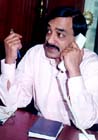 Mosquito repellants and films - the connection wouldn't be immediately
obvious to those who haven't met R Mohan,
entrepreneur and film producer all rolled into one mild-mannered, soft-spoken
yet deceptively shrewd package.
Mosquito repellants and films - the connection wouldn't be immediately
obvious to those who haven't met R Mohan,
entrepreneur and film producer all rolled into one mild-mannered, soft-spoken
yet deceptively shrewd package.
 To move on to your film... Kalapani deals with the freedom
struggle, you said. Vidhu Vinod Chopra tackled the theme some
time back, in Hindi, with 1942, A Love Story, and it bombed.
Do you think your movie will fare better, especially as people
are already negative about the subject?
To move on to your film... Kalapani deals with the freedom
struggle, you said. Vidhu Vinod Chopra tackled the theme some
time back, in Hindi, with 1942, A Love Story, and it bombed.
Do you think your movie will fare better, especially as people
are already negative about the subject?
 Look, the film is about this ordinary man. Not a freedom fighter,
or anything, he is just an ordinary man, living in a small village
in Kerala. The British come there, and he too gets involved in
the resistance. Around this time, he gets married to an uneducated
girl from a small village - and on his wedding night, he is picked
up and packed off to the Andamans.
Look, the film is about this ordinary man. Not a freedom fighter,
or anything, he is just an ordinary man, living in a small village
in Kerala. The British come there, and he too gets involved in
the resistance. Around this time, he gets married to an uneducated
girl from a small village - and on his wedding night, he is picked
up and packed off to the Andamans.
 Look, we make many films a year, but only a few of them are hits.
Often, we lose money, say 30 to 40 lakhs (Rs 3 million to Rs 4 million)
per film. The only difference
is that in the south, the producer suffers the loss, while in
the north it is the distributor who bears the brunt.
Look, we make many films a year, but only a few of them are hits.
Often, we lose money, say 30 to 40 lakhs (Rs 3 million to Rs 4 million)
per film. The only difference
is that in the south, the producer suffers the loss, while in
the north it is the distributor who bears the brunt.