There is a scene in Letters from Iwo Jima where General Tadamichi Kuribayashi (Ken Watanabe) looks out from a cave and sees, up on Mt Suribachi, six men hoisting the American flag.
It is a brief, fleeting scene that, with a few similarly deft little touches, thematically links the two movies.
Letters begins in late 1944. The Japanese military establishment, realising that Iwo Jima could be a key stop in the Allied strategy of island-hopping, dispatches the cosmopolitan General Kuribayashi, with his US military education and pearl-handled Colt, to organise the defenses.
Disgusted on learning that the mother country will not provide additional troops or materials or even air support, the general pulls his artillery back from the beaches onto high ground and, to protect his troops from air attacks, causes the construction of a series of interlinked tunnels from within which the Japanese fight the invading US troops.
As a result of his innovative approach, a battle the Allies expected to last for a week at best extends to nearly a month and a half.
As with Flags, the battle is the centerpiece and throbbing heart of Letters -- but it is not the point. In Letters as in Flags, it is the people, their reaction to war, that forms the emotional core.
Hundreds of ordinary young men go off to an island that has no strategic importance they can understand, to fight against an enemy they do not know for reasons they can't really seem to care about.
A sense of doom, of inevitability, suffuses this film. The general knows the Japanese cause is hopeless, but his sense of honour will not allow him to do less than fight and die.
Counterpointing that old world attitude are the lay soldiers, notably Private Saigo (Japanese pop idol Kazunari Ninomiya), a baker who was yanked off to war from the side of his pregnant young wife, and who wants nothing more than to be reunited with his wife and child.
The film is pegged on a collection of letters Kuribayashi and his troops wrote to their loved ones but could never mail, and which were unearthed 60 years later by researchers. The heart-aching poignancy of these letters is underlined in one brilliant scene, where the soldiers while examining the body of a dead American soldier find a letter from his mother, and break down in tears as they realize that the enemy is as human as themselves.
Eastwood uses interesting devices to not just link the two films, but to play them off against each other. In Flags, the battle is almost a thing of the past, and it is the aftermath that concerns the director; in Letters, memories of the past life are character-building flashbacks, the battle is the reality of the present, and there is, chillingly, no future.
Unlike with most war films that tell the story from one viewpoint while demonizing the opposition, Eastwood handles both sides with understanding and empathy; he shows both sides as being capable of astonishing generosity and mindless cruelty.
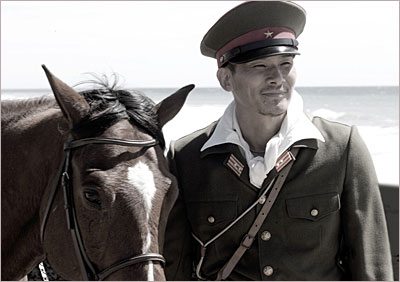
Ken Watanabe is brilliant, bringing grace and a heroic dignity to his role as the general fighting a lost cause. As with Beach in Flags, Jap pop icon Ninomiya is the unexpected scene stealer in this film, getting under the skin of the ordinary bloke who can't see the point of war, who has no use for notions of death with honor, and yearns for life, and his wife, with unabashed desire. Also worth noting is the performance of Tsuyoshi Ihara as Olympic equestrian Baron Nishi.
Paul Haggis takes credit for the story, while Iris Yamashita debuts as scriptwriter in Letters (Japanese, with English sub-titles). An interesting credit in this film is the music, by Clint Eastwood's son Kyle (Eastwood senior scored the music for Flags). Joel Cox and Gary Roach handle the editing with a deft, delicate touch, and Tom Stern encores his brilliance with the camera, shooting large swathes of the film in stark monochrome relieved only by occasional flashes of colour.
But Flags and Letters are in the final analysis Eastwood's films -- two virtuoso efforts that are individually excellent, and collectively approach 'masterpiece' status. A fierce, uncompromising intensity characterises his direction in both films; it is a tribute to his ability that he can (at a time when the US is mired in an increasingly unpopular war) question war, and the concepts of honour and patriotism with which it is routinely packaged, without ever sounding preachy and shrill.
Flags, I am told, was released in Indian metros some little while ago; Letters releases this Friday.
Tell me what you make of it.
Back to column mode next week; till then, adios.
PostScript: Enjoyed the mails, and have responded to most. On message board, meanwhile, couple of things that merit response. (1) Am I being paid by the word? No. (2) Will I write small? No, I won't write small, or big -- I'll write what I want to say in the number of words it takes me to say it; hopefully, the entire audience is not comprised of people with the attention span of the average two-year-old. Cheerio.
Also read: Are film critics 'retards'?
 Advertisement