
The average Indian fraudster isn't an outsider exploiting security loopholes.
He's usually a man between 26 and 45 years of age, working in operations or procurement, with more than six years at the organisation.

The anatomy of corporate fraud in India is different from global trends.
Corporate fraud in India is mostly internal, low-tech, and often involves those who are part of the system -- people who know exactly where the system looks, and more importantly, where it doesn't.
These are the findings of KPMG's Global Profiles of the Fraudster -- India Outlook released recently.
While cybercrime headlines dominate the global conversation around corporate fraud, in India, fraud creeps in through procurement files, travel vouchers, vendor agreements, and unchecked authority.
It often involves long-serving, respected employees.
KPMG's report finds that the average Indian fraudster isn't an outsider exploiting security loopholes.
He's usually a man between 26 and 45 years of age, working in operations or procurement, with more than six years at the organisation.
And, he's not looking to breach the firewall because he's authorised to walk right through it.
Globally, nearly 22 per cent of corporate fraud results in losses above $5 million. In India, only 11 per cent of cases cross that threshold.
The majority (72 per cent) are smaller in scale but high in frequency, each enabled by process gaps rather than high-tech tools.
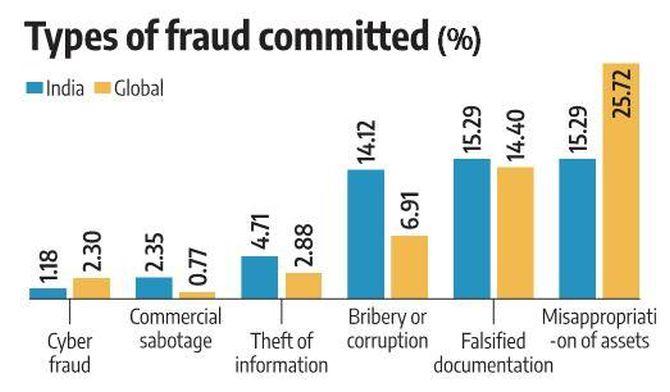
Globally, asset misappropriation is the most common form of fraud, followed by falsified documentation and internal theft.
The pattern is similar in India, where asset misappropriation and falsified documentation together account for the largest share.
However, bribery and corruption make up 14 per cent of cases in India -- almost double the global average of 6.9 per cent.
How it happens, how it is detected
One of the sharpest divergences lies in where fraud originates. Across the world, fraud is spread across departments -- including at the CEO level.
In India, however, more than half of the fraud cases come from just two departments: Procurement (30 per cent) and operations (24 per cent).
Finance, often assumed to be the prime risk area, accounts for only 11 per cent.
This pattern points to a failure of focus. Companies are scrutinising the wrong places, while the real risks remain hidden in plain sight.
Perhaps more revealing than how fraud is committed is how it's discovered.
While international companies increasingly bank on forensic audits, data analytics, and automated red flag systems, Indian firms still rely heavily on people.
Whistleblowers accounted for 38 per cent of all fraud detections in India, almost double the global average, shows the report.
Meanwhile, internal audits, automated checks, and external oversight lag far behind.
In a country with rising digital infrastructure, corporate vigilance remains largely analog.

Tech and family pressure
There's also the question of how much tech is actually involved. In 41 per cent of Indian fraud cases, the perpetrators used no technology at all.
Only 13 per cent of the cases were considered impossible without it. In other words, India's fraudsters don't need to break encryption.
They need a stamp of approval, a cleared invoice, or an unchecked vendor account.
The tools of choice are often inflated bills, forged receipts, and silence.
Beneath all this lies another layer -- less visible, but just as powerful.
Perhaps the most culturally specific insight from the report is the role of family pressure in fraud, according to the report.
While greed and opportunism remain the dominant motivators worldwide, Indian data shows family expectations and lifestyle pressure as a notable contributing factor. These factors are rarely observed globally.
In a society where upward mobility and social status often hinge on financial display, the pressure to meet familial or societal expectations can quietly push individuals toward unethical decisions, says the report.
For some, fraud becomes a means of keeping up.
Compared to the last edition of the KPMG report in 2016, today's fraudster is younger, sharper with technology, and embedded deeper in operational systems.
But what hasn't changed is the role of trust -- and how easily it's exploited.

According to Suveer Khanna, partner and head of Forensic Services at KPMG in India, the most striking insight in this year's survey is the continued dominance of the 'trusted insider' -- typically a long-serving, mid-level man in control of core operations.
"Despite all the digital advancements in fraud detection, the human element of trust and its exploitation remains the weakest link," Khanna told Business Standard over email.
That betrayal can take many forms: A regional manager awarding dealership favours in exchange for lavish gifts.
An HR staffer manipulating recruitment systems to funnel kickbacks. A procurement officer nudging through inflated contracts.
More often than not, there's no alert. No dashboard. Just a process nobody ever questioned, the report finds.
India's fraud landscape isn't defined by dramatic breaches or million-dollar hacks. It's quieter than that. It's fraud by familiarity. Fraud by discretion. Fraud by design.
And if there's one takeaway from this report, it's that fixing it won't come from better passwords or smarter software alone.
As the report suggests, it will come from better questions, stronger checks, and a willingness to look where trust has long gone unquestioned.

Feature Presentation: Aslam Hunani/Rediff











 © 2025