
The NSO previously tried to collect household income data in its ninth (1955), 15th (1959), 19th (1964), and 24th (1969) rounds (July 1969–June 1970), but these efforts were not completed, partly due to non-responsiveness by respondents.
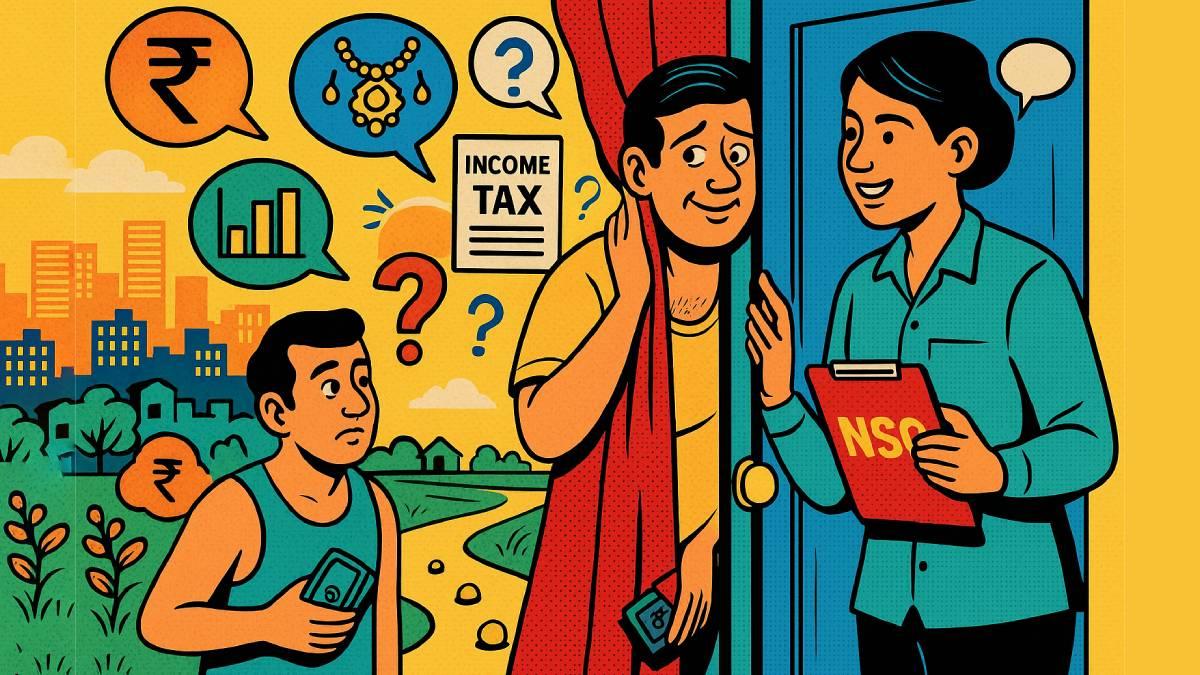
Indians are too "shy" to disclose their salary details, income from financial assets, income-tax (I-T) paid, and expenditure on jewellery, among other things, according to a pre-testing exercise conducted for the draft schedule of the National Household Income Survey by the National Statistics Office (NSO).
The pre-testing exercise -- a standard practice in large-scale socio-economic surveys to identify issues related to clarity, flow, and structure of survey instruments before final field deployment -- showed that nearly 95 per cent of respondents were reluctant to divulge details about income from different sources.
A similar proportion of respondents also refused to answer questions about I-T paid.
The NSO is preparing to launch the first-ever pan-Indian survey on household income in February 2026.
Non-responsiveness to these core questions could potentially disrupt the survey, risking a fate similar to earlier attempts.
The NSO previously tried to collect household income data in its ninth (1955), 15th (1959), 19th (1964), and 24th (1969) rounds (July 1969–June 1970), but these efforts were not completed, partly due to non-responsiveness by respondents.
Former chief statistician Pronab Sen noted that earlier attempts failed mainly because they could not capture the multiple sources of income that Indians have.
For instance, rural respondents often report at least three occupations, while urban respondents report at least two.
Additional income sources, such as rent and investments, further complicate data collection.
"The government has failed spectacularly in its attempts to generate income data, and the consensus is that this data is too difficult to collect.
"People themselves don't want to reveal their incomes, and non-responsiveness is high. Schedules should be designed with this in mind," Sen said.
Meanwhile, respondents were more forthcoming regarding the clarity, comprehension, interpretation, and relevance of the survey.
Nearly 84 per cent of respondents reported partial to good understanding of the survey's purpose, while 87 per cent showed moderate to good understanding of the reference period.
The pre-testing exercise also revealed that households, both rural and urban, tend to overstate expenditure and understate income.
Reporting on financial assets proved difficult, as respondents were often unaware of interest earned from savings accounts, fixed deposits, and other investments.
The exercise further suggested a different approach for high-income and affluent households: a self-compilation system, in which respondents are given a written request explaining the survey's objectives and the importance of income data.
The pre-testing of the draft schedule was conducted between August 4 and 8 across 15 regional offices of the field operations division of the NSO, covering all six zones -- including Mumbai, Delhi, Kolkata, Chennai, Bengaluru, and Hyderabad.
In each regional office, two urban and two rural localities were chosen, covering both affluent and non-affluent segments.
Survey findings
- Tax hesitation: Nearly all refused to reveal income tax paid
- Survey launch: NSO plans India's first household income survey in Feb 2026
- Past attempts: Earlier efforts during 1955–1970 failed due to non-response
- Survey clarity: 84% respondents understood the survey's purpose fairly well
- Reference understanding: 87% showed good grasp of the reference period
- Reporting bias: Households tend to overstate spending and understate income
- Asset recall: Respondents struggled to recall financial asset details
- Pre-test coverage: Conducted in 15 NSO regional offices nationwide
- Geographical spread: Included urban and rural areas across six major zones
- Data challenge: Collecting accurate income data remains difficult, says Former chief statistician Pronab Sen
Feature Presentation: Ashish Narsale/Rediff






 © 2025