
Given the stronger rural activity, and potential goods and services tax (GST) impact, investors are bullish on the two-wheeler (2W) segment.
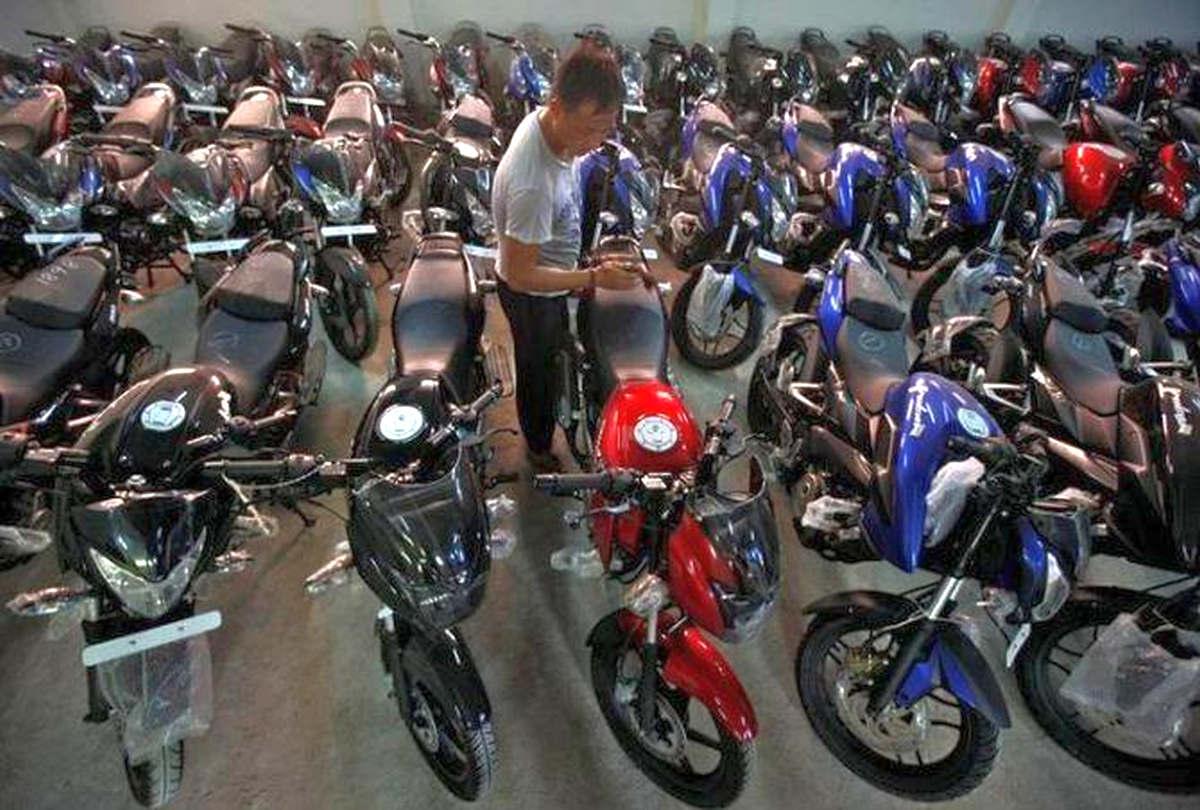
In August, dealers in the domestic market picked up 11 per cent more 2Ws year-on-year (Y-o-Y), despite only 2 per cent growth in retail registrations.
This indicates inventory stocking ahead of the festival season.
Export trends were good.
TVS Motor and Royal Enfield may have gained domestic market share.
GST rate cut hopes have pushed the Nifty Auto Index up 10 per cent, with valuations now close to long-term averages.
So, the rebound may already have been discounted to an extent.
In August, TVS’s volumes were up 30 per cent Y-o-Y, with domestic dispatches up 28 per cent and exports up 35 per cent.
Scooter volumes increased 36 per cent, while motorcycle volumes increased 30 per cent.
Electric vehicle (EV) dispatches were flat, affected by supply issues of rare earths.
Hero MotoCorp registered combined exports and domestic volume growth of 8 per cent.
Motorcycles volume increased by 5 per cent, and scooters increased 53 per cent.
Domestic volume increased 6 per cent and export volume was up 72 per cent.
Bajaj Auto saw strong exports offsetting weak domestic volume.
Total dispatches increased 5 per cent. Domestic 2W volumes declined by 12 per cent.
Domestic 3W (three wheeler) volumes increased 7 per cent.
Export volumes surged 29 per cent, with 2W exports up 25 per cent and 3W exports rising 58 per cent.
Eicher Motors’ Royal Enfield volume is up 55 per cent with domestic sales rising 57 per cent and exports up 39 per cent.
Bajaj Auto saw earnings before interest, taxes, depreciation and amortisation (Ebitda) margins below 20 per cent in Q1FY26, for the first time in several quarters. Profit after tax (PAT) was boosted by higher other income.
Export recovery and ramp up of Chetak and 3Ws are positives, but market share loss in the domestic 125 cc is a concern.
CNG bike, Freedom, has seen slow offtake.
Bajaj has a controlling stake in KTM, but it remains to be seen how quickly it can turn around operations.
Bajaj Auto generated free cash flow (FCF) of Rs 120 crore, despite infusion of Rs 300 crore into Bajaj Auto Credit (BACL) and Rs 1,525 crore into Bajaj Auto International Holdings BV, for the KTM Austria acquisition.
The management guidance is for 5-6 per cent growth in the 2W industry and some benefits from rupee depreciation. Rare earth supply issues will continue to constrain EV production.
TVS unit sales for Q1FY26 saw 5 per cent increase quarter-on-quarter (Q-o-Q) and 17.5 per cent increase Y-o-Y while revenue rose 5.6 per cent Q-o-Q and 20.4 per cent Y-o-Y.
Ebitda showed 5.2 per cent decline Q-o-Q but a strong 31.5 per cent increase Y-o-Y.
PAT was down 8.6 per cent Q-o-Q and up 34.9 per cent Y-o-Y.
Ebitda margin contracted 150 bps Q-o-Q but improved 100 bps Y-o-Y.
Export revenue was up 27 per cent Y-o-Y. Investments of Rs 2,000 crore were announced in subsidiaries and Rs 1,600–1,700 crore in direct capex for FY26.
The company expects some raw material inflation Q-o-Q in Q2FY26 and plans to offset this via price hikes.
EV volume growth will be slow due to rare earths supply issues.
HMCL is accelerating growth in its EV business, VIDA, which hit a quarterly market share of 7 per cent, is up more than 100 per cent Y-o-Y.
The battery-as-a-service (BaaS) model reduces upfront ownership costs.
The favourable macroeconomic environment and strong festival season expectations may drive the stock.
Ebitda was down 5.3 per cent Y-o-Y and down 2.4 per cent Q-o-Q in Q1FY26.
The Ebitda margin was flat Y-o-Y and up 18 basis points (bps) Q-o-Q. PAT was flat Y-o-Y and up 4.1 per cent Q-o-Q.
In the 125cc segment, the company plans two new products in Q2FY26.
In scooters, HMCL reached its highest-ever market share in June at 9.7 per cent.
The partnership with Harley-Davidson will deliver new premium models.
The internal combustion division had Ebitda margins of 16.8 per cent in Q1FY26 while investments in EV pulled overall Ebitda margin down to 14.4 per cent.
The average selling price increased 6 per cent Y-o-Y.
Demand will be helped by the upcoming festival season, lower inflation and Reserve Bank of India rate cuts, among others.
Disclaimer: This article is meant for information purposes only. This article and information do not constitute a distribution, an endorsement, an investment advice, an offer to buy or sell or the solicitation of an offer to buy or sell any securities/schemes or any other financial products/investment products mentioned in this article to influence the opinion or behaviour of the investors/recipients.
Any use of the information/any investment and investment related decisions of the investors/recipients are at their sole discretion and risk. Any advice herein is made on a general basis and does not take into account the specific investment objectives of the specific person or group of persons. Opinions expressed herein are subject to change without notice.










 © 2025