
Even as India's overall sugar consumption is projected to grow at a modest rate of 1.5-2 per cent per annum from 2024-25 sugar season to 2029-30 season, people in the low-income categories are likely to show higher consumption growth in branded refined sugar compared to those in the high- and medium-income groups, a recent study by the Indian Sugar and Bio-Energy Manufacturers Association (Isma) has found.
The sugar season runs from October to September.
The demand growth in the low-income category is expected to be driven mainly by packaged branded sugar as well as traditionally consumed gur (jaggery) and khandsari, which have a cultural preference as well, the study found.
The Isma study classified high-income groups as households with average annual per capita income of $15,000 or more.
It said there are 30 million households that would fall in this category while low-income groups are classified as those who have an average annual per capita income of $1,000 or less, comprising around 205 million households.
It said middle-income groups -- comprising around 70 million households that have an annual per capita income of $3,000 -- maintain high refined sugar use in daily consumption, and stable gur or khandsari usage.
However, they are showing slow uptake of other sweeteners, with expected gradual growth in branded sugar and shifting consumer preferences by 2030.
Isma said it prepared the report titled 'Sweetening The Future: A study on Sugar Consumption in India' based on in-depth interactions with more than 30 industry experts, including C-suite executives, procurement heads, ingredient advisors, R&D directors, group product managers, and category sales leads across segments.
The report was released by Food Minister Pralhad Joshi and Transport Minister Nitin Gadkari at the annual Indian Sugar and Bio-Energy Conference in New Delhi on Thursday evening.
The report, meanwhile, also said that institutional consumption now dominates India’s sugar demand, comprising 60-65 per cent in 2023-24 sugar season, up from 50-55 per cent in sugar season 2018-19, with retail accounting for the balance 35-40 per cent of the total demand.
Within institutional consumers, non-alcoholic beverages (35-40 per cent) and confectionery (15-18 per cent) are the largest segments, followed by bakery and biscuits, dairy and ice cream, HoReCa, pharma/nutraceuticals, and other processed foods. HoReCa stands for hotel, restaurant, and catering.
'Sugar holds the largest share in sweetener usage (more than 85 per cent retail, and 95-97 per cent institutional), with jaggery/khandsari (10-13 per cent retail, and 1-2 per cent institutional) and other natural/artificial sweeteners making up the remainder,' the report said.
It said institutional sugar consumption is expected to maintain dominance, with retail consumption showing relatively flat growth amid health trends and diabetes awareness.
'Today, the average Indian consumes around 20 kg of sugar annually, which has plateaued at this level, and is lower than the global average of 22 kg,' the report said.
It added that going forward, India’s sugar production is expected to grow from 34 million tonnes (mt) in the 2023-24 sugar season to 35-37 mt by 2029-30 in the base case while in the optimistic case, it is projected to rise to 43-45 mt by the sugar season 2029-30.
'The sugar market by ex-mill value is expected to grow from ₹1.2 trillion to ₹1.4-1.6 trillion by sugar season 2029-30 in the base case, and to ₹2 trillion in the optimistic case scenario,' the report added.
Per capita consumption of sugar, jaggery and khandsari (in kg/year)
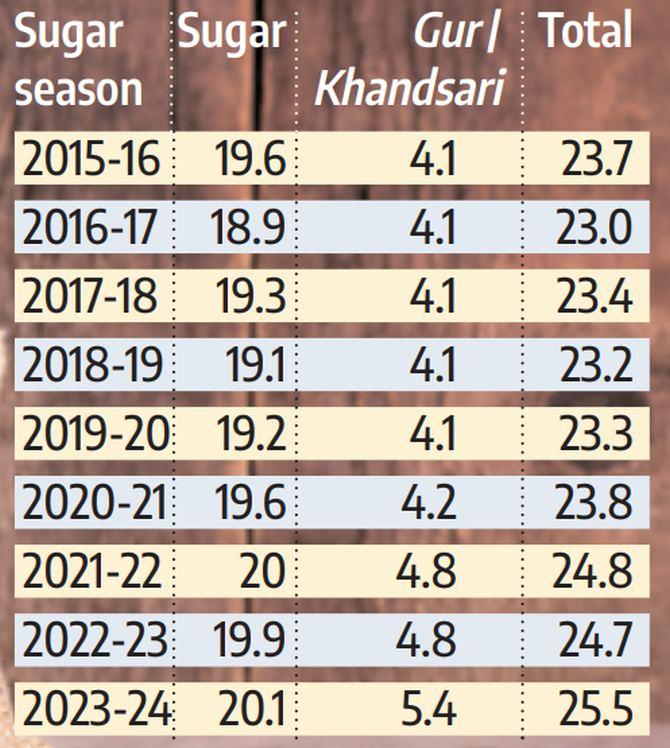
*Sugar season runs from October to September ' Sources: Isma and Primary Research
Feature Presentation: Rajesh Alva/Rediff










 © 2025