
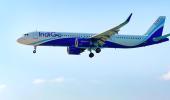
IndiGo, which operates the largest fleet among Indian carriers, has reported the highest number of serious engine-related incidents.
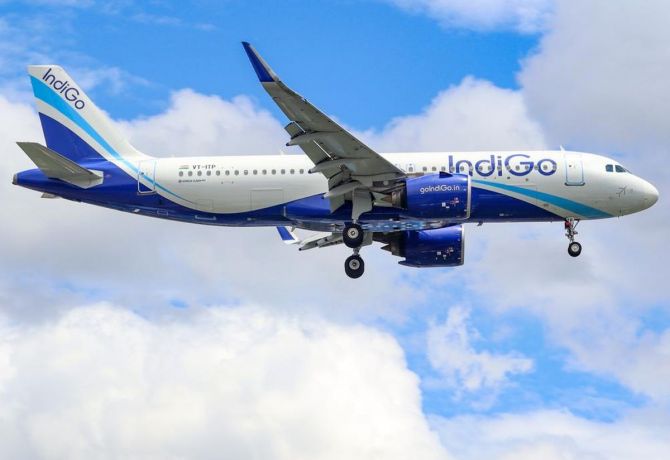
On July 16, an IndiGo flight was forced to make an emergency landing at Mumbai airport following a reported engine failure.
Two more similar incidents involving IndiGo took place within the same week. In the wake of the Boeing AI 171 crash, concerns over aircraft safety have intensified. However, these are not isolated cases.
Flight cancellations in India, particularly those caused by technical glitches, have risen in the past four years to peak in 2023, with engine failures being a major contributing factor.
IndiGo, which operates the largest fleet among Indian carriers -- including SpiceJet, Air India, and others -- has reported the highest number of serious engine-related incidents, followed closely by GoAir.
Investigations by the Aircraft Accident Investigation Bureau (AAIB) have revealed that many of these incidents have involved Pratt & Whitney engines, especially the PW1127G-JM model.
The common issues identified include failures in the High-Pressure Turbine and Gear Turbo Engine systems.
A large number of IndiGo flights have already phased out their Pratt & Whitney engines, replacing them with CFM International since 2021.
Weather accounts for the highest proportion of flight cancellations, followed by others, such as commercial issues, security concerns and strikes, and technical reasons in recent years. (Chart 1)

Flight cancellations due to technical reasons have increased across airlines, barring Air India.
IndiGo has replaced Air India with the highest share of flight cancellations since 2022. (Chart 2)

Among 27 cases of engine failures recorded in serious commercial flight incidents between 2012 and 2020, engines manufactured by Pratt & Whitney accounted for the most failures -- 18 in Airbus aircraft, 4 in ATRs, and 1 in a Bombardier. (Chart 3)

Two of the three largest engine manufacturing companies recorded a decline in the share of research & development expenditure in total expenses in FY24. (Chart 4)

The share of repairs & maintenance expenditure in total airline expenditure has remained modest, though Air India, Air India Express, and SpiceJet have seen an increase in this from FY23 to FY24. (Chart 5)

The overall surveillance activity of the Directorate General of Civil Aviation (DGCA) increased significantly from 2,283 in 2021 to 6,009 in 2024.
As of April 2025, it stood at 1,999. Enforcement actions by the DGCA increased from 171 in 2021 to 673 in 2024. In 2025, they were 254 as of April. (Chart 6)

Feature Presentation: Rajesh Alva/Rediff






 © 2026