
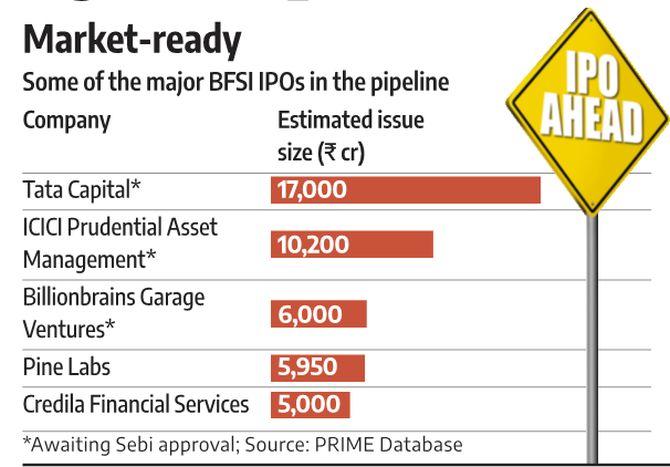
The sector's IPO pipeline is led by Tata Capital's Rs 17,000 crore issue, followed by ICICI Prudential Asset Management at Rs 10,200 crore and Billionbrains Garage Ventures at Rs 6,000 crore.

The banking, financial services and insurance (BFSI) sector is preparing for a Rs 58,000 crore (Rs 580 billion) fundraising through initial public offerings (IPO), with analysts pointing to regulatory mandates as the key trigger for this rush, amid historically lower participation rates in the primary market.
So far in 2025, three BFSI firms have mobilised Rs 16,765 crore (Rs 167.65 billion), or 21.4 per cent of total IPO proceeds.
Fifteen more are expected to come to market, the most among all sectors, from a total pipeline exceeding Rs 2.7 trillion, according to PRIME Database.
Adding to the queue, PhonePe has filed draft papers with the markets regulator through the confidential pre-filing route and is aiming to raise as much as Rs 12,000 crore (Rs 120 billion), people familiar with the matter said.
"This issue is likely to find takers. There is enough liquidity in the markets and good investor appetite," said G Chokkalingam, founder and head of research at Equinomics Research.
"That apart, PhonePe has a consumer-facing business model, which gives revenue visibility. A lot would, however, depend on the market conditions then and at what price their issues come."
The BFSI sector's IPO pipeline is led by Tata Capital's Rs 17,000 crore (Rs 170 billion) issue, followed by ICICI Prudential Asset Management at Rs 10,200 crore (Rs 102 billion) and Billionbrains Garage Ventures, the parent of Groww, at Rs 6,000 crore (Rs 60 billion).
A key factor shaping the BFSI pipeline is regulation, with several categories of financial entities facing mandatory listing requirements or at least strong nudges to get listed, said Pranav Haldea, managing director, PRIME Database Group.
Insurance companies, non-banking finance companies and asset reconstruction companies are covered by these guidelines, he said.
"A lot of what you see is regulatory-driven."
"Regulators are clearly asking many of these companies to comply with compulsory listing, and as they achieve scale, they are going ahead with IPOs," said Ashutosh Mishra, institutional equities research at Ashika Credit Capital.
"There is no other reason beyond regulatory requirements and the fact that BFSI companies always need capital for growth."
Across all sectors, 163 companies plan to raise Rs 2.70 trillion through IPOs in the coming months. Of these, 78 have secured approval from the regulator, while 85 are awaiting clearance.
The BFSI sector's share of IPOs has varied. In 2020, one-third of all issues came from the sector, accounting for 60 per cent of total funds raised.
In 2021, it was 38 per cent, followed by 46 per cent in 2022 and 15 per cent in 2023.
The shift reflects the rise of new-age technology companies as well as promoter-led family businesses, said Haldea.
Fintech focus
Within BFSI, fintech companies such as Groww and Pine Labs are in focus, together expected to raise about Rs 12,000 crore (Rs 120 billion).
"Fintech firms are also entering the fray, with several expected to launch IPOs in the coming months," Mishra said.
The sector has grown rapidly, with consolidation in broking and payments leaving only a few strong players, analysts said.
Private equity ownership is also pushing listings, as funds seek exits through IPOs.
"But unlike earlier years, IPO investors are no longer backing loss-making startups without a clear path to profitability," Haldea said.
For retail investors, analysts added, the distinction between fintech and traditional financial firms is less relevant. Their attention remains focused on listing gains.
Feature Presentation: Aslam Hunani/Rediff












 © 2025