
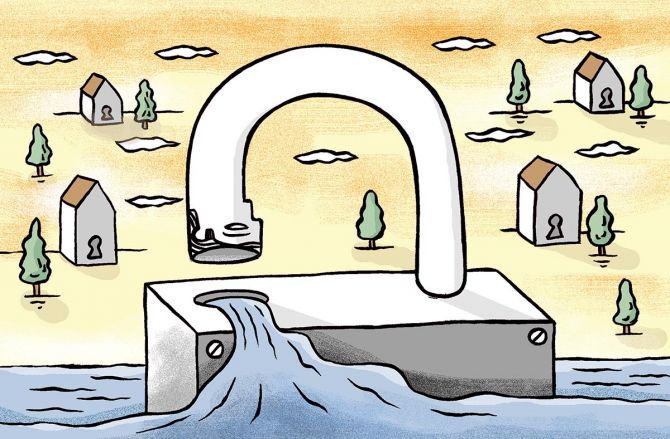
'What we see now is a much stronger need for data sovereignty.'
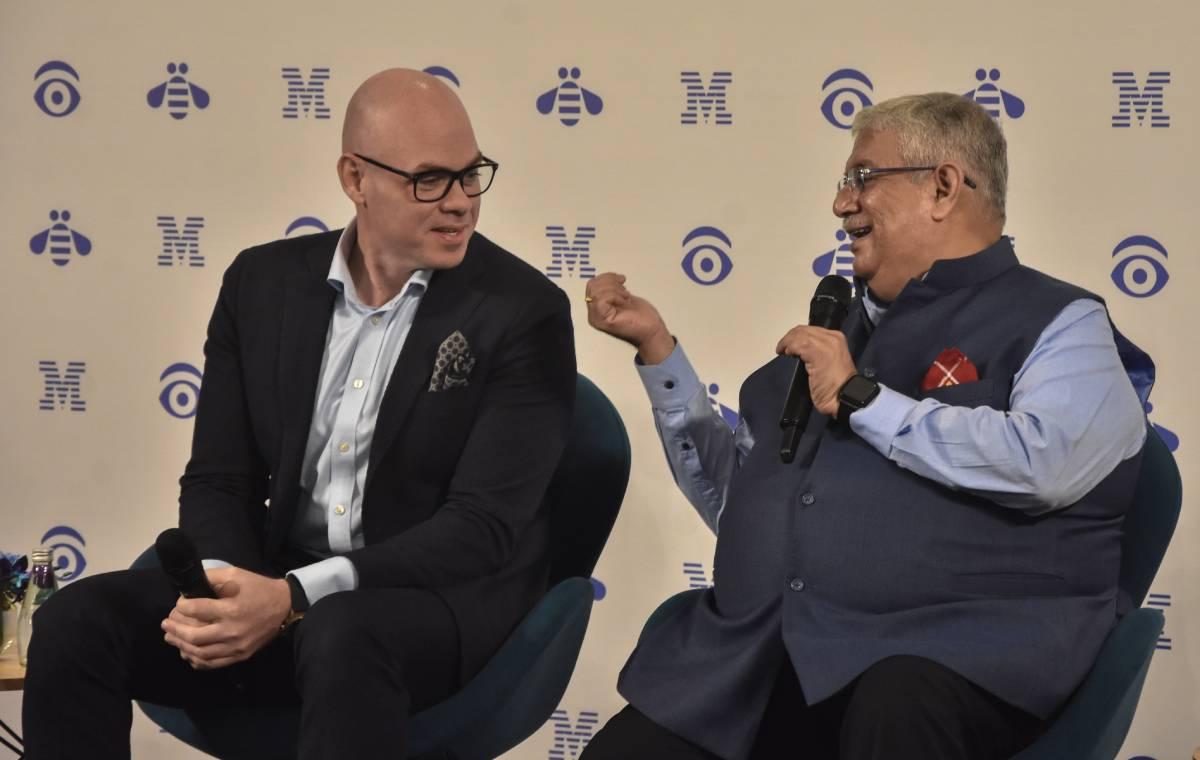
Hans Dekkers, general manager, IBM Asia Pacific, was recently in India to announce collaboration with the government of Maharashtra on quantum technologies and the opening of IBM's India Client Experience Centre in Mumbai.
In a conversation with Shivani Shinde/Business Standard at IBM's new office in Mumbai, he spoke about why data control is becoming a critical demand in a volatile geopolitical climate.
We met exactly a year ago, and the global macro and geopolitical climate has worsened. What trends have you seen among your client base?
The last one year has seen a huge disruption. What we see now is a much stronger need for technology and data sovereignty.
This was not a big topic five years ago -- it's a huge topic today -- not only for nations but also for enterprises, individuals, and states.
This requirement of 'My data is mine' is the biggest shift in the last one year, and it's a deep change.
Enterprises, governments, and people want to be in control and have the flexibility to move their data and understand it in ways that maybe we didn't need a year ago.
The second shift is that AI is no longer a talking point. People who are doing it well are scaling up on AI now.
The third trend is the journey to cloud. Today in hybrid cloud clients want to be in control.
There is a big realisation from chief information officers on how they spend their dollar most efficiently.
Is India also going through a similar shift?
What I like about India is this focus on 'Viksit Bharat'. With this vision that is being laid out, the destination is becoming clearer.
What India has, more than any other country, is scale.
We recently saw a case where an Indian energy firm's access to its own data was denied by its information-technology vendor, and the high court had to step in. This has become a huge concern here in the country. How does IBM look at this?
I cannot comment on this specific case because I am not aware of the details. But many enterprises and governments are seeing this problem.
We let our clients first identify what data belongs to them, and which part of the data should be public or beyond the borders.
Once that awareness is there -- structured and unstructured data -- you can then answer the next question.
It is not only about data but also about how it connects to the ecosystem.
Is this a concern among your customer base in the region and in India?
Yes, 100 per cent. In government, enterprises, and academia, wherever IP (internet protocol) has a value in data, I see this demand.
Where your data resides is now a fundamental question.
To a large extent (more than 50 per cent), we see data in positions where it should not be, or where clients don't want it.
Within a year the discussion has moved from GenAI to agentic AI. Where do you see the adoption?
They are running parallel and complementing each other.
We did a survey in which 87 per cent of CIOs interviewed in India were adopting and using AI.
But interestingly, 76 per cent of these CIOs are getting a return on investment..
Where agentic AI is different, and where we are helping, is on the agent side. Agents complement work in any dimension.
What is really powerful is the next evolution: Horizontal integration and orchestration of these agents into the enterprise.
How is IBM using agentic AI?
We call ourselves client zero. A lot of technologies we are implementing we first use ourselves.
Over the last two years we have saved about $3.5 billion within our own company.
In HR, 96 per cent of transactions are handled by agents. Four per cent require human interaction.
In our supply chain procurement, 50 per cent is automated.
IBM Chairman Arvind Krishna has said that clients are moving investment to hardware rather than software. Do you see this trend here and, if so, why?
Sovereignty and cost are driving this. If a vendor increases prices, are you stuck?
If there's a disruption -- Covid or anything else -- can you react?
We are seeing that this need for resilience is driving demand in a way we hadn't seen in the past 10 years.
To do that, clients need more infrastructure and hardware.
With uncertainty on tariffs rising, do you see impact on IBM's business here and in the region?
I see only positive impact. It is driven by sovereignty, which is driven by this uncertainty.
Business leaders are more educated in what they could do with this technology.
Where is India on its Quantum journey?
There is a desire in India to develop these capabilities.
We recently announced collaboration with the government of Maharashtra to bring this capability to the state and the country.
With Quantum you have to build an ecosystem and it requires facilities and everything to bring it together.
Feature Presentation: Ashish Narsale/Rediff










 © 2026