
'The danger is that when the music stops, the fall will be sudden, faster, and deeper than anyone expects,' warns Debashis Basu.
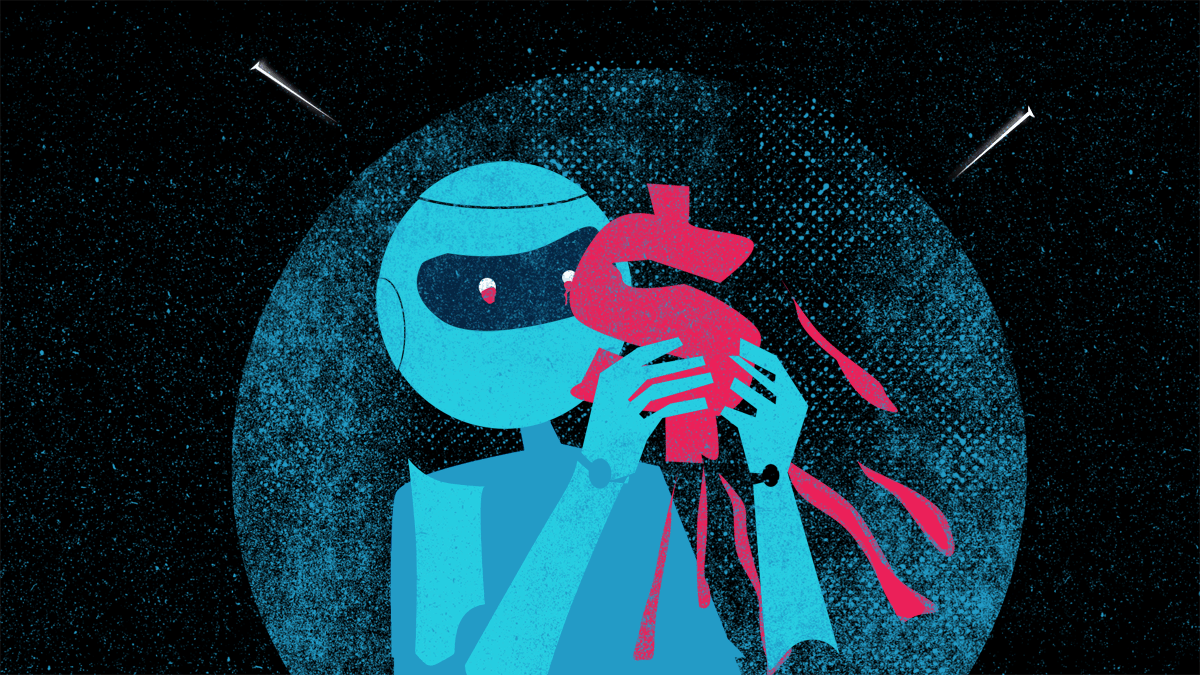
America's stock market, unconcerned by trade tensions or fiscal strain, sits near a record high.
The exuberance is driven by a new generation of techno-optimism -- this time about artificial intelligence (AI).
The 'Magnificent Seven' (Alphabet, Amazon, Apple, Meta, Microsoft, Nvidia, and Tesla) now account for roughly 38 per cent of S&P 500's market capitalisation and about half its profits.
Their dominance, and the feverish faith in a new technology revolution, evokes memories of the late 1990s dotcom mania.
S&P's cyclically adjusted price-earnings ratio has breached 40 for the first time since 2000, when it reached 44 -- shortly before the benchmark plunged by nearly half, as the Internet bubble burst.
Then, as now, the conviction that a digital revolution would rewrite the rules justified almost any valuation.
Then, as now, the danger is that when the music stops, the fall will be sudden, faster, and deeper than anyone expects.
Writing for The Economist, Gita Gopinath, till recently first deputy managing director of the International Monetary Fund, calculates that a dotcom-like market crash could wipe out over $20 trillion in wealth for American households, equivalent to roughly 70 per cent of American GDP in 2024.
The global fallout would be wealth losses exceeding $15 trillion, or about 20 per cent of the rest of the world's GDP.
Her argument has sent investors into an uneasy debate. Unfortunately, Ms Gopinath skips the likely causes behind a possible crash.
She focuses on how a crisis this time cannot be cushioned by a resilient dollar or a government-led rescue through tax cuts or spending splurges -- Washington's toolkit looks empty today.
So, is a dotcom-like crash likely? And if so, why?
The likeliest sources of trouble lie in four corners of the financial system: Incestuous investment loops within the AI ecosystem; the ballooning, barely regulated private-credit market; soaring public debt; and speculative froth in cryptocurrencies and private equity.
The first two are especially alarming.
Incestuous investment
Consider how incestuous relations across the sector have helped push up valuations.
Microsoft has invested at least $13 billion in OpenAI, which uses Microsoft's Azure cloud infrastructure.
Thus, Microsoft is simultaneously investor, infrastructure-provider, platform/host, and commercial partner (and potentially a competitor).
Amazon has committed $8 billion to Anthropic, which uses Amazon's AWS cloud infrastructure.
Amazon integrates or plans to integrate Anthropic's Claude models into its products (for example, Alexa).
So Amazon is investor, cloud-host/partner, and user/integrator of the startup's AI models. Again: Investor plus supplier plus customer.
Nvidia, the dominant AI hardware supplier, will invest up to $100 billion in OpenAI, which will buy Nvidia systems.
Nvidia has also invested in Elon Musk's AI startup xAI and will supply processors for xAI data centres.
The web of mutual dependence grows denser still.
CoreWeave, a cloud-infrastructure provider, is a major Nvidia customer and Nvidia has guaranteed $6.3 billion to purchase CoreWeave's unused capacity through 2032.
Nvidia's rival Advanced Micro Devices announced a supplier-investment deal with OpenAI.
Meanwhile, OpenAI has signed a five-year $300 billion contract with Oracle Cloud (beginning in 2027) and a $22.4 billion deal with CoreWeave, including a $350 million in CoreWeave stock, meaning OpenAI is simultaneously customer (contracting for GPU infrastructure), and investor/shareholder in the infrastructure provider.
CoreWeave also announced plans to work with Meta, creating further inter-dependencies.
This circular financing inflates both revenues and valuations of the priciest part of the stock market.
CoreWeave's valuation jumped from $19 billion to $23 billion in 2025, citing OpenAI contracts and Nvidia's backstop.
Incredibly, companies are booking these deals as revenues and lifting their market valuation.
Those multiples spill over and are used to justify higher values for other AI startups.
Since there is no chance of the AI boom delivering profits on trillions of dollars of interlocking investment, it is a bubble that can burst.
Torsten Slok of Apollo, a private-investment firm, has noted that AI stocks are more richly valued than dotcom stocks in 1999.
Private-credit bubble
If that seems worrying, the parallel boom in non-bank lending is as bad.
Non-bank private credit -- lending by funds, insurers, and shadow financiers, especially riskier midsized firms -- has ballooned to about 3.8 times European GDP and 3.1 times American GDP.
Banks have lent around a tenth of their loan books to these intermediaries.
The IMF reckons American and European banks have lent $4.5 trillion to private-credit firms, hedge funds, and other non-bank lenders.
A serious default could wipe out a chunk of their Tier-I capital, the capital cushion designed to absorb shocks.
Yet this system, vast and opaque, sits largely beyond the regulators' reach.
Their rise was accelerated by the very regulations -- Basel capital rules -- designed to curb banking risk.
Fintechs, hedge funds, and insurers now lend directly to riskier borrowers.
Nearly half of American life insurers' bond holdings are in private placements, invisible to markets, and regulators.
The system depends on faith, not transparency.
Connected to speculative excesses in these two areas is irrational exuberance in private equity and the crypto boom.
Nobody knows what will spoil the party and when, but when it does, the scaffolding of credit and cross-holdings may give way. And, it will not stop at developed markets.
The contagion will spread to emerging markets, like India, as investors sell indiscriminately to raise cash.
If we are lucky, the dark clouds will lead to a few showers, not a hurricane.
Those who have exposures to the market would do well to have their own risk-mitigation measures in place.
Debashis Basu is editor of www.moneylife.in and a trustee of the Moneylife Foundation.
Feature Presentation: Ashish Narsale/Rediff










 © 2025