In 1927 Herbert Austin introduced his baby car, the famous Austin Seven. Lyons then started creating stylish two-seater bodies, which were mounted on the Austin Seven chassis. But Lyons was not content to merely build bodies on other people's chassis.
The company's first car, the SS1, was based on a Standard six-cylinder engine and a modified Standard chassis. It was introduced to the public at a London exhibition in 1931.
In 1933 the name of the company was changed to SS Cars Ltd with Lyons becoming managing director. He bought his partner out in 1936.
In 1934, Harry Weslake, regarded as one of the industry's top engine experts, joined the company. The name Jaguar was used for the first time in 1935. The same year, William Heynes joined the company as chief engineer.
The firm's production included limousines, convertibles, and sports cars fitted with 1.5-litre, 2.5-litre, and 3.5-litre engines. The most notable vehicle of the period was the 3.5-litre SS 100 model. This was the fastest and most famous pre-war Jaguar, with speeds of 100 mph and acceleration from rest to 60 mph in about 10.5 seconds. The engine had a compression ratio of 17.5:1. Racing successes in the Marne Grand Prix of Reims, the Villa Real International event, the Alpine Rally, The Monte Carlo Rally, and the RAC Rally made this one of the most famous Jaguar cars.
After the World War II, the company's name was changed to Jaguar Cars Ltd. The first Jaguars were produced with the option of left-side driving controls!
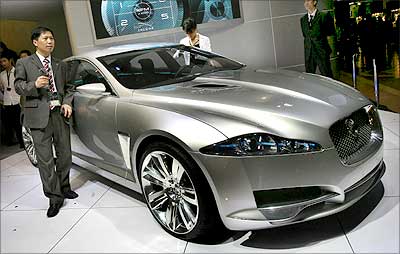
A Chinese man poses for a photo next to a luxury Jaguar car at the exclusive 'Millionaires Fair' in Shanghai.
Photograph: Mark Ralston/AFP/Getty Images
Also read: We never compromised on ethics: Tata
 Advertisement