|
|
 Email | Email |  Discuss | Get latest news on your desktop Discuss | Get latest news on your desktop
When the first wheels rolled into India
December 23, 2008
Post-Independence, full-fledged manufacture from assembly was a logical sequence. But the real impetus to the Indian automotive industry came from the first Tariff Commission Enquiry initiated by the Government of India in the early 1950s.
A comprehensive policy for the development of the indigenous automotive industry was evolved with a seven-fold thrust as follows:
Progressive increase in indigenous content up to 100 per cent in raw materials, components and vehicles;
Protection against imports (tariff as well as restrictions on imports);
Healthy domestic competition;
Consumer choice of multiple models;
Collaboration with leading manufacturers in the world;
Quality to the best international standards; and
Foreign equity participation restricted to 49 per cent, excepting in special cases.
"With this policy, India could manufacture almost every component that goes into a car, commercial vehicle, two-wheeler, tractor or industrial engine. To build a self-sufficient industrial base in a short span of 10 years is not an easy task in any country. This self-sufficiency model is unique. . .
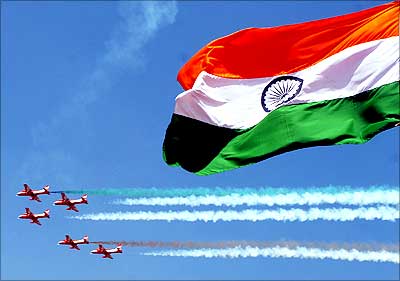
Image: The Indian flag flutters as the Surya-Kiran aerobatics team of the Indian Air Force flies past at the Yelahanka air force station in Bangalore. | Photograph: REUTERS/Jagadeesh NV
Also read: Consumer confidence: Asia's top 10 nations
Powered by 
| Live updates on money.rediff.com |
|
|
|
|
 Advertisement