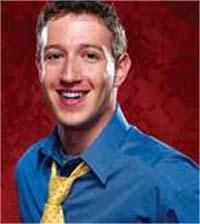
Each of them had different interests and activities,' Facebook's lawyers wrote. 'Only one of them had an idea significant enough to build a great company. That one person was Mark Zuckerberg,' left.
ConnectU's suit against Facebook has much more to do with seeking unspecified damages from Facebook, the three friends believe.
"I was raised on certain values," Narendra, the son of a New York physician couple who graduated with a degree in mathematics from Harvard, says. "And for me those values of integrity and honesty are crucial whether one is an hedge fund analyst or a entrepreneur."
A court in Boston will decide soon if the three friends indeed have a case against Facebook and its founder. The site reportedly has 34 million active members in more than 60 countries ranging from India to Iceland to Canada.
The founders of ConnectU, which has fewer than 100,000 members, claim Zuckerberg, who dropped out of Harvard, was involved in November 2003 in developing what became ConnectU, used code originally intended for it in the development of Facebook.
Facebook kicked off in February 24, 2004. ConnectU was launched the same year in May. In previous interviews, the Winklevoss brothers have said that some people think they sued Facebook only after it became hugely successful. They sued in 2004, the same year Facebook was launched and was struggling; the lawsuit came after the Winklevoss twins and Narendra failed to get Harvard University to stop Facebook.
Narendra has said along with his co-founders he appealed to Harvard's disciplinary board and directly to then president Lawrence H Summers, saying Zuckerberg had violated the school's honour code.
'At first we were devastated and climbed into a bottle of Jack Daniels for a bit,' the three said in a message posted on their site, 'but eventually emerged with a bad headache and renewed optimism. We weren't going to lie down and get walked over like this.'
Whatever the fate of Facebook or ContactU, Internet experts say the idea to start a site that allowed users to post profiles with pictures, biographies and other personal information and created networks of people at their schools or jobs or with similar interests, was fascinating and timely.
"I don't really remember how the idea of a social network for students came up," Narendra said recently. "But I -- and my friends, who were in the same dorm I was in -- had the feeling that there were too many barriers and lack of time for students at Harvard to do social networking based on common interests. We wanted to offer something that had immediate utility for the students."
"The twins, like me, understood the social dynamics of college communities," he says. And that was what got us to start Connect U."
It did not take him and his friends much time to think of a site serving students not just Harvard students but other American campuses too. "For that matter, we knew it had to be a global connecting social network," he says.
He admits that their idea may not have sounded original because there were others trying to bring students together for a wide variety of purposes ranging from romance to poltiics to religion. But they lacked quality control. "They were niche operations but they were not for everyone," he continues. "We thought of a critical piece of gate-keeping that would not only give our site credibility but also get the right kind of people in. We did not want people to join us pretending to be students, worse pretending to be a student of a particular university."
So the three insisted the members had a college e-mail address.
Narendra, who says his parents -- unlike many other immigrant parents -- never insisted he became a lawyer or a doctor or an engineer, had been convinced from his early days at Harvard that any idea that excited a handful of astute people could fly.

Also read: The kid who turned down $1 billion!
 Advertisement