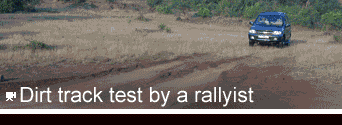
This was the most dreaded and awaited test as the previous versions had failed drastically in the 4x4 off-roads. More so due to the sheer size and reduced power of the earlier versions.
There is a distinct change in the 4H 4L shift which was earlier a knob next to the gear shaft. I had to literally hunt for the changer which was hidden behind the steering wheel where the dimmer knob was situated in the earlier versions.
This becomes somewhat of a pain as you have to bend forward to look for the switch to change. But then maybe as a safety measure it is good as it prevents you changing into 4-wheel drive while the car is in motion.
On an off-road dirt track with the 4H engaged, the Safari tackles the dirt with ease. But the real test comes while climbing. The engine roared like a lion as it positioned itself to climb a hill in a village in Mulshi in the Sahyadris. And climb it does. Much better than it did before and with much more ease. Although there is just so much I as a highway driver can do.
Mr Surinder Pannu, a 4x4 rallyist did things with the Safari I would never dream of. And it came through it all...
There is a distinct lighter feeling in the new Safari 2.2L VTT Dicor.
There is one thing that came as a disappointment though. The rear door is still too heavy. If too much of off-road is tried in this city beast the door tends to brush the surface of the bumper. I do hope the Tatas will find a solution for this as this is happening in a new vehicle, within its first year. Also, I find that the fuel lid opens on its own during bumps, and the dashboard pops open. Glitches, but these need to be ironed out.
The fuel efficiency came as a surprise to me. I had driven off-road, sped up to 160km/hr, had the air-condition on most of the way and yet it gave me an average of 12.5km/lt. Now that was unexpected. It means that if I drive my normal range to work and back this car will easily give me an average of 13 to 14km/lt, which is mind-blowing!
 Advertisement