
Partner Channels: Auctions | Auto | Bill Pay | IT Education | Jobs | Lifestyle | Technology | Travel
March 30, 2001
|
|
|
|
|
|
||
|
Channels: Astrology | Broadband | Contests | E-cards | Money | Movies | Romance | Search | Weather | Wedding | Women Partner Channels: Auctions | Auto | Bill Pay | IT Education | Jobs | Lifestyle | Technology | Travel |
||
|
|
||
|
Home >
Money > Business Headlines > Report March 30, 2001 |
Feedback
|
|
|
Govt considering inclusion of films in Concurrent List: SwarajRonjita Das in Bombay
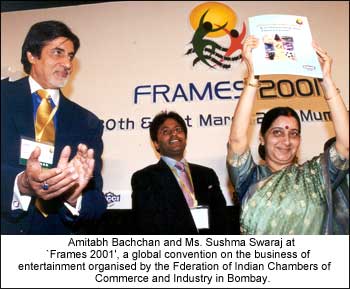
"In the last conference of information ministers of all the states, the Centre flagged the issue of bringing films in the concurrent list and for reduction of entertainment tax accordingly," Swaraj said at the inaugural session of Frames 2001, a global convention on the business of entertainment, in Bombay. She said a committee of ministers from nine states has been set up to go into issues of entertainment sector and tackling the problems of high and diverse rates of entertainment tax. The industry, on its part must make presentations to the concerned chief ministers and emphasise the importance of the lower taxes, the minister said. Referring to technological advances made by the Indian entertainment industry, Swaraj said the entertainment as an aspect was being transformed by the convergence phenomenon. "While the guidelines for Direct To Home platforms have been issued by the government already, we are in the process of examining the Digital Terrestrial Telecast policy for India," the minister said. Big B makes a case for corporatisation of film industry The fact that the entertainment industry was being looked at as serious business sure found superstar Amitabh Bachchan in high spirits. "Corporatising the film industry is a thought that I picked up several years ago. Hollywood is the second largest exporter and foreign exchange earner of USA. I thought to myself why couldn't India, being the largest producer of films in the world, be anywhere near that?" he said. "My brother and I had thought of corporatising way back in 1980. In 1995, we went into the whole idea of corporatising at that point of time. What really attracted all of us to this concept was the uniqueness of the Hindi films. Hindi films are unique in several ways: we have a unique storyline, music, cater to a diverse audience, and caters to their needs and wants," he went on. "A film is made, produced and distributed. A film had value as a film, as a fountain of goodwill, creates stars, who become brands, which in turn become very valuable entities for endorsing products and so many more. So we think that when there are so many entities under one roof, why not build the roof! That is exactly why corporatising was thought of and that is what we're trying to do," he said. "We thought that we must bring all these entities under one roof, as there is a natural forward and backward integration taking place in this facility. So we thought that we must be in charge of the production, it's exhibition, it's music, it's marketability on TV etc. we are the masters of the main product and all the benefits arising from that should come back to the original. This is easier said than done." "A film in India is made in stages. The producer or director comes up with an idea, they'll choose some saleable names, put them together and get hold of a saleable music director, take the proposal to a set of distributors, sell them the idea, they will then make the advances of money. This money will be used to shoot the first schedule. Most probably a song or action sequence, since they are more appealing. Then they will show the first 2 reels to the distributors, who will advance some more money. In this similar fashion they will complete the film," he explained. "We think this practice is not professional and absurd, coz it leads to a lot of time loss, and costs go up. Therefore our appeal at the time of corporatising is that if someone can give us all the money in the beginning, we can give you a planned product. 80 per cent of the film industry functions like this that's why there are delays and unprofessional behavior and inefficiency." "That is why also you find more than one star working in one film at a time. This is why it becomes a rat race and we have to work in eight-nine projects at the same time just to keep ourselves fully fed and occupied. It's a wrong practice. Therefore when we went with Merchant Bankers to financial institutions we told them our concept. They said, 'There was a lot of insecurity in this business. How can we invest in a company like this'?" At The Regent, Bombay, where Frames 2001 was unfolded, there was palpable excitement. Film personalities, political bigwigs and the other dignitaries alike seemed visibly exhilarated. And why not? After all the film industry was finally being accorded industry status. 'Frames' is the anagram for Film Radio Audio-Visual Music Events and Shows. The function saw personalities like Chirayu R Amin, president of Ficci, Lalit Modi, chairman, entertaiment committee, Ficci, Bobby Bedi, covenor, Ficci, R S Agarwal, executive director, IDBI, Amitabh Bachchan, actor, Pawan Chopra, secretary, Maharashtra, Chhagan Bhujbal, deputy chief minister of Maharastra and Sushma Swaraj. Also present were film personalities Feroz Khan, Kabir Bedi and Mukesh Khanna. Swaraj avoids controversy Meanwhile, Information and Boradcasting Minister Sushma Swaraj refused to be drawn into a controversy over the National Film Awards and described the allegations against her as ''baseless''. ''I have clarified in New Delhi yesterday. The allegations on saffronisation of awards were baseless,'' Swaraj told reporters after inaugurating ''Frames 2001'' -- a two-day global convention on entertainment industry. ''There is no no controversy at all on the awards,'' she added. The controversy arose when three members of the jury: Pradip Kishen, Sashi Anand and Madhumita Raut, resigned in protest against ''rigging'' of awards earlier this week. Eminent film director Goutam Ghose has also refused to accept the award for his film Dekha. Noted actor Soumitra Chatterjee, who has been named for his role in the same film, has stated to follow suit. Additional inputs: PTI & UNI |
||||