There is plenty of economic, political, cultural and religious violence in India. What gives you the confidence that India could still continue as one nation for another 60 years, if not 600 or 6,000?
Because there is an inclusive plural idea of India embodied in the Indian constitution and articulated by such people as Tagore, Nehru, Gandhi, Ambedkar and others. Before Independence, there were many ideas of what India should be, and among them is the idea formulated by the likes of Gandhi and Nehru. The conflicting ideas still (remain).
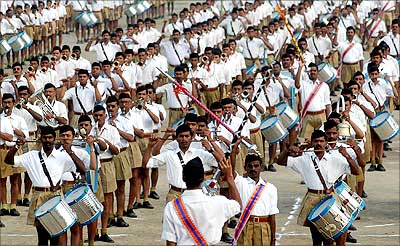
On the religious right, there was the idea that India should be a Hindu theocratic State, like Pakistan is an Islamic State. On the Left, you have a Communist revolutionary idea of India, as articulated by the Naxalites, of a one-party State run by a militant, mobilised revolutionary party (based) on the Chinese model. There is also the idea that there is no India and that regional parties will balkanise the country.
None of these ideas are new. Even in 1947, the RSS was promoting the Hindu Rashtra. In March 1948, (came) the Communist Party insurrection in Telengana. Since 1946, the Nagas have said they are not part of India. So over 60 years, the inclusive plural, unified, democratic idea of India has to contend with several kinds of ideological opponents.
As a historian I can say that that struggle will continue. I think it is a miracle that India has survived as a united and pluralistic State for 60 years; it will be an even greater miracle if it survives for another 60 years! Because, the odds are still substantial, it is a very heroic exercise; it is still a very daring and grand exercise but one that is not pre-destined to succeed.
As a historian, I cannot say that I am totally optimistic. But, of course, both as a historian as well as a citizen, I would like the inclusive, pluralistic idea of India to survive because I think that represents the best of possibilities and accommodation. Actually, it would lead to the least violence in comparison to a Hindu Rashtra or a Marxist nation.
When asked about what will happen to India in the future, I say, frivolously, that I'm a historian, not an astrologer. Actually, in India, it is a much more lucrative profession to be an astrologer than a historian.
Image: Rashtriya Swayamsevak Sangh activists at a mass drill in commemoration of the birth centenary of the second RSS Sarsangchalak, Madhavrao Sadashivrao 'Guruji' Gowalkar, in New Delhi, February 18, 2007. Photograph: Dijeshwar Singh/Saab Pictures
Also read: An encounter with Gandhi
 Advertisement