

Your EPF isn't just a retirement pot. It's a financial safety net you can dip into for life's biggest needs -- from buying a home to paying hospital bills or funding children's education.
Here's how these one-time advances work and when to use them wisely.
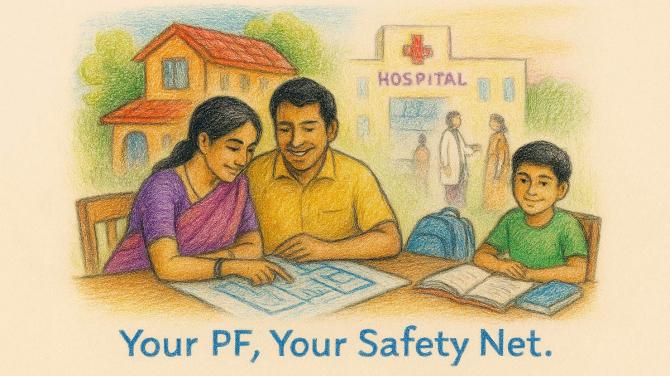
In Part 5, we discussed the rules around full and partial withdrawals, including tax implications and the importance of transfers. But EPFO also recognises that members may need money during their career for pressing needs. That is why the Provident Fund Scheme allows advances for specific purposes -- from buying a house to paying for surgery.
Unlike loans, these advances are non-refundable withdrawals, taken against your own balance.
Housing: Building or buying a home
Owning a house is the most common reason members dip into their PF savings. The EPF Scheme, 1952 (Para 68B and 68BB) permits:
After 5 years of service, you can withdraw up to 90% of your total PF balance for:
- Purchase of a plot
- Construction of a house
- Repayment of an existing housing loan
Additional conditions include:
- The house or flat must be in the member's or spouse's name
- In case of housing societies, at least 10 members of EPF must come together to avail
This provision has been a game-changer for many middle-class families, though financial planners caution that withdrawing too much too early may hurt long-term retirement security.
Marriage and education:
Major family events such as weddings or higher education are also recognised.
- You can withdraw up to 50% of your own contribution with interest
- Purpose: Marriage of self, siblings, or children; or higher education of children
- Minimum service: 7 years
- Maximum: Three times during service
For example, Anita, an EPF member with 10 years of service and Rs 4 lakh in her EPF kitty, can withdraw Rs 2 lakh to pay for her daughter's college admission.
Medical emergencies:
Unlike housing or marriage, medical needs have no minimum service requirement. Members can withdraw:
- Up to 6 times monthly wages (basic + DA), or
- The employee's share with interest, whichever is lower.
Conditions:
- Hospitalisation for more than one month, or
- Major surgery, or
- Treatment of TB, cancer, leprosy, heart disease, or mental illness (as per EPFO circulars).
This provision ensures PF serves as a fallback in health crises, especially for families lacking comprehensive health insurance.
Retirement advance:
As retirement approaches, members can withdraw part of their balance one year before superannuation (after age 54). The rule permits withdrawal of up to 90% of the accumulated corpus, helping members plan the transition to retired life.
Worked example: Housing advance in practice
Take Rajesh, age 40, with 15 years of service and a PF balance of Rs 12 lakh. He wants to repay his housing loan of Rs 8 lakh.
- Eligible withdrawal = up to 90% of PF balance = Rs 10.8 lakh
- Rajesh applies via the UAN portal, furnishing loan repayment proof
- EPFO approves Rs 8 lakh, credited to his bank directly
This saves him years of interest outgo on his home loan, though it reduces his retirement kitty.
Digital claims and timelines
Like withdrawals, advances can be applied for through the UAN Member e-Sewa portal. Aadhaar and KYC must be verified. In many cases, settlement happens within 10-20 working days, though glitches and employer verification delays remain common.
The takeaway:
EPF advances provide a financial lifeline for housing, health, education, and retirement needs. They are simpler than loans and carry no repayment burden, but come at the cost of reduced compounding for retirement. For first-time readers, the lesson is clear: Use EPF advances judiciously -- treat them as a safety net, not a primary funding source.
Part 1: Payslip To Pension To Long-Term Wealth: How EPF Works
Part 2: EPF Secrets Revealed: Where Your 12% Goes
Part 3: EPF@8.25%: Is It Really Worth It?
Part 4: How EPS Turns Part Of Your PF Into Lifelong Income
Part 5: EPF: How To Withdraw Smart, Protect Your Corpus
You can ask your personal finance questions to rediffGURUS HERE









 © 2026