

Investors having a moderate-risk profile can use these funds in their retirement portfolios.

With markets remaining volatile over the past year, many investors are seeking solutions that combine the benefits of equity exposure for long-term wealth building while also mitigating volatility.
Aggressive hybrid funds fit the bill well.
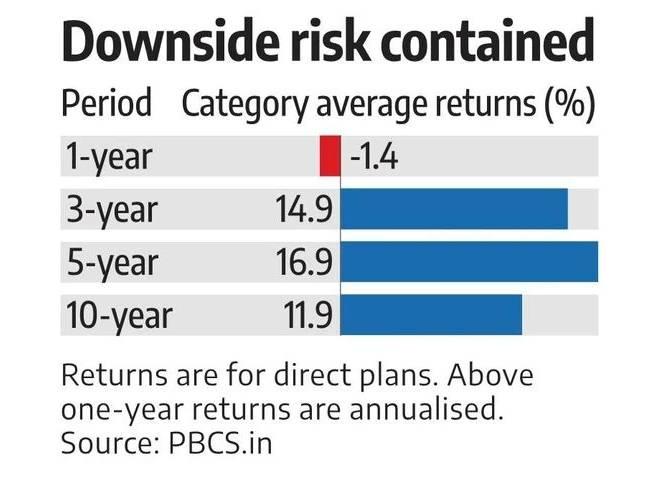
Over the past year, the Sensex has fallen 3.6 per cent, largecap funds have lost 5.2 per cent, and flexicap funds have declined 5.6 per cent.
Aggressive hybrid funds have done a better job than the frontline index and diversified-equity categories by losing only 1.4 per cent.
"Markets have been quite volatile in the past year. Aggressive hybrid funds are better positioned to navigate such volatile and uncertain periods compared to pure equity funds," says Harshad Borawake, head of research and fund manager, Mirae Asset Investment Managers (India).
"The allocation to fixed-income securities provides much-needed stability to the overall portfolio. Hence, their drawdowns are relatively less compared to equities," explains Borawake.
"The fund structure of aggressive hybrid funds allows room for fund managers to actively manage the portfolio between equity (65 to 80 per cent) and debt (20 to 35 per cent)," says Ankur Punj, managing director and business head, Equirus Wealth.
"These funds are well-suited for volatile markets as they offer active portfolio rebalancing, reducing the overall risk of the portfolio," adds Punj.
Asset allocation advantage
Diversification across asset classes is the hallmark of these funds.
"Aggressive hybrid funds offer a good blend of equities and fixed income as they aim to balance returns and provide relative stability," says Jayesh Sundar, fund manager, Axis Mutual Fund.
Their fund managers rely on dynamic asset allocation by transferring gains from equities to bonds, and vice versa, to stabilise the portfolio.
"These funds do active portfolio rebalancing based on market conditions. Active fund management across equity and debt helps reduce portfolio risk and optimise returns," says Punj.
They invest heavily in largecap equities and quality bonds.
Their managers actively track the duration of bonds held in the debt portion.
Not immune to volatility
The 65 to 80 per cent equity exposure of these funds means they are not completely immune to market fluctuations.
"Since they invest predominantly in equities, the drawdowns can still be higher (compared to fixed income and other hybrid categories) during significant market corrections," says Borawake.
"These funds also tend to underperform pure equity funds in a structural market up-cycle," says Sundar.
Suited for retirement
Investors having a moderate-risk profile can use these funds in their retirement portfolios.
"If your retirement is more than 10 years away, these funds can work well for you," says Parul Maheshwari, certified financial planner.
They are also suited for other long-term goals.
"Besides retirement, they are ideal for financial goals such as funding higher education or children's marriage, and even for investors seeking regular income through systematic withdrawal plans," says Borawake.
"Compounding through equities with stability from debt makes them ideal for riding volatility while achieving long-term goals," adds Borawake.
For first-time investors
New investors can also consider them.
"First-time investors who do not want high volatility but want equity exposure can use these funds," says Maheshwari.
"Moderate-risk investors with at least a five-year time frame, who want tax efficiency, can also invest. Such investors can have even a 50 to 65 per cent allocation to these funds," adds Maheshwari.
The ideal holding period for them, Sundar adds, should be a minimum of three years.
Disclaimer: This article is meant for information purposes only. This article and information do not constitute a distribution, an endorsement, an investment advice, an offer to buy or sell or the solicitation of an offer to buy or sell any securities/schemes or any other financial products/investment products mentioned in this article to influence the opinion or behaviour of the investors/recipients.
Any use of the information/any investment and investment related decisions of the investors/recipients are at their sole discretion and risk. Any advice herein is made on a general basis and does not take into account the specific investment objectives of the specific person or group of persons. Opinions expressed herein are subject to change without notice.
Feature Presentation: Ashish Narsale/Rediff











 © 2026