
'Pick a sum insured that realistically covers major hospitalisation costs in your city.'

With health insurance premiums rising sharply, the government is in talks with various stakeholders on ways to curb the surge, according to news reports.
Policy changes may take time, but customers need immediate strategies to manage rising costs.
One widely recommended approach is combining a base health policy with a super top-up.
- You can post your health insurance related questions HERE
Super topup vs topup
Rising medical costs require stronger financial protection.
"Top-up and super top-up plans offer the additional safeguards many customers seek," says Bhaskar Nerurkar, head -health administration team, Bajaj General Insurance (formerly known as Bajaj Allianz General Insurance Company).
A super top-up covers cumulative medical expenses across multiple claims in a policy year.
"A top-up plan provides coverage only when a single claim crosses the threshold limit.
"Multiple claims that individually fall below the limit do not trigger the cover," says Siddharth Singhal, head of health insurance, Policybazaar.
For instance, with a deductible of Rs 10 lakh and four claims of Rs 5 lakh each (totalling Rs 20 lakh), a standard top-up pays nothing, while a super top-up covers the remaining Rs 10 lakh once total expenses cross the deductible.
Cost advantage
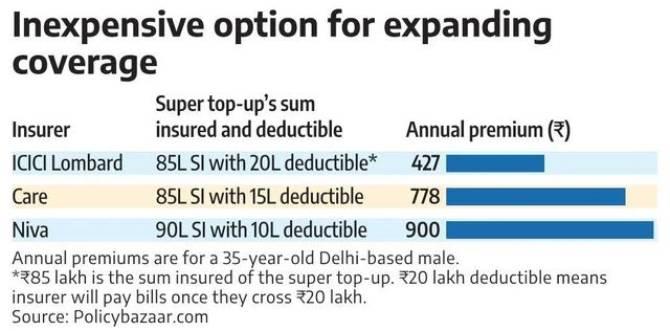
A super top-up provides large coverage at a lower cost.
For example, instead of paying Rs 20,000 to Rs 40,000 annually for a Rs 1 crore cover, a Rs 20 lakh base plan plus an Rs 80 lakh super top-up would cost Rs 12,000 to Rs 15,000.
"This structure remains far more cost-efficient while providing large coverage," says Nerurkar.
Super top-ups usually offer cashless at network hospitals.
"If you choose a non-network hospital, you may need to go for reimbursement, which involves paperwork and waiting time," says Nerurkar.
What to check before buying
The sum insured should be adequate.
"Pick a sum insured that realistically covers major hospitalisation costs in your city. Check for network hospitals nearby," says Sanjiv Bajaj, joint chairman and managing director, Bajaj Capital.
"Ensure there are no room rent restrictions.
"Coverage should allow access to preferred hospitals.
"Check waiting period for pre-existing diseases (PED)," says Shilpa Arora, cofounder and chief operating officer, Insurance Samadhan.
Review exclusions, copayments, day-care cover, pre- and post-hospitalisation cover, and ambulance support.
"Look for useful features such as reinstatement benefits, no-claim bonuses, and minimal sub-limits," says Adhil Shetty, chief executive officer, BankBazaar.com. Also, ensure the plan offers lifetime renewability.
Same insurer offers convenience
Buying super top-up from the same insurer (as the base policy) simplifies claims and reduces paperwork.
"Choosing a different insurer can give better premiums or fewer limits, though claims may involve more coordination.
"Pick the same insurer for convenience; explore others if cost and coverage are your priority," says Shetty.
"When base and super top-up are from different insurers, the second insurer may insist on reimbursement," says Arora.
Claims: Dos and don'ts
Customers should track when the deductible is crossed and retain all bills.
"Inform both insurers at the time of admission if your base and super top-up plans are from different firms.
"Submit all documents, including reports and discharge summaries, in one complete set to speed up approval," says Bajaj.
Common mistakes
The biggest one is choosing the wrong deductible.
"It should ideally match your base sum insured, or you may end up paying more out of pocket," says Bajaj.
Other errors include ignoring higher city-wise medical costs and failing to check if modern procedures are covered.
"Always disclose your medical history to prevent claim issues, and don't buy the plan just for tax benefits," says Shetty.
- You can post your health insurance related questions HERE
Disclaimer: This article is meant for information purposes only. This article and information do not constitute a distribution, an endorsement, an investment advice, an offer to buy or sell or the solicitation of an offer to buy or sell any securities/schemes or any other financial products/investment products mentioned in this article to influence the opinion or behaviour of the investors/recipients.
Any use of the information/any investment and investment related decisions of the investors/recipients are at their sole discretion and risk. Any advice herein is made on a general basis and does not take into account the specific investment objectives of the specific person or group of persons. Opinions expressed herein are subject to change without notice.
Feature Presentation: Ashish Narsale/Rediff











 © 2025