

Whilst the truth of the village lies shrouded in ruins and mystery, I exit Kuldhara with goosebumps -- and those feel entirely real!
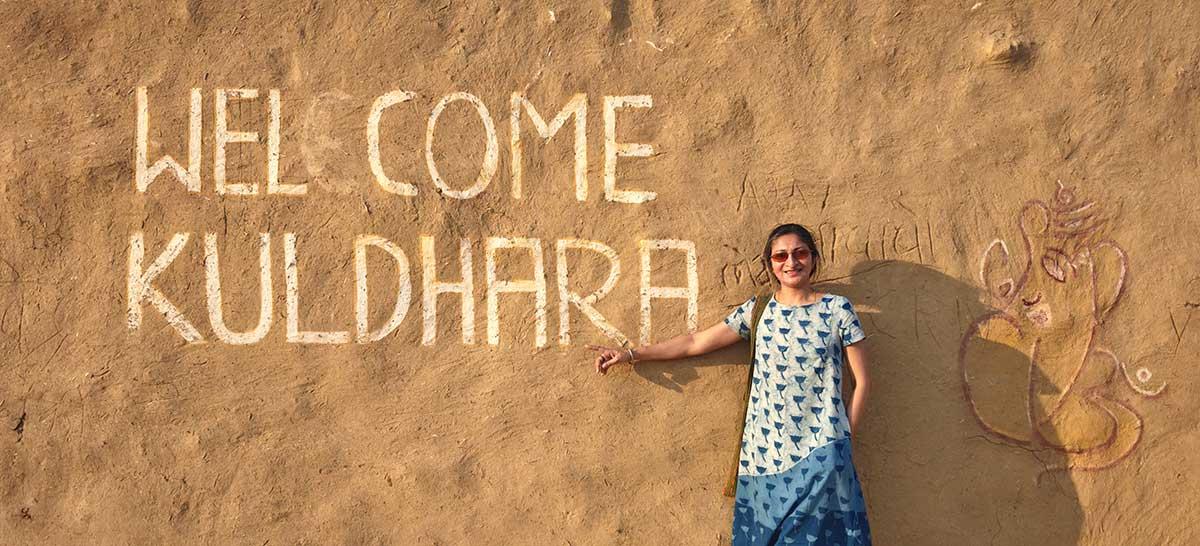
I'm headed about 20 km west of Jaisalmer, in western Rajasthan, to a tiny little village that has cropped up in the last couple of days in my conversations with locals in Jaisalmer.
They speak of this village as being haunted and spooky. Others discard it as all hearsay. Fact or fiction, myth or truth, the town continues to remain relevant, even if only in local chatter and curiosity which is further fuelled by YouTubers and bloggers.
Intrigued, I decide to see it with my own eyes.
To add to the experience, instead of booking a cab, I am chaperoned on a Bullet motorcycle by Soheb, a college-going local, who is also learning the ropes of tourism and comes referred by senior Manganiyar artists (Rajasthani folk musicians).
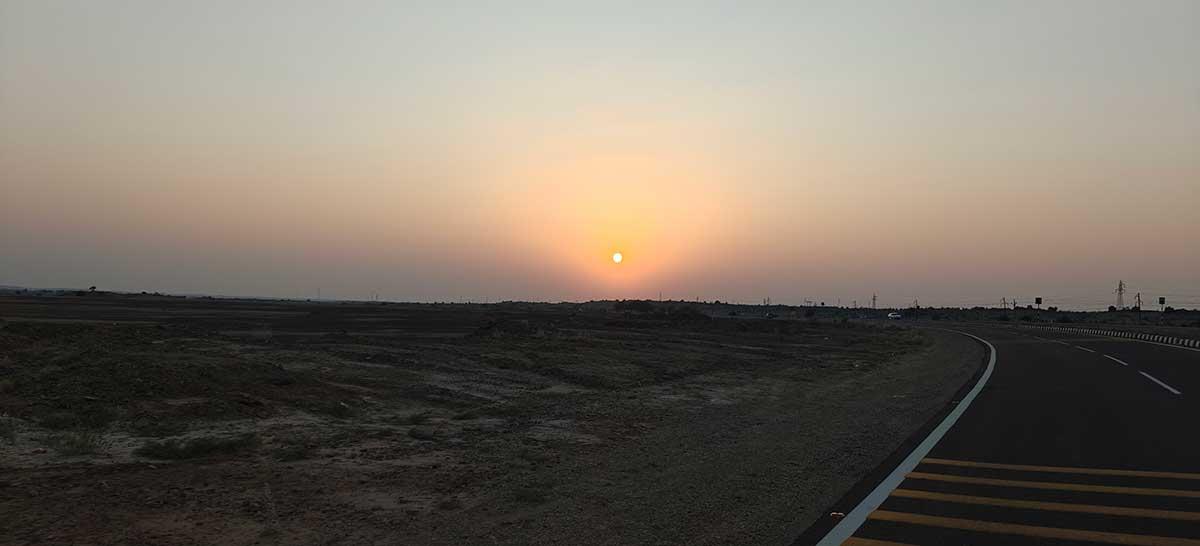
We set out by 4 pm, under a blazing sun, and, in just a few minutes, leave the golden-hued town behind to ride onto the vast highway that stretches between arid lands and throws up multiple mirages.
Enroute, the vegetation is reduced to short, dusty bushes and tall cacti. We're headed to the infamous village of Kuldhara, very close to the Indian border.
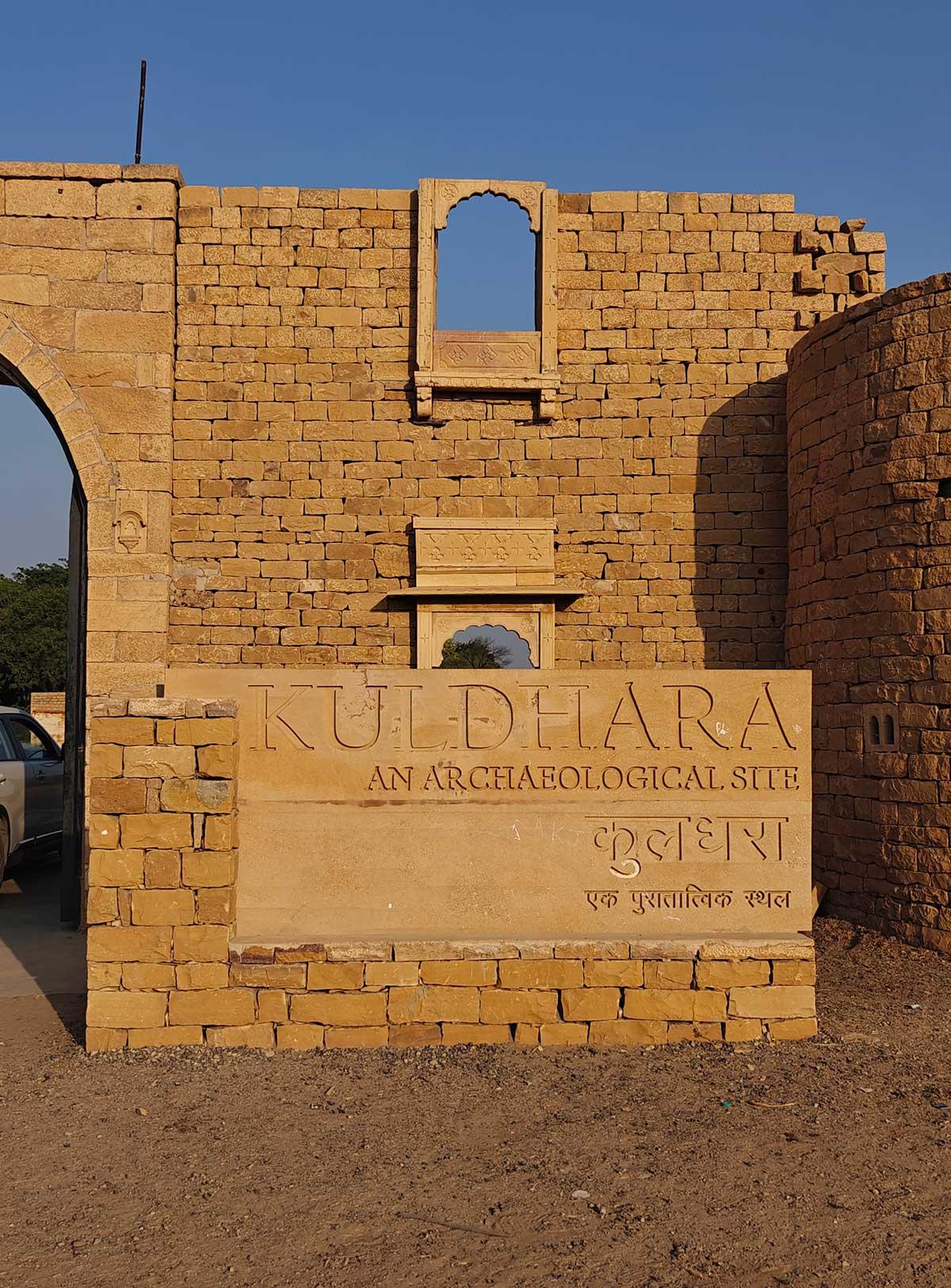
One is greeted at the village by a welcome engraved in sandstone that pronounces it to be an archaeological site.
The village has also been seen in several films like Gupt, Agent Vinod, The Eken and others.
It takes me a little over an hour to look around and chat up some of the local boys as well as the hawaladars on duty.
Unlike the rest of Jaisalmer, whilst there are other tourists too, the place is far from crowded.
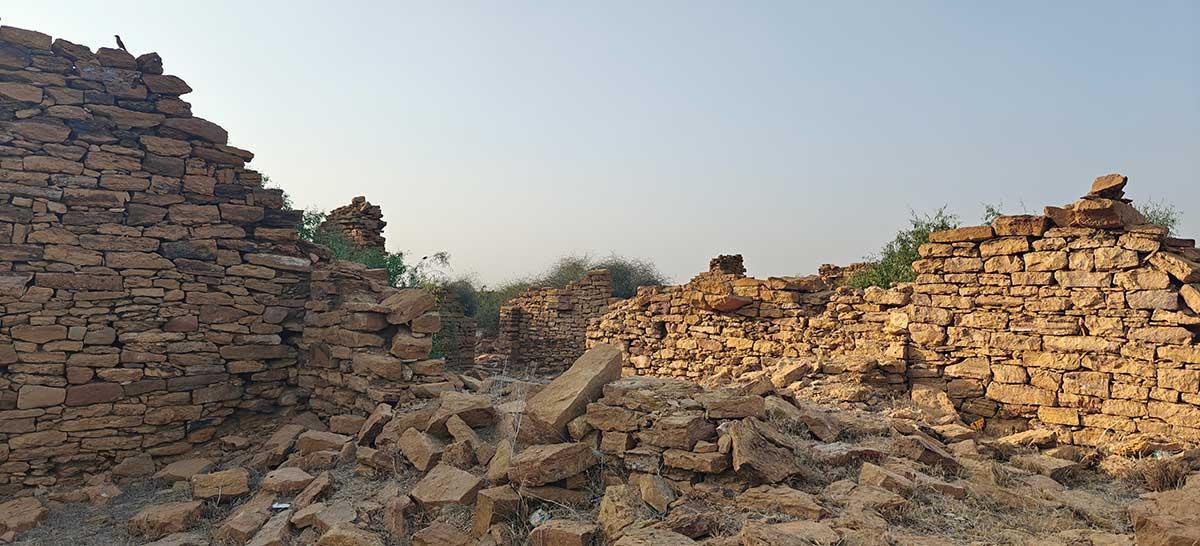
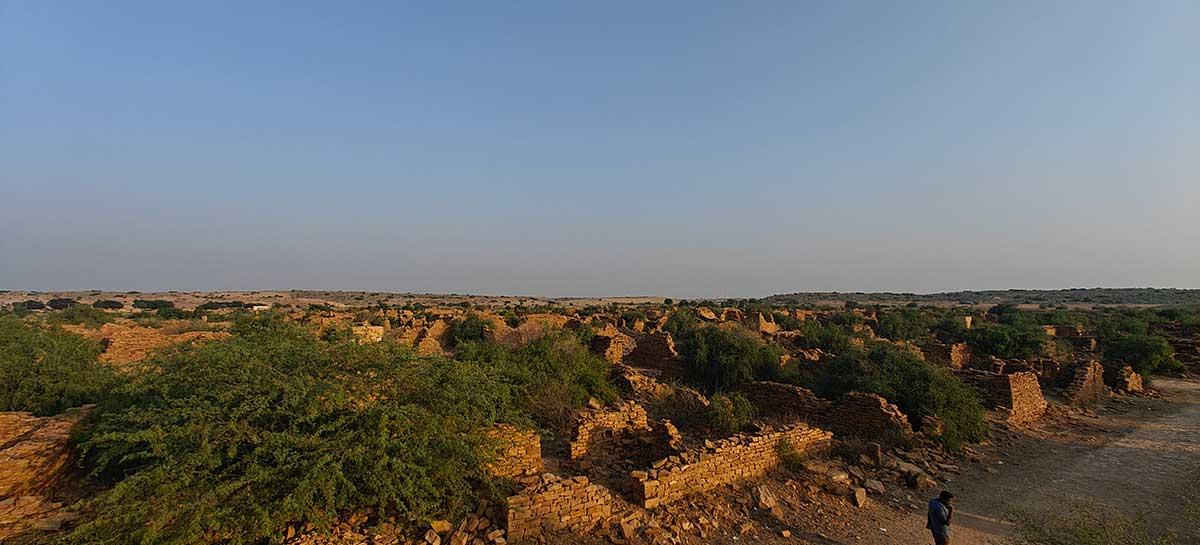
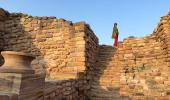
What one navigates is a vast ruin of homes that were abandoned by the 19th century. Some almost ruined homes have been partially restored so one can go into them and see how these Paliwal Brahmins, who had migrated from Pali, also in Rajasthan, to Kuldhara way back in the 13th century, possibly lived.
One witnesses large courtyards, surrounded by rooms. The terraces overlook the village that have stayed abandoned for the last 150 odd years.
It is estimated that there were as many as 400 odd houses during its heyday.
I see a mandir with a bell hanging outside, suggesting that it is probably still in use. I ask Soheb if one could go in and he advises otherwise. It is believed that the mandir is severely haunted. As are the wells.
It is cue enough for me to dig deeper into the story.
The story goes that the Paliwal Brahmins, who were the original inhabitants of this once prosperous village, exited the village overnight because of the ill intentions and atrocities of Salim Singh, apparently a prime minister of the Rajput state of Jaisalmer.
Colloquially called Zalim Singh, the minister was notorious for his brutalities, including high taxes, which were being levied on the villagers.
But it was when Salim Singh set his lecherous eyes on a beautiful, young girl, who was perhaps the daughter of one of the more affluent and important men of the village, and declared that come what may, he would wed her, that things came to an irreversible boil.
Knowing that Salim Singh was capable of carrying out his threat, the villagers, each and every one of them, decided to abandon the village overnight.
As the legend goes, Salim Singh reached the village the next morning, only to find it completely devoid of people and he commanded his men to burn it.
It is from that day on that Kuldhara has acquired the reputation of being a cursed village that has never seen habitation again.
It is believed that when the villagers were abandoning the village, they also gave it a shraap or a curse that nobody would ever be able to live in these villages again.
Despite being such a huge tract of land, the government too has never tried to redevelop it.
There are other sanitised versions explaining the sudden and overnight abandonment of Kuldhara as well -- that the villagers left due to an earthquake or because of poor water supply. But even if that were to be true, the fact that none of those villagers have been conclusively traced anywhere else since, deepens the mystery and ghostly stories around Kuldhara.
There have been multiple groups of brave investigators, interested in investigating paranormal activities, who have visited Kuldhara. Many have reportedly felt uneasy, particularly during the night, and have confirmed the presence of unexplained energies and of encountering moving shadows and talking spirits.
The exit time from the village now stands mandated at 6 pm.
Whilst the truth of the village lies shrouded in ruins and mystery, I exit Kuldhara with goosebumps -- and those feel entirely real!
Supriya Newar is a multi-lingual writer and poet from Calcutta.
Besides being a music aficionado, she is also an avid traveller, particularly drawn to places that have a 'je ne sais quoi' about them.
She may be reached on connect@supriyanewar.com
Feature Presentation: Ashish Narsale/Rediff








 © 2026