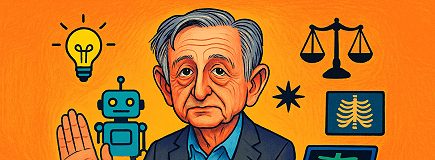
'People who really are at the frontier of using AIs are going to be way more employable than people who are not.'

Perplexity AI CEO Aravind Srinivas recently appeared on The Verge's Decoder podcast with Nilay Patel and shared some interesting observations about the future of artificial intelligence (AI) and its vast possibilities.
Srinivas warned how AI is rapidly transforming the job market and emphasised on the urgent need for individuals, especially the younger generations to adapt and master AI tools.
You can listen to the full podcast HERE (external link).
Meanwhile, here are top 5 takeaways that will help you in your career:
1.What he said: 'A recruiter's work worth one week is just one prompt: Sourcing and reach outs.'
'You want it to keep following up, keep a track of their responses.
'If some people respond, go and update the Google Sheets, mark the status as responded or in progress and follow up with those candidates, sync with my Google calendar, then resolve conflicts and schedule a chat, then push me a brief ahead of the meeting. Some of these things should be proactive. It doesn't even have to be a prompt,' he'd added.
The takeaway: According to Srinivas, mundane and repetitive tasks that typically require days of manual work, like searching for candidates, reaching out with e-mails and follow-ups can be worked into a single natural-language prompt.
2. What he said: 'Spend less time doomscrolling on Instagram; spend more time using the AIs.'
The takeaway: Srinivas emphasises that people who learn to use and adopt AI productively will have a clear edge in the emerging and future job market.
He is also urging youngsters to ditch passive and unproductive scrolling of social media.
3. What he said: 'People who really are at the frontier of using AIs are going to be way more employable than people who are not. That's guaranteed to happen.'
The takeaway: Sooner or later, white collar jobs are at the risk of automation. Those in administrative and organisational task roles will need to find a way to adapt AI into their work.
Continuous reskilling is the key to staying relevant on the job.
4. What he said: 'The human race has never been extremely fast at adapting. The field is moving in cycles of three to six months.'
The takeaway: Aravind Srinivas is hinting that humans, as a society, are generally slow to adapt to big changes, especially when it comes to technology.
Meanwhile, AI is evolving extremely fast -- there is something happening every three to six months. If you don't actively keep up with AI developments now, you will risk falling behind.
5. What he said: 'The browser is the most agentic software that we use every day. It has your login state -- It's the most powerful surface area where AI can actually take actions for you.'
The takeaway: Srinivas believes that the web browser is the best place for AI.
Since it is already linked to the apps and tools we use every day, it will help AI do more than just search. For example, it can suggest and even take actions for you.
6. What he said: 'It's (Comet is) not just a smarter search engine... (it) could become an AI operating system that runs in the background.'
The takeaway: Comet, Perplexity's AI powered browser, wouldn't mimic your regular AI search tool.
Instead of simply answering questions, it is designed to act like an AI operating system. It will proactively help users manage tasks, workflows and information across apps, acting almost like a digital chief of staff.