

Do you have income tax-related queries?
Please ask your questions HERE and rediffGURU T S Khurana, a fellow member of The Institute of Cost Accountants of India, will answer them.
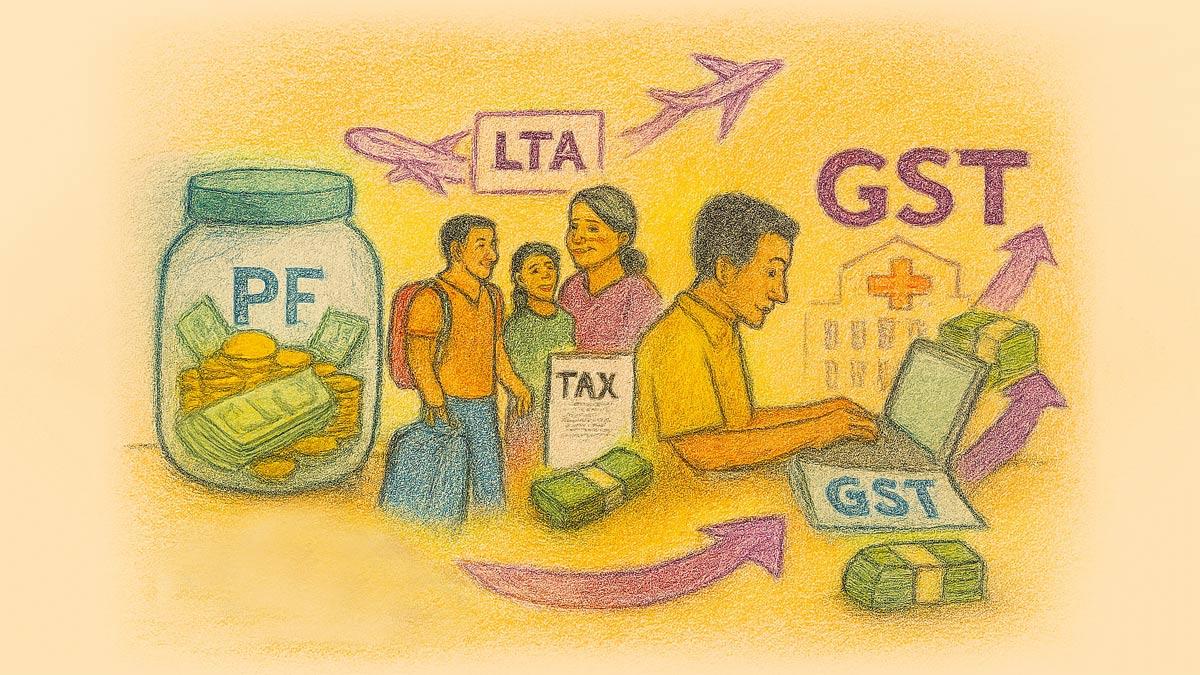
Anonymous: I freelance across India, earn 12-14 lakh annually. How should I handle GST and income tax filings? I don't have a fixed office and I mostly work from my parents' home in Chandigarh.
Do I need GST registration across states? Also, should I pay advance tax quarterly or opt for presumptive taxation?
What's the smartest way to reduce tax and stay compliant?
You are a freelancer, operating from Chandigarh and providing services across India. You are liable to take GST registration. This is in view of your activities which span inter-state and are not limited to within state. Moreover your turnover also seems to cross GST basic limit.
You need to file GST returns regularly and pay GST, where ever applicable.
In case of income tax, you may pay advance tax from time to time, on estimated basis, which will save you interest chargeable by the IT Department.
Regular payment of taxes & filing of returns, should not be missed.
Anonymous: Is LTA tax-free if I travel abroad or book via a travel website? My company offers LTA as part of my CTC, and I booked a family trip through an online portal.
Can I claim tax exemption if the travel was within India but booked online? What if I had taken an overseas trip?
LTA paid (cash or through baking channels) is taxable under the provisions of Income Tax Act. May be you have actually traveled or not.
LTC is not subject to tax, because it is reimbursement of actual travel cost.
To avail any tax benefits, you have to travel within India only.
Rama: I worked in company around 22 years ago. I had withdrawn my pf but family pension is still with the company and not getting any response. Similarly, was associated with another company 20 years back and pf is still with that company. Trust maintains that.
I'm due to retire in another 1 year. Please suggest how to proceed for claim of pf/family pension.
You should approach your past employer for payment of your PF dues & this should not be a problem. Similarly, you should also pursue your case for family pension with concerned authorities. You can also approach, Commissioner Provident Fund of your state, for any help or complaint.
Anonymous: My mother purchased land in 2019 along with three other persons. They jointly constructed a building on the said land and each was entitled to a floor. The construction for our floor was completed in 2022. The said premise (our floor) was sold in Aug 2024. The property was sold by way of GPA. The buyer has not registered the GPA. The proceeds of the sale were transferred to my mother’s account.
In October 2024, she invested the proceeds (80 lakh) in a property in her daughter’s name. Will she be able to claim capital gains exemption on this transaction? Or can she open a capital gains account?
The cost of construction of the house along with cost of land was around 65 lakh.
If the LTCG has been invested in a property (Registered in her daughter's name), you can claim exemption u/s 54 of IT Act, PROVIDED the property purchased is a RESIDENTIAL Property.
Anonymous: If I sell a residential property (close to 40 lakh amt with a profit of ~5 lakh), bought in 2016, and use the proceeds to pay off my current home loan (in which I live, bought in 2024), can I claim exempt from LTCG?
There should not be a difference of more than one year between house purchased last year & house to be sold now. If the difference is more than one year, you may not be getting any exemption u/s 54.
- You can ask rediffGURU T S Khurana your questions HERE.
Disclaimer: This article is meant for information purposes only. This article and information do not constitute a distribution, an endorsement, an investment advice, an offer to buy or sell or the solicitation of an offer to buy or sell any securities/schemes or any other financial products/investment products mentioned in this QnA or an attempt to influence the opinion or behaviour of the investors/recipients.
Any use of the information/any investment and investment related decisions of the investors/recipients are at their sole discretion and risk. Any advice herein is made on a general basis and does not take into account the specific investment objectives of the specific person or group of persons. Opinions expressed herein are subject to change without notice.










 © 2026