

Somewhere between the darshan queue and the fugadi dancing, between ancient stone pillars and the riverfront, my nine-year-daughter found her own understanding of pilgrimage, discovers Hemantkumar Shivsharan.

For nearly a year, we had watched the WhatsApp updates from a tour operator specialising in temple circuits across Maharashtra. Each month, their Pandharpur batches would fill up within days.
The pilgrimage to Akkalkot, Pandharpur, Solapur and Tuljapur was on our wishlist but work and school -- my wife and I work and our nine-year-old daughter, Parisa, is in the third standard -- made it challenging.
This time, when Parisa's Diwali holidays came around, we decided we would make the three-day trip. Unfortunately, the October batch was full but there were slots available for the last week of November. We confirmed immediately.
Finally, November 27 -- it was a Thursday -- arrived. After Parisa reached home from school, we readied for our 9 pm departure from the Vashi (in Navi Mumbai) highway.
The bus was on time and we -- Parisa, her mum and me -- settled in our seats. Our tour guide distributed identity cards and travel kits containing soap, toothpaste, oil and shampoo.

It was dawn by the time we reached the Shri Vitthal-Rukmini Bhakta Niwas, a well-appointed lodge where we would stay in Pandharpur.
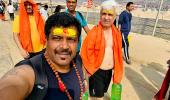
After breakfast came an announcement that thrilled Parisa: Everyone would wear a pheta, the traditional Maharashtrian turban. A photo session followed with Parisa posing around the courtyard -- by the gate, near the staircase, beside the tulsi plant...
Five-seater autos took all 35 travellers to the Shree Vitthal-Rukmini temple.
At the Chandrabhaga river, locals applied a special tilak, symbolising Lord Vitthal, with yellow and black paste on each traveller's forehead.
"Now you've got the naam (the tilak, in Marathi), Parisa," I told her.
"First the pheta, now the tikka! I am a real pilgrim," she smiled.

Our guide explained the rules we would have to follow. Everyone's footwear was collected in a cloth sack. Mobile phones, pocket cameras, DJI mini cameras -- all kinds of recording devices were prohibited. Anyone who broke this rule would have their devices confiscated for 24 hours.
We walked barefoot through heritage lanes, now lined with shops selling water, snacks and mobile locker services. The path led to a covered skywalk curving upward to the three-storey darshan mandap, then narrowed towards the garbhagriha (sanctum sanctorum
The queue was long -- we waited for almost an hour. I told Parisa this would be our first time touching the feet of Lord Panduranga, as Lord Vitthal is also called; our previous visits only allowed mukh darshan from a distance.
Finally, we stood before Lord Vitthal's black stone form, his arms on his waist, smiling gently. Parisa folded her hands and whispered a prayer. At Goddess Rukmini's sanctum, she repeated the gesture.
When we stepped outside, we saw women playing fugadi -- holding on to each other's crossed hands and spinning in circles. I explained it was their expression of gratitude after darshan and, within moments, she was twirling with her mother and the other women in our group, chanting "Vitthal Vitthal Jai Hari Vitthal".

Outside, we purchased prasad -- here, it is shaped into laddoos -- and enjoyed cool matha (buttermilk) from a bicycle vendor. We also bought small Vitthal-Rukmini idols.
Now, it was time for some pet pooja. We headed to the Rajbhog Thali House for their unlimited thali -- pickle, three types of chutneys, two dry sabzis, three gravy sabzis, chapatis, puris, dhokla, bhajiyas, chaas and sweets. Servers moved swiftly with refills. Parisa sampled everything, matching their speed with her appetite.
The afternoon was free until 6.30 pm when we would visit the Riddhi Siddhi Mahaganpati Temple, Mangalwedha. We explored Pandharpur's shopping lanes. Bangle sellers beckoned -- Parisa selected pink and green bangles whilst her mum chose red-gold.
At a clothing shop, Parisa discovered the parkar polka -- a traditional long skirt and fitted blouse made from Khunn fabric; it has decorative borders. She settled on deep purple with golden zari work, twirling happily before the mirror.
Our final purchase was a manjira -- small brass cymbals used while singing devotional songs.

We walked to the Chandrabhaga riverfront. Local photographers offered instant prints -- Parisa posed willingly, her new bangles catching light, her pheta slightly tilted, the tikka still visible. Nearby, children laughed as they dived and splashed. She wanted to join them but we had to return for our evening temple visit.
Somewhere between the darshan queue and the fugadi dancing, between ancient stone pillars and the riverfront, she had found her own understanding of pilgrimage -- not just in rituals but in the joy of participation.









 © 2026