


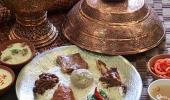
The entire multi-course spread of Kashmiri cuisine is referred to as Wazwan.
It is a word synonymous with a formal Kashmiri banquet and also the extravagant, indulgent entire Kashmiri gastronomic experience, that awakens all the senses and satisfies so many gustatory urges.
Wazwan may be over 36 courses, cooked by a team of chefs who are called wazas, under the supervision of a vasta waza or the master chef. Vasta wazas are said to be descendants of the cooks from Samarkand.
The food is characterised by thick gravies utilising copious amounts of yoghurt, spices and dried fruits, and is usually cooked in ghee.
Kashmiri cuisine has strong influences from Persian and Central Asian cuisine. Reflected too are Mughal era styles, which favours cooking methods like slow simmering over a low flame, thus elevating the flavours.
It has evolved over the centuries and the spices and ingredients used, along with the cooking methods, are what impart the nuanced flavours, characteristic of this way of cooking.
Local ingredients -- saffron, asafoetida, fennel seeds -- are more often than not the spices that give iconic Kashmiri dishes their strong and flavourful aroma.
Seasons and availability of fresh produce dictate the ingredients, some of which are dried and used in the winter months.
Typical Wazwan dishes are Rista or tender-cooked meatballs in a red gravy; Gustaba or meatballs in a yoghurt gravy; Rogan Josh or a slowly-simmered lamb curry; Tabak Maaz or mutton cooked in milk and then fried in ghee.
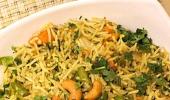
Kashmiri Pandit cuisine overflows equally with delicacies -- Rajma Gogji, a kidney bean and turnip stew; Modur Pulaav, a sweet rice preparation with nuts and raisins; Lyodoor Tschaman, a piquant cottage cheese curry; and Nadir Haaq, lotus stems or nadroo is cooked with haak or collard greens.
Adrika Anand goes hunting for Kashmiri recipes. From Chef Nalini Sadhu -- who started Matamaal with her husband Surender, a Kashmiri restaurant with two branches in the National Capital Region, and one more in Pune -- she sources the Kashmiri Pandit recipe for Tschaman Kaliya, also called Chaman Kaliya or Lyedar Tschaman, a rich Kashmiri paneer dish.
Kashmir is known for the excellent quality of its paneer and when prepared in the innovative Valley style with spices and no onion and garlic, you get a paneer far more splendid than anything you have had before.
Adrika approached Chef Bilal Reshi for a classic Gustaba recipe. Waza Reshi is a chef at Wazwan Stories, a popular eatery of Srinagar, known for the quality of its Wazwan. Gustaba is a very representative dish from the state and is meatballs in a delicately-spiced yoghurt curry usually served at weddings and for special occasions.
Waza Reshi's recipe is for 100 meatballs! We have pared it down to a recipe that caters to 5-6.
This is a 100 per cent traditional recipe and definitely not an easy dish to cook at home. Most will find creating the meat paste by hand not easy to accomplish. An easy short cut would be to buy pre-minced mutton and mince it once more at home in a grinder and wash it well and make the gustaba balls out of it.
Come let's roll up our sleeves, sharpen the knives, pull out spices and begin cooking these Kashmiri delights!

Lyedar Tschaman
Recipe by Chef Nalini Sadhu
Serves: 3-4
Ingredients
- ½ kg paneer or cottage cheese, cut into cubes
- 1 cup full-fat milk
- 1 tbsp mustard oil
- ¼ tsp hing or asafoetida
- 1½ tsp haldi or turmeric powder
- 1 tsp sonf or fennel powder
- 1 tsp saunth or dry ginger powder
- Salt to taste, about 1 tsp
- ½ cup water
- 500 ml mustard oil, for deep frying the paneer
- Few strands kesar or saffron for garnish
Whole spices:
- ½ tsp kalonji or nigella/black cumin seeds
- 2-3 lavang or cloves, lightly crushed
- ½ tsp jeera or cumin seeds
- 3 pods green elaichi or green cardamom, lightly crushed
- 1 stick dalcheeni or cinnamon
- 1 pod kala/bara elaichi or black cardamom, lightly crushed
Method
- Heat the mustard oil in a deep saucepan or a kadhai, over medium-high heat, and deep fry the cottage cheese cubes in batches until golden brown.
Drain onto a paper towel-lined plate and keep aside. - Heat the 1 tbsp oil mustard oil in a saucepan or a kadhai over medium heat.
Once the oil is hot, add in the asefoetida, jeera.
Once the jeera crackles, add in the remaining whole spices, except the kalonji.
Now add the turmeric, salt and cook for a few seconds and then add about ½ cup water.
Once the water comes to a boil, add in the milk along with the ginger powder, fennel powder, cottage cheese and simmer until the gravy liquid is reduced by half -- it should have a thin, yet viscous consistency.
Take off heat, garnish with the kalonji and saffron . - Serve hot with hot steamed rice.

Gustaba
Recipe by Chef Bilal Reshi
Serves: 5-6
Ingredients
For the gustaba meat paste balls or mutton gande:
- 3 kg boneless mutton, very well washed
- 1-3 pods kala/bara elaichi or black cardamom, crushed
- Salt to taste, about 3-4 tsp
- Water
- 2 ½ litres mutton broth with salt, made from mutton bones
- 125 gm fried shallot onion paste
For the yoghurt gravy or yakhni:
- 5 kg yoghurt, beaten
- ¼ kg ghee
- 2½ litres mutton broth with salt, made from mutton bones
- 3-4 pods green elaichi or cardamom
- 3-4 lavang or cloves
- 25 gm saunth or ginger powder
- 12-15 gm sonf or fennel seed powder
- 15 tbsp garlic paste
- Small handful dried mint leaves
Method
For making the gustaba or meat paste balls:
- The lean pieces of mutton, portion by portion, are beaten on a smooth stone or silora or silbatta using a wooden hammer or mallet until it forms a coarse paste.
- The fat pieces are minced separately and added to the lean mince.
Then add the bara elaichi and salt to the mince and beat again until mixture blends uniformly.
Add small amounts of water, while beating to form a smooth elastic paste. - Roll the paste into small smooth round balls of 70 gm each and keep aside.
For cooking the gustaba:
- In a large saucepan, bring the mutton broth to a boil over medium heat.
Gently add the meat balls to the boiling gravy.
Cook until half done and firm.
Add the fried shallot/onion paste and continue cooking until fully done. - Keep the balls aside in the broth, but keep warm.
For the yoghurt gravy or yakhni:
- In a large saucepan, heat the yoghurt over low heat, stirring continuously, until the water reduces.
Add in the ghee and allow the gravy to reduce further, by nearly half.
Add a little water to adjust the consistency and ensure no lumps remain.
Now add in the mutton broth and the gushtaba balls with their broth/gravy.
Add in the cardamom, cloves, ginger powder, fennel powder, garlic paste.
Cook a little longer, allowing the spices to steep into the gravy.
Add more salt if required.
Take off heat.
Add in the dried mint before serving with steamed rice.







 © 2026