
'If we're smart about it, we can use AI to amplify human potential, not replace it. But time is running short.'
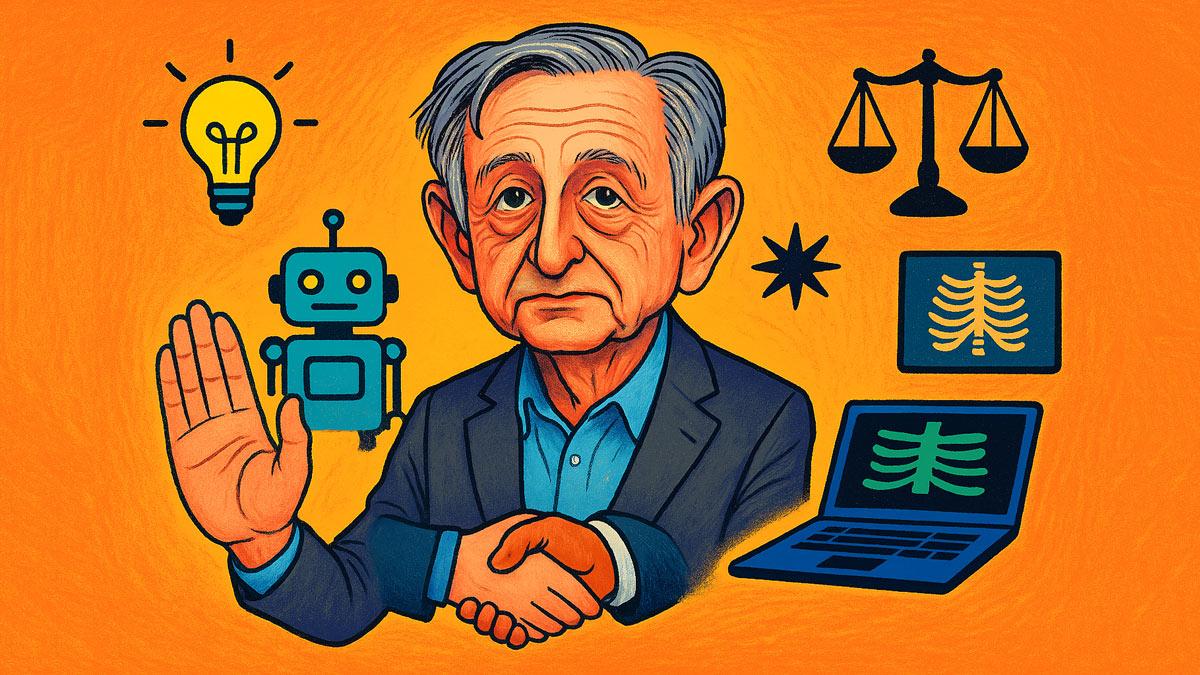
Dr Geoffrey Hinton, often called the 'Godfather of Artificial Intelligence', has sounded a fresh warning on the transformative -- and potentially destructive -- power of AI in the workplace.
In an interview with the BBC, the British-Canadian computer scientist said several professions are on the brink of being made obsolete and not all of them are traditionally associated with automation risk.
Dr Hinton, whose pioneering work on neural networks laid the groundwork for the AI revolution, powering tools like ChatGPT, recently left Google to speak more freely about the risks posed by the very technology he helped build.
Now, he's issuing a sobering alert: 'We have machines that can out think us in many areas -- and that changes everything about work.'
Not just factory jobs: AI is coming for white collar professions as well
Dr Hinton believes the popular assumption that AI will mostly replace blue-collar workers is outdated. Instead, he warns, white-collar jobs -- those that involve tasks like analysis, writing and even artistic creation -- are in the AI crosshairs.
'If you look at who it's going to take jobs from, it's not the obvious blue-collar workers. It's the sorts of things like assistants or radiologists,' Hinton said, highlighting roles that involve repetitive knowledge-based tasks.
Financial analysts, graphic designers and even coders are increasingly at risk.
His remarks echo a growing consensus that AI's ability to generate text, images, code and even legal documents in seconds is accelerating job displacement in sectors once thought secure.
Radiologists, lawyers on the chopping block?
Among the professions most under threat, Dr Hinton specifically named radiologists.
Machines, he said, can already scan and interpret medical images more efficiently than human experts in many cases. The same goes for legal assistants, who are routinely tasked with digesting large amounts of text -- something AI models now do effortlessly.
'AI systems don't get tired. They don't get distracted. And they can process thousands of cases in the time it takes a human to complete one,' Dr Hinton explained.
However, he added that the eventual impact of AI on employment depends on how governments and societies choose to regulate and adapt to the technology.
But there's one thing AI still can't do
Despite the doom and gloom, Dr Hinton believes there's still one task that AI can't replicate -- genuine emotional connection and care.
While machines might one day write novels or perform surgery, they will never possess a true human empathy, he argues. This makes professions such as nursing, caregiving and psychotherapy uniquely resistant to automation.
'Being able to connect deeply with another human being -- to hold their hand in grief, or celebrate their joy -- that's something machines cannot feel,' Dr Hinton said. 'Jobs that involve caring for people will likely remain human for a long time.'
A call for caution, not panic
Dr Hinton's warning doesn't mean mass unemployment is inevitable. Instead, he urges policymakers and educators to prepare for massive economic shifts -- by reshaping curricula, prioritising human-centred skills and building a safety net for those displaced by machines.
'If we're smart about it, we can use AI to amplify human potential not replace it. But time is running short,' he said.









 © 2025