

Do you have mutual fund, insurance and personal finance-related queries?
Please ask your questions HERE and rediffGURU Naveenn Kummar, an AMFI-registered, IRDAI-licensed, qualified financial planner, and founder of Alenova Financial Services, will answer them.
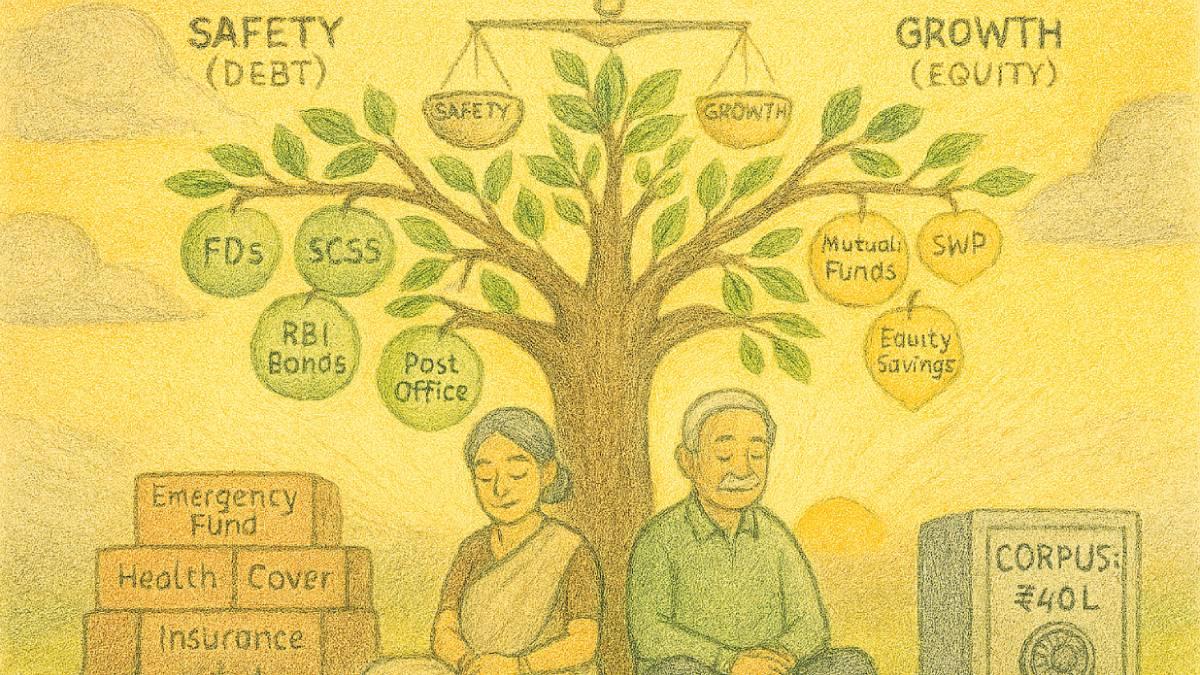
KAUSHIK: How to invest Rs 40 lakh for maximum monthly income post retirement?
rediffGURU Naveenn Kummar: First Principles:
- At retirement, your goal is income stability + safety first, not chasing high-risk returns.
- Typical safe withdrawal rate in India: ~4-6% per year.
With Rs 40 lakh, that means:
- 4% SWR → Rs 1.6 lakh/year (~Rs 13,000/month)
- 6% SWR → Rs 2.4 lakh/year (~Rs 20,000/month)
- If you want more income, you must mix debt (safety) with some equity (growth).
Options for Monthly Income
1. Senior Citizen Savings Scheme (SCSS)
- For 60+ age, government-backed
- Current rate ~8.2% (quarterly payout)
- Max limit: Rs 30 lakh
- On Rs 30 lakh, you’ll get ~Rs 2.46 lakh/year (~Rs 20,500/month).
2. RBI Floating Rate Bonds/Post Office MIS / FDs
- FDs (7-7.5%) can be laddered across banks.
- RBI bonds (7.35%) -- safe, bi-annual payout.
3. Debt / Hybrid Mutual Funds with SWP (Systematic Withdrawal Plan)
- Well-managed corporate bond, banking & PSU funds: ~6.5-7% return.
- Equity savings / conservative hybrid funds: ~7-9% return with some equity kicker.
- SWP can give tax-efficient monthly income (capital gains taxed lower than FD interest).
4. Annuity (from LIC, HDFC Life, ICICI Pru)
These will give you guaranteed income till life but rates are low (~6-6.5%) and no flexibility. Go for this only if you want peace of mind, not growth.
Suggested Split for Rs 40 lakh for balanced, safe + growth + tax efficiency income strategy:
- Rs 20 lakh → SCSS (guaranteed, 8.2%, ~Rs 13,700/month)
- Rs 10 lakh → FD ladder (7-7.5%, ~Rs 6,200/month)
- Rs 5 lakh → Debt/Hybrid MF (SWP) (~Rs 3,000-3,500/month; tax efficient)
- Rs 5 lakh → Equity savings / Balanced Advantage MF (SWP) (~Rs 3,000-3,500/month; growth + hedge against inflation)
- Total expected monthly income = Rs 26,000-27,000 (safe side), with potential to rise with inflation if MFs perform.
Guru's Take:
- Don't put all 40L in FDs -- tax will eat away.
- SCSS + SWP combo is the sweet spot: stability + inflation-beating growth.
- Keep Rs 3-5 lakh separately in liquid fund / FD as an emergency kitty.
Thanks for your query. With Rs 40 lakh corpus, you can generate some level of monthly income through safe instruments like SCSS, RBI bonds, bank FDs, Post Office schemes or through SWPs in mutual funds for better tax efficiency. Typically, you can expect in the range of Rs 25,000-30,000 per month on a conservative basis, provided funds are allocated carefully between safety and growth.
However, this reply is generic in nature since you haven’t shared details like:
- Age & retirement stage
- Risk appetite
- Existing assets & liabilities
- Dependents / spouse requirements
- Health cover, insurance, or emergency reserves
For a clear cash flow plan, tax-efficient withdrawals, and inflation-adjusted income strategy, I strongly recommend you consult a QPFP-certified financial planner or an AMFI-registered MFD who can design your retirement income plan in detail.
Mutual Fund investments are subject to market risks. Read all scheme related documents carefully before investing.
Anonymous: I am 57. Have 50L in kvp all maturity in 2028, 30L in mf, 22L in ppf maturity in 2026, 3nos houses, and a car. Monthly expenditure is Rs 70K. Now I want to rest. Give a plan.
rediffGURU Naveenn Kummar: You are 57 years old with the following profile:
- KVP: Rs 50 lakh (maturity 2028)
- Mutual Funds: Rs 30 lakh
- PPF: Rs 22 lakh (maturity 2026)
- Real estate: 3 houses (value not mentioned, assumed loan-free)
- Car owned
- Monthly family expenses: ~Rs 70,000
- Desire: To rest / retire now
Observations:
- Corpus Liquidity -- A large part of your money (KVP + PPF) is locked till 2026-28. This restricts liquidity in the next 2-3 years.
- Mutual Fund Portfolio -- Rs 30L is available for planning withdrawals and monthly income.
- Real Estate -- If one/two houses are generating rent, that can supplement monthly income. If not, you may need to plan some liquidation or rental in future.
- Expense Requirement -- Rs 70k/month = Rs 8.5-9L per annum. Your corpus is capable of supporting this, provided allocation is done carefully.
Action Plan:
1. Bridge the Next 2-3 Years (till PPF/KVP maturity):
- Use part of your MF corpus (~Rs 30L) for a Systematic Withdrawal Plan (SWP) of Rs 50-60k per month.
- If you have rental income, that reduces the strain on MF withdrawals.
- Keep 1 year's expense (~Rs 8-9L) in liquid fund / FD for emergency and travel.
2. From 2026 (PPF maturity):
- Rs 22L becomes available. Allocate into debt MF / SCSS / RBI Bonds for safe fixed income.
- Use that for a second layer of monthly income.
3. From 2028 (KVP maturity):
- Rs 50L maturity will give a major boost.
- At that time, you can create a laddered income plan: part in debt funds for SWP, part in annuity for guaranteed income.
4. Asset Mix Recommendation (conservative):
- 60-65% in safe debt instruments (FD, RBI Bonds, Debt MF)
- 25-30% in balanced / equity MF (for inflation hedge)
- 5-10% in gold / SGB (if not already in physical form)
5. Health & Protection:
- Ensure you and your spouse have adequate health insurance (≥Rs 15-20L family floater).
- Keep an emergency fund aside (not touched for routine expenses).
6. Approximate Income Feasibility:
- With Rs 30L MF now → can generate Rs 18-20k/month (SWP @ 7-8% return).
- Add rental income (if any).
- Add corpus maturing in 2026 & 2028 → strong income flow later.
- By 2028, you will have ~Rs 1 crore+ available corpus + houses. This is more than sufficient to sustain Rs 70k/month expenses + inflation.
Conclusion: Yes, you can ‘rest’ now. Just plan carefully for the next 2-3 years liquidity before KVP & PPF maturity. After that, your retirement income will be comfortably sustainable.
Please consult a QPFP financial planner / AMFI-registered MFD to design your cash-flow withdrawal plan and structure SWPs tax-efficiently.
For a clear cash flow plan, tax-efficient withdrawals, and inflation-adjusted income strategy, I strongly recommend you consult a QPFP-certified financial planner or an AMFI-registered MFD who can design your retirement income plan in detail.
Mutual Fund investments are subject to market risks. Read all scheme related documents carefully before investing.
Batakrushna: I pay monthly future saving NPS 5000; EPF 2000; PPF 1000; LIC 60000 (annually); MF 10000; Bajaj capital 45000 (annually). Now I want start some SWP INVESTMENT TO Withdraw a few monthly earning after 5yr. Please Guide.
rediffGURU Naveenn Kummar: You are currently saving in:
- NPS: Rs 5,000/month
- EPF: Rs 2,000/month
- PPF: Rs 1,000/month
- LIC: Rs 60,000/year
- Mutual Funds (SIP): Rs 10,000/month
- Bajaj Capital Policy: Rs 45,000/year
Now you want to start SWP investments today so that after 5 years you can withdraw a regular monthly income.
Observations:
Current Mix:
- NPS, EPF, PPF → locked till retirement / long term.
- LIC, Bajaj policies → low return (~5.5-6.5%), not flexible for SWP.
- Mutual Funds → only liquid & growth-oriented asset here for future SWP.
- Goal → Create a pool of money today which in 5 years can start giving you monthly cash flow (SWP).
Recommended Action:
1. Start a Dedicated SWP Corpus (Separate from existing investments):
Invest lump sum / systematic investments in Debt + Hybrid Mutual Funds for 5 years.
Good options:
- Short Duration Debt Fund / Banking PSU Debt Fund (safe, stable)
- Aggressive Hybrid Fund / Balanced Advantage Fund (for growth + income)
2. 5-Year Build-Up Example (if you start Rs 10,000/month extra now):
- At 8% CAGR → in 5 years, corpus grows to ~Rs 7.5 lakh.
- From 6th year → you can withdraw ~Rs 6,000/month (SWP) comfortably while letting capital grow.
- If you put higher (say Rs 25,000/month), corpus will be ~Rs 19 lakh in 5 years → SWP ~Rs 15,000/month possible.
3. Tax Efficiency:
- SWP from equity/debt MF is more tax-friendly than FD interest (capital gains taxed at lower rate).
- Plan mix: ~60% debt funds + 40% balanced/hybrid for inflation protection.
4. What Not to Use for SWP:
- LIC & Bajaj policies are not designed for monthly cash flows. Keep them as maturity lump sums.
- NPS, EPF, PPF -- long-term, don’t touch now.
Simple Strategy:
- Open 1-2 good mutual fund folios only for SWP corpus.
- Invest regularly (monthly / lump sum).
- After 5 years, instruct AMC/MFD to start Systematic Withdrawal Plan (SWP) for desired monthly payout.
- Withdraw only ~6-7% of corpus annually to keep money sustainable.
Conclusion: For reliable SWP after 5 years, build a dedicated MF corpus (debt + hybrid). Avoid locking in more with LIC/ULIP type products. Keep target clear: Corpus first, SWP later.
Please consult a QPFP / AMFI-registered MFD to select right schemes & plan tax-efficient SWP.
Mutual Fund investments are subject to market risks. Read all scheme related documents carefully before investing.
- You can ask rediffGURU Naveenn Kummar your questions HERE.
Disclaimer: This article is meant for information purposes only. This article and information do not constitute a distribution, an endorsement, an investment advice, an offer to buy or sell or the solicitation of an offer to buy or sell any securities/schemes or any other financial products/investment products mentioned in this QnA or an attempt to influence the opinion or behaviour of the investors/recipients.
Any use of the information/any investment and investment related decisions of the investors/recipients are at their sole discretion and risk. Any advice herein is made on a general basis and does not take into account the specific investment objectives of the specific person or group of persons. Opinions expressed herein are subject to change without notice.









 © 2026