
The biryani, happily, was the very definition of simple.
Light-textured, with a subtle tomato-ey twang, it reminded me a lot of a North Indian pulao.
The flavour whack came from the sweet-sour Khatta Baingan simmered in a gravy of tamarind, jaggery, fried mustard seeds, and spices, served with it.

Sona Bahadur, a journalist with a deep passion for food, married her two loves to become a gastronomic travel expert.
The former editor of BBC Good Food India, Sona set off travelling to write a book that is an ode to India's many food landmarks, in the north, south, west, east.
For An Invitation to Feast, she heads out to investigate the secret of Butter Chicken, the magic of dosa-making, why the rosogulla is the king of sweets, the intricate art of making Shammi Kebabs, the dance of rice that is biryani and many more culinary secrets that surround the origin and creation of our spectacular signature foods.
After discovering what Kolkatan and Lucknowi biryani is and the notable biryanis of Mumbai, she wanders through South India digging up the formulas of the famous Southie biryanis -- Hyderabad, Dindigul, Thalassery.
In this fascinating excerpt from An Invitation To Feast, we join Sona on her exploration of the story behind Ambur Biryani:

In Ambur, you might step out to buy shoes and return with a box of biryani.
I learnt this startling fact while hanging out with Zeeshan Anees at The Ambur Canteen in Chennai.
The genial owner of the restaurant was telling me about his hometown. The mecca for stock-lot footwear became renowned for its biryani, thanks to the large Muslim population employed in the city's tanneries. "Many shops sell both," he said, laughing as I tried to picture the surreal scenario.
Growing up, this sleepy Tamil Nadu town is where Zeeshan and his restaurant partners, Mohamed Samee and Mohammed Faraaz, spent their summer holidays. The cousins, who were schooled at Chennai's Don Bosco, would eagerly look forward to the sumptuous Muslim-style Ambur dishes made by their family cook Mohideen at their ancestral home.
Mohideen would feed them chawal rotis, ghee rice and kurma (coconut-based chicken gravy), a peppery curry known as phaal, and of course, biryani.
As elsewhere in India, biryani is staple wedding fare in Ambur. What sets it apart, Mohammed pointed out, is its minimalism. "The greatest taste comes from humble ingredients. The base of the biryani is a light yakhni of tomatoes and meat with the barest hint of masalas. It's milder in terms of spices and oil. There are no strong flavours, just the juices of the meat soaking into the rice."
The desire to take these culinary heirlooms outside their native city led the trio to launch The Ambur Canteen in Chennai in 2023. It was my friend Ashwin Rajagopalan, a seasoned food and travel writer,who told me about this gem in the heart of T Nagar. "You have to go there. The owners are my ex-classmates. They serve kickass Ambur biryani," he raved, promising to join in.
Ashwin was late. The authentic aromas wafting in from the kitchen had caused the rumble in my stomach to rise to a crescendo. Having swiped off way too much chicken 65, I was afraid I wouldn't do justice to the main course.
The biryani, happily, was the very definition of simple. Light-textured, with a subtle tomato-ey twang, it reminded me a lot of a North Indian pulao. The flavour whack came from the sweet-sour Khatta Baingan, or mashed eggplants simmered in a gravy of tamarind, jaggery, fried mustard seeds, and spices, served with it.
The buddy reunion was a boisterous affair, with Don Bosco stories, jokes, and gossip being exchanged. Ashwin had an interesting biryani story from school. Growing up in a staunchly vegetarian TamBrahm (Tamil Brahmin) family, his introduction to biryani was through his Muslim classmates' tiffins.
"When these three would open their lunchboxes, the entire classroom would fill up with that amazing smell. I fell hard for Ambur biryani," he reminisced.
Those early flavours and aromas got lodged in his memory, making the 'tiffin biryani' of his childhood the benchmark against which all others must be measured.
"That's the thing about first tastes, right? They always win," he said.

Ambur Mutton Biryani With Khatta Baingan
Serves: 4
Time Taken: 1 Hour 30 Minutes Plus Overnight
Marination
Ingredients
- 1 kg mutton, cut into medium-sized pieces
- 500 gm basmati rice pre-soaked for 30 minutes
- 4 medium onions, thinly sliced onions
- 6-8 green chillies, slit
- 2 tbsp ginger-garlic paste
- 1 cup chopped mint leaves
- 1 cup chopped coriander leaves
- 200 gm yoghurt
- 2 tbsp lemon juice
- 2 tej patta or bay leaves
- 2 two-inch sticks dalcheeni or cinnamon stick
- 6 lavang or cloves
- 4 pods green elaichi or cardamom
- ½ tsp haldi or turmeric powder
- 1 tbsp red chilly powder
- 1 tbsp biryani masala
- Salt to taste, about 1 tbsp + 1 tbsp for adding while cooking the rice
- 4 tbsp oil
- 2 tbsp ghee
- 2 litres water
For the Khatta Baingan:
- 250 gm baingan or eggplant, slit into quarters
- 4 tbsp oil
- 1 tsp rai or mustard seeds
- ¼ tsp methi or fenugreek seeds
- Pinch hing or asafoetida
- 10 curry leaves
- 1 tbsp ginger-garlic paste
- 1 tsp haldi or turmeric powder
- 1 tsp red chilly powder
- 1 tsp brown dhania or coriander powder
- 1 tsp jeera or cumin powder
- 2 tbsp imli or tamarind paste
- 400 ml water
- 1 tsp jaggery or sugar
- Salt to taste, about 1 tsp
- Handful green dhania or coriander leaves or cilantro, chopped

Method
- Place the mutton pieces in a large bowl and add the yoghurt, half of the ginger-garlic paste, turmeric, red chilly powder, half of the chopped mint, half of the chopped coriander, lemon juice, salt.
Mix thoroughly so the mutton pieces are well coated, then marinate for at least 2 hours or preferably overnight in the refrigerator. - To cook the rice, bring 2 litres of water to a boil in a large saucepan.
Add in half of the bay leaves, cinnamon, cloves, cardamom, 1 tbsp salt to the boiling water.
Add the pre-soaked rice and cook until it is about 70 per cent done.
Drain the rice completely and keep aside. - For the biryani base, heat the oil and the ghee in a large heavy-bottomed saucepan.
Add the remaining whole spices and fry till they release an aroma.
Add the sliced onions and fry until golden brown.
Stir in the remaining ginger-garlic paste and sauté until the raw smell disappears.
Add the chopped tomatoes, green chillies, the remaining mint and the remaining coriander leaves; cook until the tomatoes soften.
Add the marinated mutton and cook on high heat for 5 minutes.
Lower the heat, cover, and cook until the mutton becomes tender, either for about 1 hour in a sauepan or for 4-5 whistles in a pressure cooker, adding a little water if needed.
Once the mutton is cooked, spread the partially cooked rice evenly over it.
Sprinkle 1 tbsp biryani masala on top and drizzle some ghee over the rice. - Cover the saucepan with a tight-fitting lid and cook for 20-25 minutes to allow the biryani to steam in its own flavours (the 'dum' process).
When done, gently fluff and mix the biryani without breaking the rice grains.
Serve hot with raita and Khatta Baingan.
For the Khatta Baingan:
- Heat the oil in a kadhai, add the mustard seeds, fenugreek seeds, asafoetida,curry leaves and let them splutter.
Add the ginger-garlic paste and sauté for 30 seconds.
Add the eggplant, turmeric powder, salt.
Cook covered for 10 minutes over low heat until soft.
Add the red chilly powder, coriander powder, cumin powder and mix well.
Add the tamarind paste and the water.
Bring to a boil and let simmer for 10 minutes.
Stir in jaggery or sugar and check for seasoning.
Sprinkle chopped coriander leaves and serve with the Ambur Mutton Biryani.
Sona's Tip: You could add 1 cup fresh tomato purée along with water and tamarind paste to give more body to the gravy.
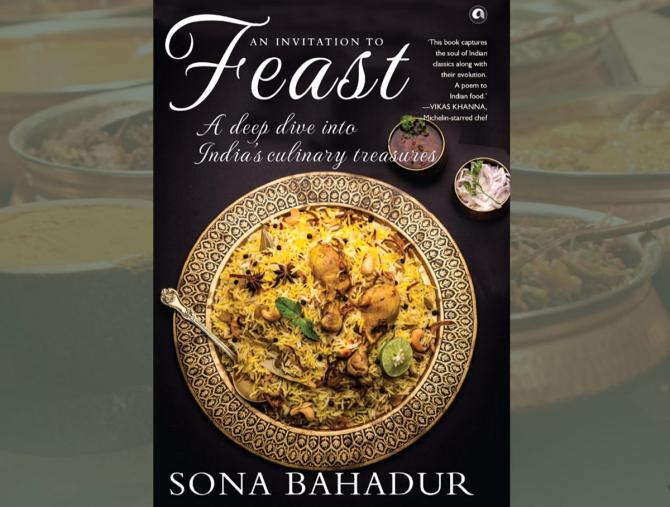
Excerpted and published from An Invitation To Feast, by Sona Bahadur, with the kind permission of the publishers, Aleph Book Company.










 © 2025