

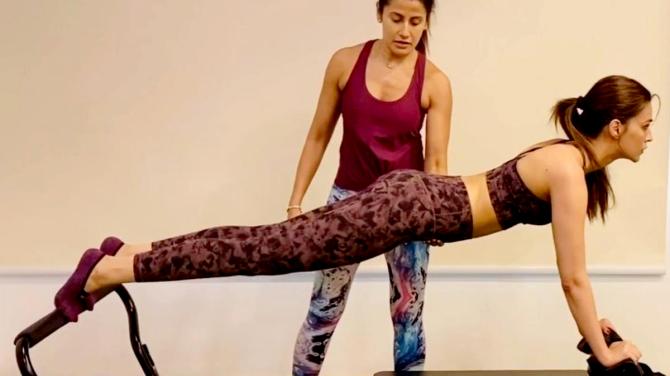
We are all aware that exercise and movement is good for health.
But can exercise and physiotherapy help reduce blood pressure or lower back pain?
Whether you are stressed, leading a sedentary lifestyle or recovering from an illness or injury, the right exercise and guidance can help you stay fit and flexible.
rediffGURU Dr Shakeeb Ahmed Khan, a senior consultant physiotherapist with over 12 years of experience specialising in orthopaedic and paediatric physiotherapy, suggests exercises and routines that will help you recover from pain and injury.
- You can post your health-related questions to rediffGURU Dr Shakeeb Ahmed Khan HERE.
Anonymous: Can physiotherapy help reduce high blood pressure?
I am a 28-year-old male. I am physically active. I exercise regularly, do cardio workouts and strength training several times a week, and I even follow a balanced diet.
Recently, my doctor diagnosed me with high blood pressure, and I've been prescribed medication to control it.
I want to know if physiotherapy can help lower or better manage my blood pressure naturally.
Thank you for your query. Yes, physiotherapy can definitely support you in lowering and better managing your blood pressure, especially when people are committed to active lifestyle.
Please visit a physiotherapist who specialises or have good experience in cardiorespiratory care can help with your current workout routine so that you are getting the maximum blood pressure lowering benefit without unintentionally pushing it up, which can sometimes happen with heavy isometric or poorly balanced training.
They can guide you in adjusting the ratio of cardio to strength work, progressing your sessions safely, and even adding techniques like deep diaphragmatic breathing and paced breathing exercises, which calm the nervous system and lower blood pressure naturally.
It is very important to remember that your medication is there for a reason. At this stage, you should not stop or reduce it on your own, no matter how disciplined you are with your workouts and diet. The role of physiotherapy and lifestyle interventions is to complement your treatment, not replace it.
Over time, as your blood pressure improves and remains stable, your doctor may consider reducing your medication, but that decision has to come from careful medical monitoring.
In short, physiotherapy can absolutely play a role in helping you move toward healthier blood pressure levels, but it should work hand in hand with your medical treatment rather than being seen as a substitute.
I wish you a healthy and active life.
Anonymous: After a major orthopedic surgery such as total knee replacement, ACL reconstruction, or rotator cuff repair what does a complete physical therapy program typically involve? How is the therapy structured across the different phases of recovery, and what role do passive exercises, manual therapy, and progressive strengthening play in regaining full function? What factors determine how long someone needs to continue therapy?
Thank you for query. After a major orthopedic surgery a complete physical therapy involve assessment which helps to determine range of motion , strength of each muscle and group of muscle, understand client queries, complain and based on their expectation determine short term and long term goals.
Passive exercises help to achieve range of motion when a person cannot do actively due to injury or weakness. Manual therapy focuses on ensuring joint mobility and tissue flexibility.
Similarly progressive strengthening helps to increase strength gradually that will help to achieve full range of motion against resistance.
Many factors determine how long someone needs to continue therapy which are achievement of goals, ability to do functional movement for activities of daily living independently.
Beyond these factors if therapy services are accessible, and affordable you can continue.
Anonymous: Hi Dr I am a working professional, 32, female. I have a busy schedule.
I spend long hours sitting at my desk and have recently started experiencing sciatica pain that radiates from my lower back down to my leg.
The pain is affecting both my work and personal life, and I'm finding it hard to stay active.
Can you recommend some exercises for me?
Thank you for reaching out to me. I am sorry to hear that you're struggling with sciatica.
It can be challenging to concentrate on work especially if you spend long hours sitting at work.
The best step you can take is to see a physiotherapist, since they can figure out the exact cause of your pain and create a treatment plan tailored for you.
In the meantime, you can do these:
- Try to avoid sitting for long stretches.
- Stand up or move around every 20 to 30 minutes.
- Make sure your chair supports your lower back.
Simple exercises like lying on your stomach, gentle back extensions, bridging, and bird-dog can help relieve pressure and strengthen your core and glutes, but stop right away if anything makes your leg pain worse.
Hamstring stretches, piriformis and gluteal stretch along with nerve glides may also help keep the sciatic nerve moving freely.
Pay close attention to your posture and avoid heavy lifting or twisting, since those can aggravate your symptoms.
With the right mix of professional treatment, small daily adjustments, and regular exercises, you’ll be able to manage this condition well. I wish you quick recovery.
- You can post your health-related questions to rediffGURU Dr Shakeeb Ahmed Khan HERE.
Disclaimer: All content and media herein is written and published online for informational purposes only. It is not a substitute for professional medical advice. It should not be relied on as your only source for advice.
Please always seek the guidance of your doctor or a qualified health professional with any questions you may have regarding your health or a medical condition. Do not ever disregard the advice of a medical professional, or delay in seeking it because of something you have read herein.
If you believe you may have a medical or mental health emergency, please call your doctor, go to the nearest hospital, or call emergency services or emergency helplines immediately. If you choose to rely on any information provided herein, you do so solely at your own risk.
Opinions expressed herein cannot necessarily provide advice to fit the exact specifics of the issues of the person requesting advice.










 © 2026