

Chip giant Nvidia's Jensen Huang questions the dominance of degrees in the AI economy.
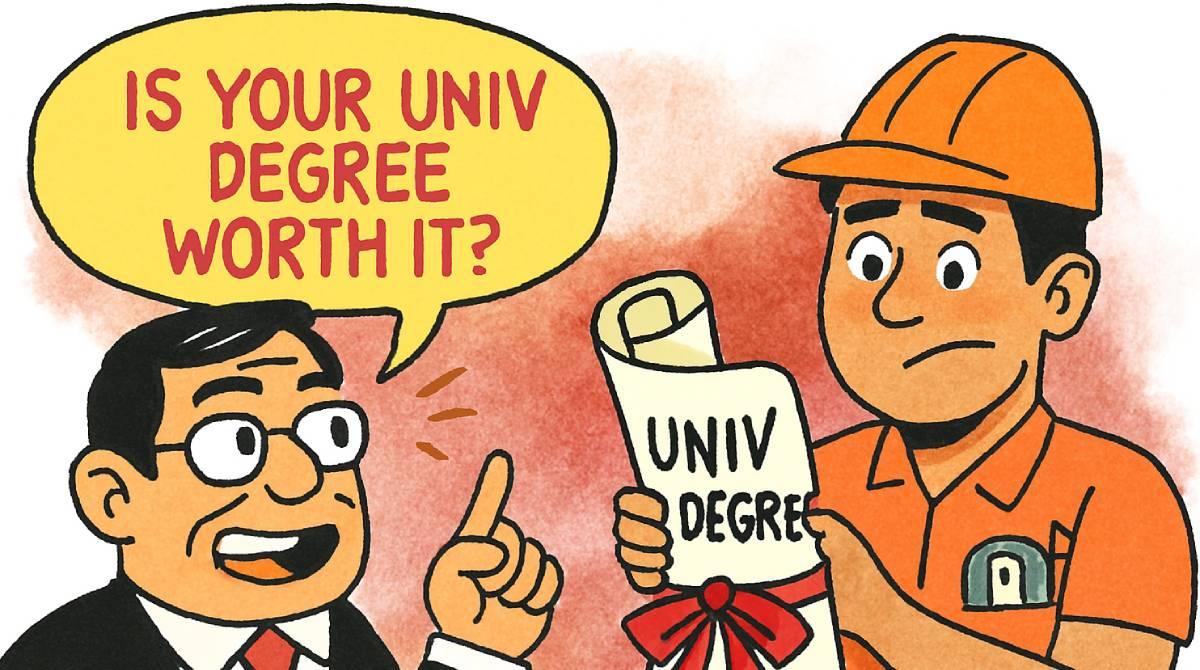
Nvidia CEO Jensen Huang has challenged long-held beliefs about education, suggesting that skilled trades such as electricians and mechanics may be more valuable than traditional university degrees in the artificial intelligence era.
Trades on the rise
Huang urged young people to rethink conventional career paths as the global economy shifts under the weight of AI.
'If you're an electrician, you're a plumber, a carpenter -- we're going to need hundreds of thousands of them to build all of these factories. The skilled craft segment of every economy is going to see a boom. You're going to have to be doubling and doubling and doubling every single year,' Huang told Channel 4 in an interview.
The comments highlight a side of the AI revolution that often goes overlooked -- the need for people to wire, cool and physically manage the huge data centres driving machine learning models.
The education debate
For decades, university degrees have been treated as the gold standard for career success. But Huang suggested that society has 'long overvalued four-year degrees while undervaluing vocational training,' according to Investopedia.
Reflecting on his own academic path, he said that if he were starting over today, he would dive more deeply into the physical sciences. 'Physics, chemistry, material science -- these are the fundamentals behind all the technologies that eventually come to life,' Huang noted.
His comments arrive amid a wider reassessment of higher education. Tech leaders such as Palantir's Alex Karp have previously argued that formal degrees are not always the best preparation for the demands of the modern workplace.
A workforce gap
As Nvidia races to meet surging demand for AI chips, the global infrastructure needed to house and run them is expanding at breakneck speed. Data centres require far more than software engineers -- electricians, HVAC technicians and skilled builders are essential.
'Tech leaders urge young people to rethink the primacy of a university degree as the industry faces major shifts,' Investopedia observed in its analysis of Huang's remarks.
Labour shortages in trades are already visible, with rising wages in sectors tied to data centre construction. Industry analysts predict escalating demand for such expertise in the coming years as hyperscale facilities multiply worldwide.
Critics caution, however, against turning the discussion into a stark choice between university and vocational training. Software engineers, data scientists and machine learning specialists remain pivotal to AI progress.
The most future-ready workers may be those who can bridge both domains -- combining technical fluency with practical, hands-on capabilities. Hybrid skill sets, economists say, are likely to command the strongest opportunities.
Nevertheless, Huang's intervention has pushed the conversation forward, encouraging governments, educators and employers to rethink the balance of their investment. Policies promoting apprenticeships, advanced vocational training, and dual-track education systems may now move closer to the centre of workforce planning.
By underscoring that the AI economy relies as much on electricians as on coders, Huang has broadened the debate on the future of work. His remarks suggest that adaptability -- not degrees alone -- will determine who thrives in the age of artificial intelligence.










 © 2026