

|
|
|
|
|
| HOME | MOVIES | BILLBOARD | |||
|
December 13, 1999
BOX OFFICE
|

'This is what really happened in Bhopal'Sonal Nerurkar
"It was an enormous tragedy, it was a shame that it happened, but we all did have a responsibility for putting a bomb in the middle of a populated place..."
'Union Carbide, USA, has not responded to summons to appear before the magistrate court of Bhopal to face criminal charges of homicide. In November, 1996, the Supreme Court reduced these charges to criminal negligence amid protests from survivors.'
As you soak in the quiet shade outside his office at Bombay's Altamount Road, a thought creeps in. There's absolutely nothing in your vicinity that brings back memories of that disastrous night in December 1984, when the leakage of MIC gas from a Union Carbide plant cost over 16,000 people their lives and many others their future. So how did the world's worst industrial disaster, one that the very same world has almost entirely forgotten, become the focus of his debut feature? "I thought it was time for me to do a full-length feature and when I was discussing it with my friend (and producer) Deepak Nayar, he came up with a few ideas," explains Mathai. "This was the one that got me." The fact that the Bhopal gas tragedy was scarcely documented and rarely remembered furthered his interest. "Nothing had ever been done about it," he says. "If you look back, December 2, 1984 (the night of the gas leak), was just a month after Indira Gandhi was assassinated." Out of the chaos that followed emerged a new prime minister -- one who symbolised hope. "Rajiv Gandhi ushered in a new era -- he was bigger than anything that had happened before." And certainly bigger than the deaths of thousands of people living in a remote village in Bhopal. "Tragedy is commonplace to our nation," Mathai explains. "People die in train crashes, earthquakes, floods, famines. Death has never been an issue." The fact that these people were poor immediately ensured they would have no voice. "If it had happened at Malabar Hill, or New Friend's Colony, I'm sure the response would've been different."
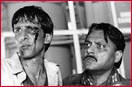
Instead, he presents Varma, Tara and Bashir, the three main protagonists whose lives are forever changed the night of the tragedy. Written by admen and brothers-in-arm, Piyush and Prasoon Pandey, the story juxtaposes the intimate relationship that Varma (Kay Kay) shares with his wife, Tara (Nethra Raghuraman), and best friend, Bashir (Naseeruddin Shah), with the death and devastation caused -- as is implicitly stated in the film -- by negligence on the part of Union Carbide. "At one level, the story is about friendship and the simplicity of life in middle-class India," explains Mathai. "At another, we're trying to show how little (or seemingly little) one's actions can impact communities in other places." Implying, obviously, Union Carbide, which as we all know, emerged relatively unscathed through the investigation. "But it is not a cry against multinationals or anything," he hastily adds. "It concentrates more on the transition of a simple young man into a man of the world." An easy enough plotline for your average Indian viewer -- because that is exactly who Mathai is targeting. "Yes, your urban viewer will club Bhopal Express with Hyderabad Blues and the like," agrees Mathai. "But I am looking at extending the film into a general viewership category." Towards this end, he has ensured the film remains "simple and straightforward story-telling, not advanced, obscure or artistic."
His choice of actors spells that out. Kay Kay, who makes an impressive debut on screen, snagged the role of Varma "after I had tested extensively." The fact that he had played Naseer's son in director Feroze Khan's theatrical venture, Mahatma v/s Gandhi, scored him a few extra points. "Bashir, Varma and Tara -- I had to get them in that order. And how they worked together was important," he explains. "As Bashir, Naseer was it. Kay Kay already had a rapport with him and, like Naseer said, he has an emotional honesty that comes through on film." Raghuraman was an interesting casting decision. Think Tara, a small town housewife (complete with sindoor, mangalsutra and coy moves) and Nethra -- tall, lissome and very much a model of the '90s -- hardly springs to mind. "But under the circumstances, she looked so real," says Mathai. "She's not experienced, but she's willing to learn. I think it turned out great." The coup of sorts was really Zeenat Aman. Casting for the role of mujra singer Zohra Bai, Mathai wanted "a one-time raving beauty who still showed signs of the same radiance." Aman fit the bill perfectly and, with a little persuasion from Mathai's producer, Nayar, agreed to a comeback cameo. "What's interesting is that she's not playing a character that she's done before," he says. "So, in a sense, she is reinventing herself."
Prasoon put an end to the dilemma. "He said to me, 'You've been shooting your own films for over the past four years now. Why put an end to that balance?'" That convinced Mathai. "I think through the camera with the viewfinder in front of me," he says. "I knew exactly when I had the shot I wanted. And given our time constraints (the film was shot in 35 days), that made a big difference." His control over the cinematography could be one reason why you never figure -- while watching the film -- that it isn't set in Bhopal. "We shot in Hyderbad, the old part of the city, which is very similar to Bhopal," explains Mathai. The decision not to shoot in Hyderabad was a conscious one, because "the episode still hangs in the midst of people there, so it would have become essential to take their opinions into consideration." Considering it wasn't a documentary, there wasn't much scope for that. Also "it's a sensitive issue, and I didn't want people to relive it." On a less personal note -- "it's easier to shoot in a cinema-friendly city like Hyderabad, which also supported the look we wanted to create." Despite the temptation to use sophisticated techniques that would impress an international audience (the film has been selected for the Berlin Film Festival), Mathai stuck to presenting the facts without any frills. "This is what really happened in Bhopal," he concludes. "Not an artist's impression. But a common man's."
RELATED FEATURES:
|
|
Do tell us what you think of this interview
|
|
|
HOME |
NEWS |
BUSINESS |
SPORTS |
MOVIES |
CHAT |
INFOTECH |
TRAVEL | MONEY
SHOPPING HOME | BOOK SHOP | MUSIC SHOP | HOTEL RESERVATIONS PERSONAL HOMEPAGES | FREE EMAIL | FEEDBACK |
|