

The ground brought sanity to the wild, soaring numbers for the batters in the series. The wicket had grass, and it made the batters struggle.

Is this London of 2025, or is this Jalandhar of 1983? Manchester or Multan? Has the space-time fabric unravelled and placed Multan of the 1980s in the Manchester of now?
Is this really England? Where's the sting, then? Why this mountain of runs, which seems almost embarrassing, given that this is England? 3,809 runs by India in five Tests, with eight totals of over 350 in 10 innings... 12 centuries for India in 10 innings, the joint-most in a Test series; five Indian batsmen scored over 400 runs, something that hasn't ever happened even on the most batsmen-friendly wickets, and the home conditions, of the Indian subcontinent.
With due apologies to Shubman Gill, he's not a superior batsman to Sunil Gavaskar, whose record he beat to become the top-scoring Indian captain in a series. Gill is second on this list of international captains, behind Don Bradman, who made 812 runs in nine innings against England in 1936/1937.
It must be said, again with apologies to Gill, that he's no Bradman -- or Gary Sobers or Graham Gooch or David Gower or Greg Chappell, who are below him in the list of top-scoring captains in a series.
The flat pitches in England have upended the logic of number and created lopsided recordography. How is it a new record, and comparable to the numbers from the past, if runs are scored in smaller grounds, on flatter pitches --- or if sixes are struck off the edge of the bat, something that never, ever happened as recently as three decades ago? It makes sense, then, to have decadal rather than timeless records or readjusted records.
The evolution of the records in the javelin throw is instructive -- in the 1980s, the record for the farthest javelin throw was held by Uwe Hohn at 104.80 metres among men, and Petra Felke (80 metres) among women. The current records are 98.48m by Jan Zelezny among men and 72.28m by Barbora Spotakova among women.
How did the records recede? What happened? Well, the records were reset in April 1986, when new javelin designs were standardised --- and the new javelins flew shorter distances than the old ones.
Such an adjustment won't happen in cricket, of course --- it's just not possible, even if there were the will to do so, for there are far too many variables in the sport.

As for the batting records in the current series, there are more that are incomparable with the past. India hit 470 boundaries in the five Tests (422 fours and 48 sixes), the most by any team in a Test series, breaking Australia's record of 460 (451 fours and nine sixes) in the 1993 Ashes series.
Gill, K L Rahul and Ravindra Jadeja scored over 500 runs --- only the second instance of three batters from one team aggregating over 500 runs in a series.
Thank god for The Oval, then --- the ground brought sanity to the wild, soaring numbers for the batters in the series. The wicket had grass, and it made the batters struggle.
Only three half-centuries were recorded in the first two innings. In the third innings, Yashasvi Jaiswal bludgeoned and blundered his way to 118, dropped four times by England's cold-handed fielders. Three other half-centuries were scored in the innings --- they were made possible as much by the pitch easing down as by the scattergun, error-prone England pacers who didn't bowl to their fields, and by butter-fingered fielders.
England, under Captain Ben Stokes and Coach Brendon McCullum, have simplified the game, often at the cost of nuances --- the pitches are very flat at home, and the batsmen are licensed to play wildly from the word go. This has won them matches in a higher proportion than ever before, and made Stokes the greatest England captain in the eyes of many.
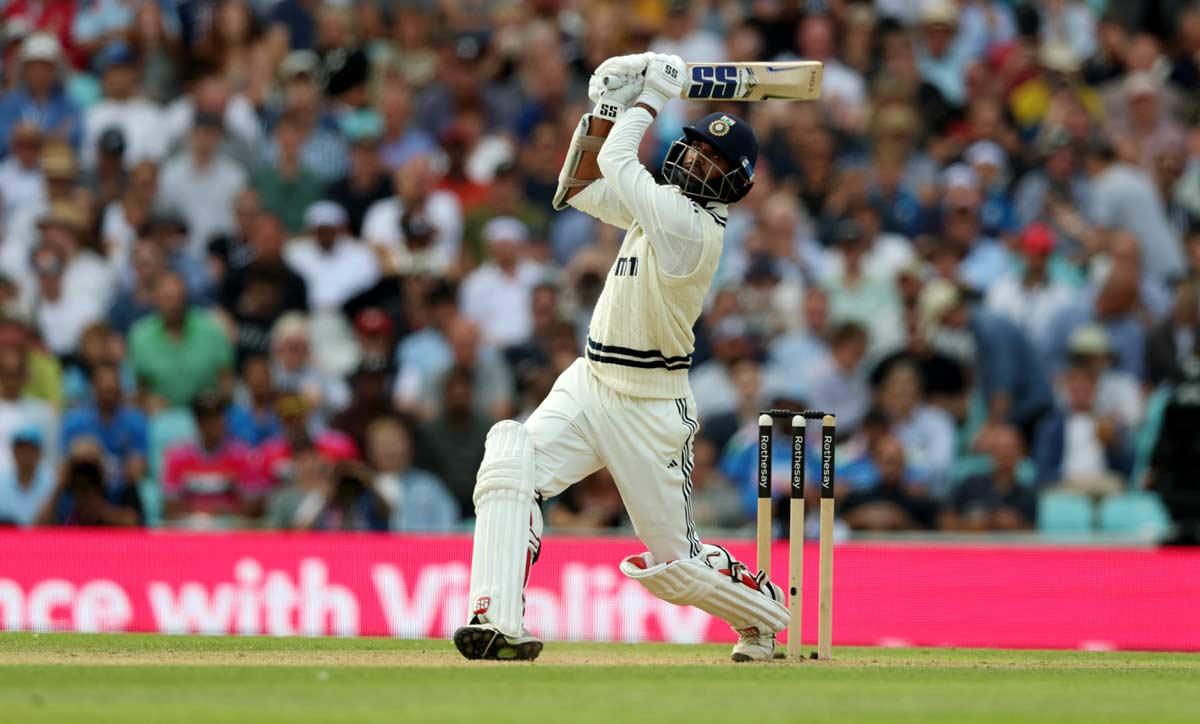
Day 4 of The Oval Test is also likely to be the last --- either England will smash their way to 374, or they would subside, routed by India's pace bowlers.
Either way, it took the final few days of the Test series to show to the world that a green, juicy pitch can produce more thrills than flat tracks on which everyone fancied getting a large score.











 © 2026