

Ian Bishop and Abhinav Mukund question the legality of Jason Holder’s catch to dismiss Rajat Patidar, saying there was enough evidence to rule it not out.

Key Points
- Ian Bishop questioned the legality of Jason Holder’s catch to dismiss Rajat Patidar.
- Bishop felt the sliding motion and lack of full body control raised doubts about whether the catch was clean.
- He argued there was “sufficient evidence” to consider the decision as not out.
- Virat Kohli and the Royal Challengers Bengaluru camp visibly protested the decision.
The debate lingered long after the moment had passed.
When Rajat Patidar walked off, the game shifted, but the question remained. Had Jason Holder really completed that catch?
For Ian Bishop, the answer wasn’t so straightforward.
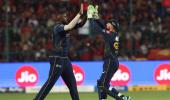
During the IPL 2026 match between Gujarat Titans and Royal Challengers Bengaluru, the incident unfolded quickly. Holder moved low, got his hands under the ball, and held on as he slid forward. But it was what came next, the subtle drag along the turf as he got up, that drew scrutiny. The Royal Challengers Bengaluru camp, with Virat Kohli at the forefront, made their feelings clear.
From 79 for 3, RCB slipped to 96 for 6. The dismissal didn’t just remove a batter, it altered the mood, the momentum, perhaps even the match.
The law itself leaves little room for interpretation: control of the ball and control of the body must both be established before the ball touches the ground. But in real time, those lines blur.
Bishop, speaking on ESPNCricinfo's TimeOut, wasn’t convinced those conditions were fully met.
'...If the ball touches the ground, to me it is not out'
'My debate on it would be: Jason Holder, first, he caught the ball, no problems with that. And then with the sliding of the hand initially, that deserved a second look. And then you talk about control of the ball, but also control of the body. So when you are looking to get yourself up having slid along the ground, are they determining that his fingers was under the ball?'
The detail, as always, lay in the mechanics. The angle of the hand. The position of the ball. The fraction of a second where control is either gained or lost.
'And so there was to me doubt there about ball and ground, because you are not in control of your body until you stop sliding and you stand up if you are going to do that. So out or not out? I think there was sufficient evidence in my mind for that to be (not out),'
For Bishop, the standard was clear and unforgiving.
'To me, that is not out because the ball should not touch the ground. If the ball touches the ground, then it clearly is not out. And there are multiple ways to get up. You are an extremely fit international athlete. You do not need your hands or a ball to get up. So that is where I stand in the whole matter,'
Former India opener Abhinav Mukund saw it the same way, leaning not on interpretation, but on what he believed was visible.
'I know there's a lot of ambiguity in the law itself. But if the ball touches the ground, to me it is not out. And what I saw, which I am sure the TV umpire did see, and a lot of viewers also saw, (was that) the ball touched the ground.'










 © 2026