

Gill had struggled for consistency in the longest format before the breakaway England series, averaging 35.05 for a tally of 1,893 runs in 32 Tests, with five centuries and seven fifties.
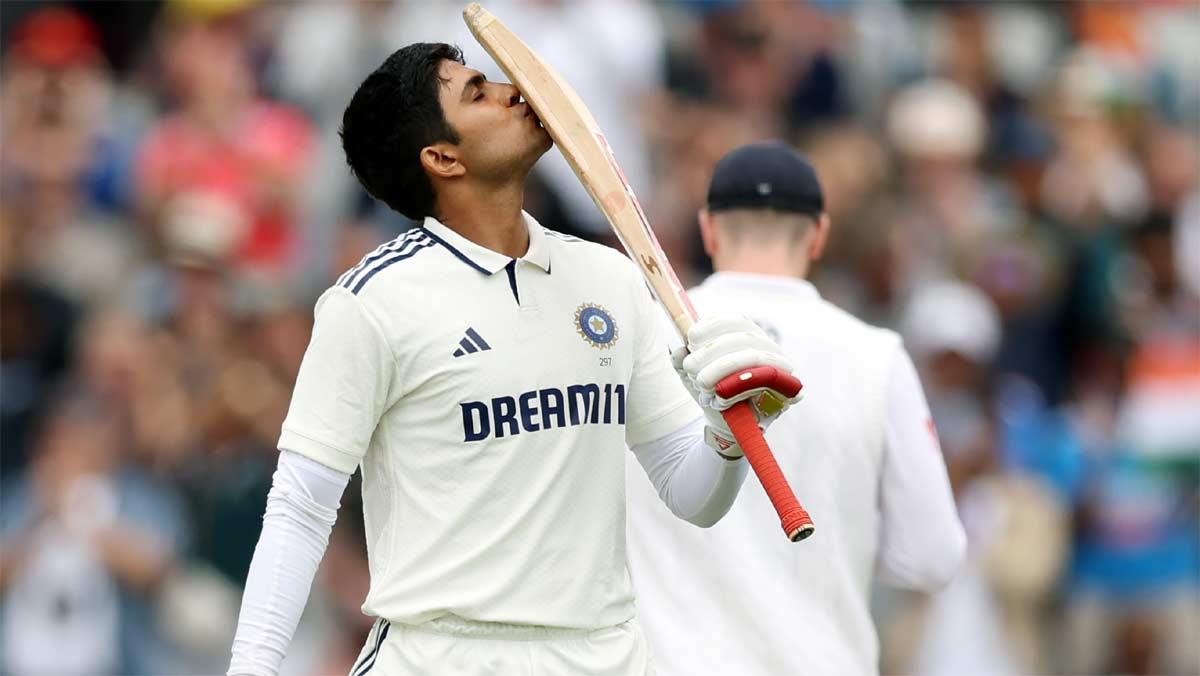
From a youth cricket prodigy to a consistent performer on the international stage, Shubman Gill’s journey has been nothing short of extraordinary.
His ability to adapt, innovate, and anchor innings has seen him cement his place across all three formats -- a rare feat in the modern era.
Ever since his Test debut in 2020, Gill has blossomed into a mainstay in the Test side. With a double century against New Zealand and crucial knocks in England on his captaincy debut, Gill has proven that he possesses the wherewithal to succeed at the highest level.
However, not so long ago, he had been heavily scrutinised for his technique and temperament in Test cricket, particularly when playing away from home.
Gill had struggled for consistency in the longest format before the breakaway England series, averaging 35.05 for a tally of 1,893 runs in 32 Tests, with five centuries and seven fifties.
He had been found guilty of playing with hard hands on multiple occasions. His defensive technique too had been questioned.
However, showing an insatiable hunger to learn and succeed, he turned to senior players and former greats for insights, embodying the ethos of a student of the game.
In an interaction with the JioHotStar, the 26-year-old stylish right-hander has revealed how he refined his skills to overcome certain weaknesses and equipped himself to adapt to new challenges.
"There was pressure of not doing well outside India. But I was feeling very confident in terms of my practice, mentally, and what positions I was getting into. I spoke to Sachin Sir and also took the phone number of Steve Smith from Matthew Wade. Both said the same thing: defend straight and score square,” he said.
Heeding their advice, Gill tweaked his techniques -- especially his tendency to transfer weight on the front foot with minimal movement, which created a gap between bat and pad, and started playing consistently with a straight bat and in the 'V'.
The tinkering allowed him to free his arms while playing through the off-side and the England series marked his resurgence in overseas conditions.
There was plenty of speculation over India's new No 4 following the retirement of Virat Kohli, but Gill put all those doubts to rest with a dream run with the bat in England under challenging conditions.
He finished the five-match series as the highest run-getter with a tally of 754 runs.
Gill began with a century at Headingley, followed by twin hundreds in Edgbaston, and another in the Manchester Test, bouncing back strongly after a quiet outing at Lord’s.
He equalled the records set by batting greats Sir Donald Bradman, who as Australia captain scored four centuries against India in a home series 1947-48 and Sunil Gavaskar, who as India skipper hit centuries at home against West Indies in 1978-79.
He also became the third Indian to score four centuries in a series after Gavaskar, who achieved the feat twice -- both times against West Indies in 1971 and 1978-79, while Virat Kohli hit four hundreds in Australia in 2014-15.
Gill's rise stands as a testament to perseverance and self-belief, proving that form may be temporary, but class -- honed through discipline -- is permanent!











 © 2026