

The 2026 T20 World Cup is already turning out to be a headline grabber even before the tournament has kicked off, but for all the wrong reasons.
In a historic first, Bangladesh were excluded from the T20 World Cup starting on February 7 following their refusal to play their matches in India citing security concerns.
The International Cricket Council replaced Bangladesh with Scotland, saying the 'difficult decision' was taken since it was not feasible to meet the Bangladesh Cricket Board's request to shift their matches to Sri Lanka so close to the tournament.
This marks the first time that a team has been pulled out of a World Cup tournament. However, shocking incidents have marred previous World Cups, mostly the 50 overs event, like teams forfeiting matches by refusing to travel to a particular country or the shocking death of Pakistan coach Bob Woolmer during the 2007 ODI World Cup, Shane Warne's controversial withdrawal from the 2003 World Cup after testing positive for drugs, and crowd trouble forcing the 1996 World Cup semi-final to be abandoned at the Eden Gardens in Kolkata.
Australia, West Indies forfeit 1996 World Cup games in Sri Lanka
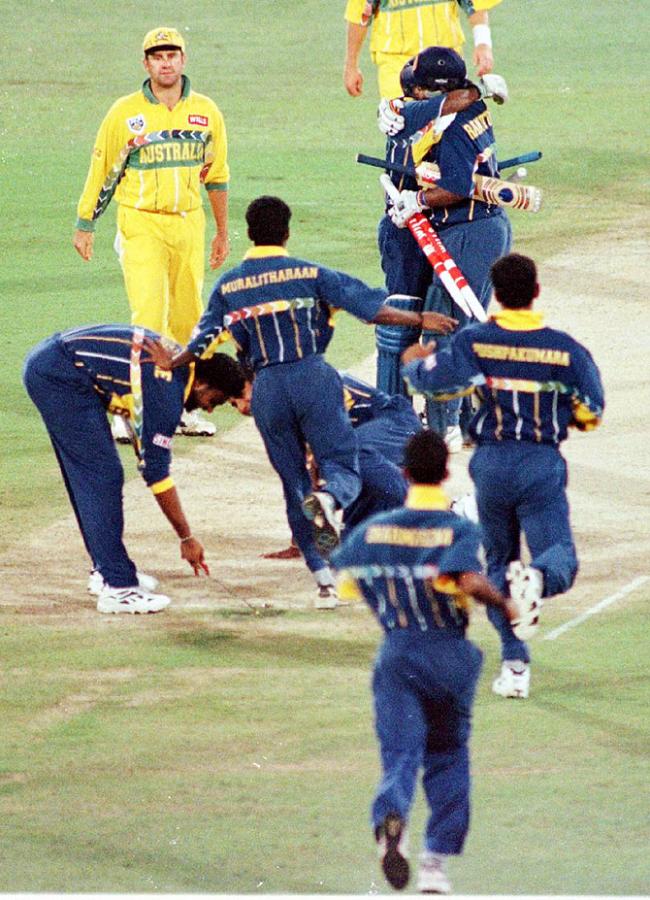
Both Australia and the West Indies did not travel to Sri Lanka because of security concerns following a suicide bombing at the Central Bank in Colombo.
Hosts Sri Lanka were adjudged winners in both games by a walkover.
One Sri Lankan politician responded by branding the Australian players 'cowards'.
Arjuna Ranatunga's Sri Lanka went on to create history in Lahore as they stunned Steve Waugh-led Australia by seven wickets in the final to win their first ever World Cup.
England, New Zealand forfeit 2003 World Cup matches
The 2003 World Cup saw a couple of matches forfeited when England and New Zealand pulled out.
England forfeited their match against Zimbabwe in Harare citing security concerns. The England and Wales Cricket Board's request to switch the game to South Africa was rejected by the ICC.
The British government was not in favour of England playing their World Cup match in Harare, fearing it could signal support for then Zimbabwe president Robert Mugabe.
The forfeit proved costly for England as they failed to advance to the Super Six stage.
A few days later, New Zealand also repeated the act by forfeiting their match against Kenya in Nairobi.
New Zealand Cricket announced that the Kiwi cricketers would not travel to Nairobi stating that 'the risk to player safety and security remains too high'.
Kenya benefitted greatly from that decision as they not only advanced to the Super Sixes stage but also became the first non-Test nation to advance to the World Cup semis.
Andy Flower, Henry Olonga's black armband protest
Zimbabwe players Andy Flower and Henry Olonga became major talking points during the 2003 World Cup when they wore black armbands throughout the tournament as a mark of protest against Robert Mugabe's repressive regime.
They also signed a powerful statement condemning the 'death of democracy' and the worsening conditions in their strife-torn country.
Andy and Henry escaped punishment despite Zimbabwe urging the ICC to take action against the duo.
The Zimbabwe Cricket Union referred the matter to the ICC's Technical Committee seeking the players to be punished under the ICC's Code of Conduct but the six-member committee chaired by then ICC CEO Malcolm Speed did not find evidence 'to warrant a charge being laid against the two players.'
Olonga, the first black cricketer to play for Zimbabwe, was dropped for the match against India and only played for his country once after that, but Flower continued to be picked for Zimbabwe.
Pakistan Coach Bob Woolmer found dead during 2007 World Cup
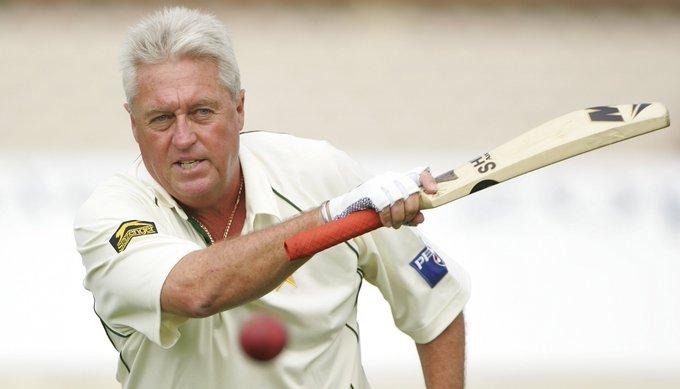
A day after Pakistan's early exit from the 2007 World Cup following a shock defeat to Ireland, their head coach Bob Woolmer was found dead in mysterious circumstances in his hotel room in Jamaica.
The Jamaican police, acting on autopsy findings, initially said Woolmer was strangled and launched a murder investigation.
The announcement touched off frenzied media speculation that Woolmer, 58, might have been killed by gamblers, match-fixers or disgruntled players.
Following months of investigation, the Jamaica police said Woolmer was not murdered but had died of natural causes.
Crowd trouble mars 1996 World Cup semis

The 1996 World Cup semi-final at the Eden Gardens was one of the darkest days in Indian cricket's history.
Sri Lanka outclassed India in the first semi-final, leaving a packed Eden Gardens stunned. Chasing a total of 251 for 8, the hosts slumped to 120 for 8 in the 35th over following which the fans inside the stadium started throwing bottles and set fire in the stands using newspapers.
The players left the field for 20 minutes hoping that the crowd would cool off. However, when the players returned for play, more bottles were thrown on to the field, forcing Match Referee Clive Lloyd to award the match to Sri Lanka.
The poignant images of Vinod Kambli leaving the ground in tears are still etched in the memory of Indian cricket fans.
Shane Warne's drug scandal ahead of 2003 World Cup

The great Shane Warne sent shockwaves ahead of the 2003 World Cup by announcing that he was pulling of the tournament after testing positive for a banned diuretic used to treat his injured shoulder.
The shock announcement came shortly before Australia played against Pakistan in its first match at the Wanderers in Johannesburg.
The banned substance had been found by the Australia Cricket Board as part of a routine test.
Australian television reported that Warne took diuretic, a masking agent, while receiving treatment on his shoulder.
'I was shocked and devastated when the findings were revealed to me last night. I was shocked because I've never taken performance-enhancing drugs. I am proud to be in the shape I'm now but that's nothing to do with drugs. It's all due to my own hard work,' Warne said.
Duckworth-Lewis stuns South Africa in 1992 and 2003 World Cups
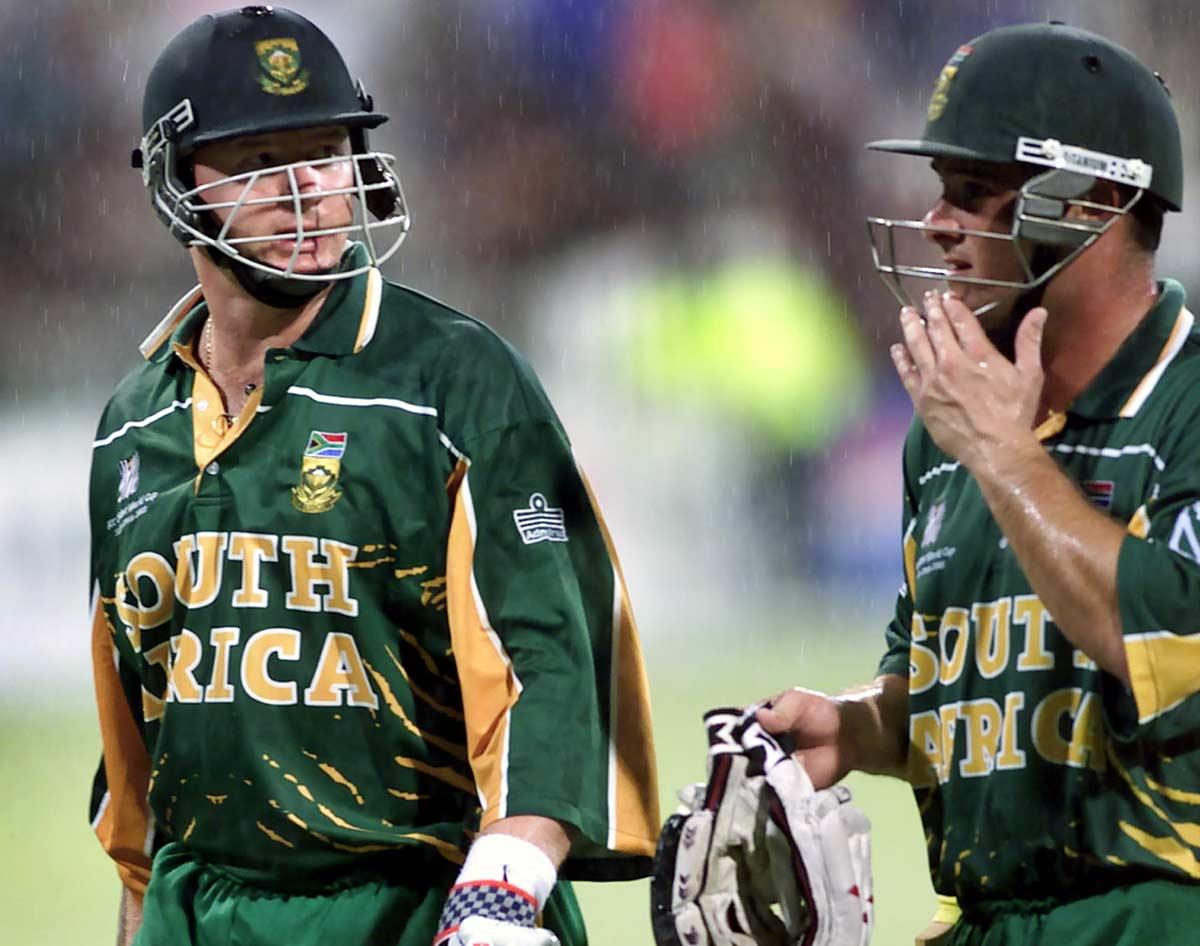
South Africa got the rough end of the Duckworth-Lewis system used in rain-affected World Cup matches -- twice.
Reinstated in international cricket after 22 years of exile, South Africa had everything going for them in the 1992 World Cup.
However, in the semi-final against England in Sydney, the weather proved to be a big turning point.
South Africa looked on course for victory with 22 needed from the last 13 balls before a rain interruption saw the target revised to 22 from just one ball.
South Africa then blundered with the Duckworth-Lewis method once again in the 2003 World Cup, which resulted in their shock first-round exit from the tournament.
South Africa tied their final rain-affected match against Sri Lanka in Durban to be knocked out of the World Cup.
They were still well-placed when heavy rain cut short the game. South Africa, on 229 for six, were one run short of the score required for victory under the DLS scoring system for rain-affected run chases.
Mark Boucher hit what proved to be the penultimate ball of the match for six to take the score to 229, then defended the final delivery of the 45th over before the umpires called off the match.
Some commentators pointed out that South Africa had failed to realise that the Duckworth-Lewis over-by-over tables show what is needed to tie a game, not win it.
England win first ever World Cup title in controversial circumstances
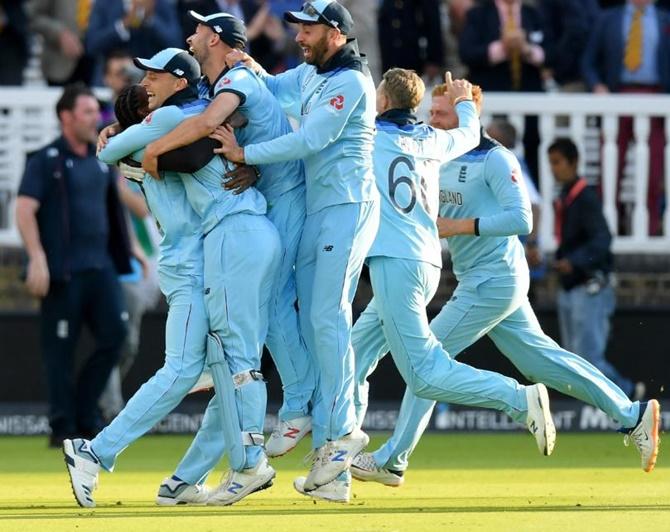
England won the 2019 World Cup final against New Zealand in bizarre fashion, as they were declared the winners on the boundary countback rule after the match and the Super Over both ended tied.
New Zealand needed two off the last ball of Jofra Archer's over but Martin Guptill was run out coming back for the second run, and England triumphed due to hitting more boundaries on the day.
Both England and New Zealand had finished on 241 in their 50 overs. Similarly, in the super over, both managed to score 15 runs.
Another controversial moment in the thrilling final was the last-over overthrow that went for a four after getting a deflection off Ben Stokes' bat, helping England take the match into the Super Over.
The throw from Guptill from deep midwicket struck Stokes' bat and deflected behind the wickets for a boundary. England were awarded six overthrows -- four for the resulting boundary and two for the batsmen's accrued runs.
Never before had a World Cup final been decided on the boundary count rule, by the margin of 26-17 in England's favour.
England became only the second team, after Pakistan, to win a World Cup despite losing three matches in the tournament.








 © 2026