

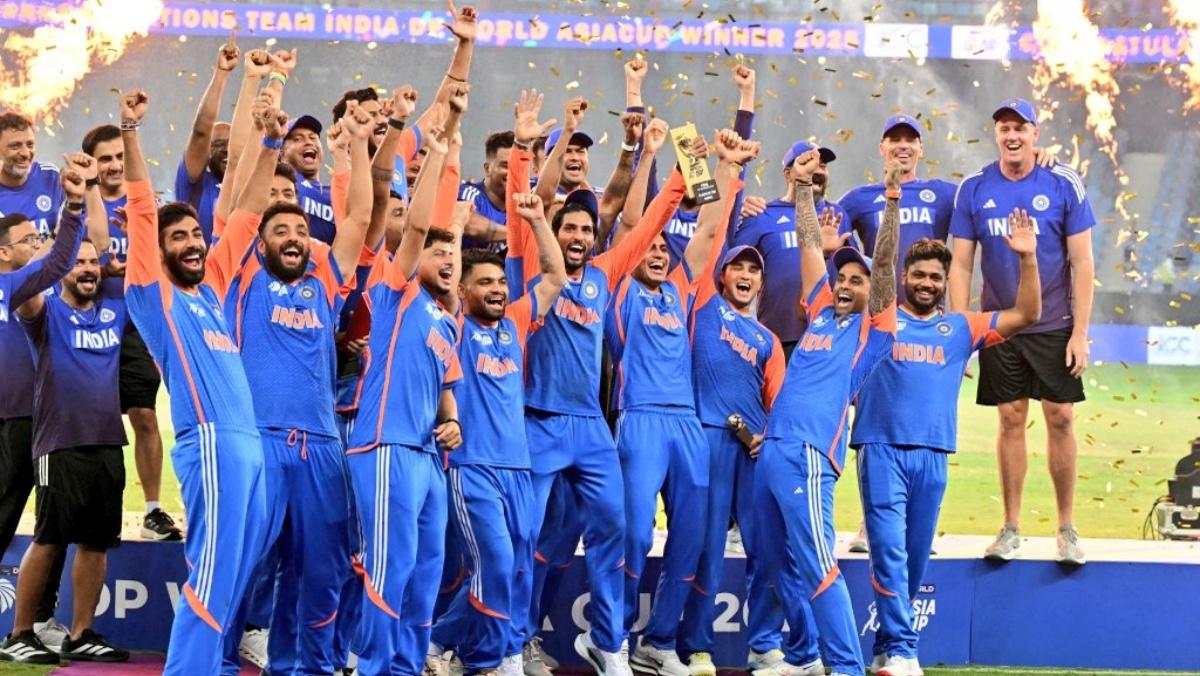
Expect the unexpected at an India-Pakistan cricket match, but what unfolded at the Dubai international stadium after the Asia Cup 2025 final defied even the wildest imagination.
In a sport where victorious teams traditionally rush to lift gleaming trophies above their heads, India's players celebrated with empty hands, making cricket history for all the wrong reasons.
For the first time ever, a winning team refused to collect their trophy at the presentation ceremony, creating a moment that went beyond sport and became a political statement.
The drama began long before the final delivery was bowled. Asia Cup 2025 had been simmering with tension from the very first India-Pakistan encounter, and by the time the final arrived, the animosity had reached boiling point.
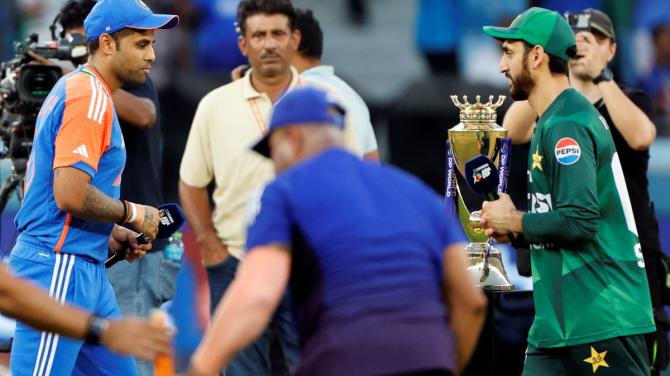
Breaking from tradition, Pakistan Captain Salman Agha conducted the pre-match trophy photoshoot alone, rather than alongside his Indian counterpart.
The unconventional arrangements didn't stop there. Even the simple act of conducting the toss interview required an extraordinary solution for the first time ever, two presenters were deployed.
Ravi Shastri interviewed Suryakumar Yadav while Waqar Younis spoke to Salman Ali Agha after the Pakistan Cricket Board refused to have their captain speak to Shastri.
When India sealed their victory, what should have been a routine celebration turned into one of cricket's most bizarre scenes.
The triumphant team made their way to the podium, celebrating enthusiastically with their fans, but the trophy was conspicuously absent from their hands.
The Indian players had taken an unprecedented decision: They would not collect the Asia Cup trophy from Pakistan Cricket Board Chairman Mohsin Naqvi, who also serves as the Asian Cricket Council president. He is also Pakistan's interior minister.
The presentation ceremony, delayed by over an hour, became a surreal affair. Fans had already begun leaving the stadium when the ceremony finally commenced.
The Indian team initially refused to share the stage with Naqvi, and at one point, sources suggest they threatened to lodge a formal protest if he insisted on presenting the trophy to them.
An Asian Cricket Council official was seen discreetly removing the trophy from the field of play.
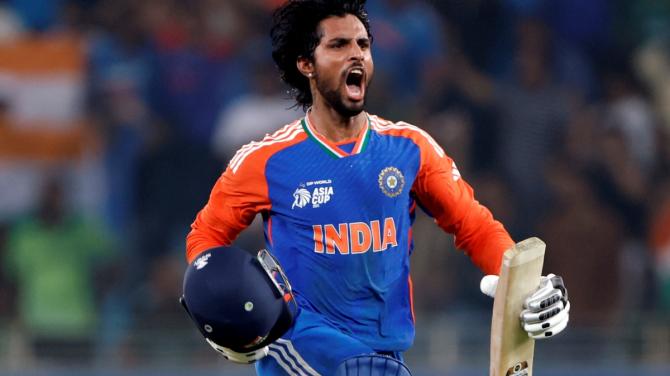
The compromise that followed was as awkward as it was telling. Only individual award winners Tilak Varma and Abhishek Sharma appeared on stage to collect their personal accolades from other dignitaries, not from Naqvi. The two younger players looked visibly uncomfortable on the dais, their moment of triumph overshadowed by the political undercurrents.
The atmosphere grew increasingly hostile as the ceremony progressed. The few fans remaining in the stadium made their feelings clear, booing loudly as Salman Ali Agha attempted to speak during his post-match interview.
The jeering continued as the Pakistani players emerged one by one to collect their runners-up medals, creating an uncomfortable spectacle that highlighted just how charged the atmosphere had become.
For these youngsters on both sides, what should have been career-defining moments were tainted by circumstances beyond their control.
Only after Naqvi had left the stage did the Indian team return to the dais. The victory song rang out, and the players posed for photographs. Yet the silverware they had fought so hard to win remained absent from their celebration.
Having marked their triumph in their own unique way, India left the stadium without the trophy they had rightfully earned.
The Board of Control for Cricket in India wasted no time in making their own statement. In an emphatic social media post, they wrote: '3 blows. 0 response. Asia Cup Champions. Message delivered'.
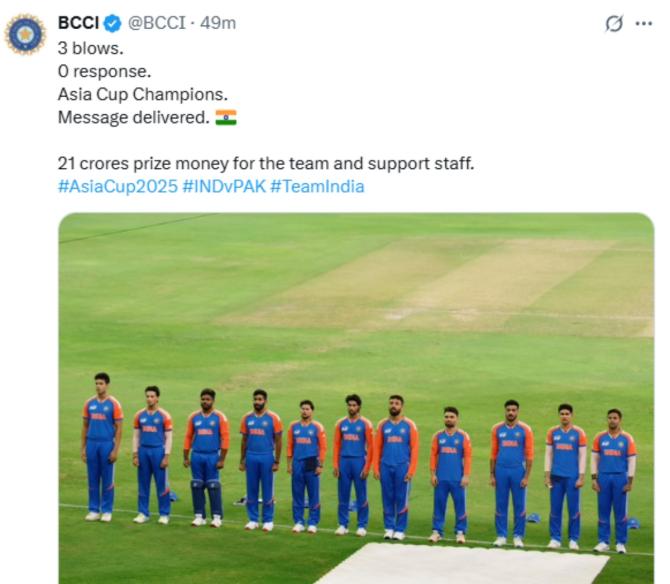
The Indian team and support staff were announced to receive a massive Rs 21 crore (Rs 210 million/$2,368,375) prize money. By contrast, Pakistan collected a prize purse of $150,000.
The real statement came from the nation's leadership. Prime Minister Narendra Modi chose to celebrate India's triumph not with a simple congratulation, but with a starkly political metaphor, immediately elevating the sporting win into a geopolitical statement: 'Operation Sindoor on the games field. The outcome is the same -- India wins! Congrats to our cricketers.'
But what exactly did Team India achieve through this dramatic gesture?
Critics were quick to point out the glaring contradiction: If the BCCI and Indian team felt so strongly about their principles, why participate in the Asia Cup at all?
The timing of the BCCI's social media post also raised eyebrows. Was this aggressive messaging an attempt at damage control after facing criticism for agreeing to play Pakistan in the Asia Cup in the first place?
Under fire for playing the tournament, the Board's 'message delivered' statement appeared to be domestic public relations rather than a sincere diplomatic stand.
Social media reactions were sharply divided. Supporters praised the team's stance: 'Huge respect for team India for doing victory celebration without a Trophy,' wrote one fan.
Others lamented the state of the game: 'We Need to Respect this Cricket Game. Cricket was once called a 'gentleman's game.' Seeing players refuse handshakes, skip presenters, and avoid receiving trophies on national grounds is heartbreaking'.
While India's players celebrated their victory with characteristic passion, their empty hands told a story that no amount of confetti or victory songs could mask.
Cricket may never be the same after Dubai 2025. The image of champions celebrating without their trophy will linger long in memory -- not as a moment of triumph, but as a reminder of how far the beautiful game has drifted from its origins.










 © 2026