
When players select themselves, the selectors' job becomes delightfully simple. But did the Indian selectors have that luxury while picking the T20 World Cup squad for the 2026 T20 World Cup? asks K R Nayar.

Choosing a winning combination -- that too for a World Cup -- from an ocean of talent is never an easy exercise.
The Indian cricket landscape today is crowded with aspirants knocking loudly on the doors of the national team, each one staking a claim and demanding attention. And when the team in question is a World Cup-winning outfit like India, the task becomes even more demanding.
The reason is obvious: A few wrong calls can send the hopes of millions of Indian cricket fans crashing down.

The loudest and most debated headline of them all has been Shubman Gill's omission.
Dropping a player of his calibre sounds harsh, almost unthinkable, but the selectors were handed a solid reason to make that tough call.
In his last 15 T20I innings, Gill managed only 291 runs. An average of 24.25 and a strike rate of 137.26, with no fifties or hundreds to his name, made the decision less emotional and more statistical.
Numbers, after all, seldom lie, and they gave the selectors enough justification to move on.
Such is the brutal competition for places in the Indian squad today that the moment consistency takes a pause, even the most gifted can be pushed to the sidelines.
Class alone is no longer a guarantee. Still, the question lingers -- should recent form have been given greater weight than Gill's undeniable pedigree?

Cricket, however, always finds a replacement. When one falters, another rises, hand firmly raised with the bat speaking louder than words.
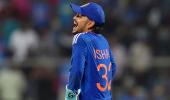
Enter Ishan Kishan. His performance in the recently concluded Syed Mushtaq Ali Trophy was nothing short of a statement.
Leading Jharkhand from the front as captain, he powered his team to the title. Kishan amassed a staggering 517 runs in just 10 innings at an average of 57.32 and a strike rate of a breathtaking 197.32.
Two half-centuries and two hundreds followed, capped by a scintillating 101 off just 49 balls in the final against Haryana. These are the fearless, breezy knocks that define modern T20 cricket.
The batting unit looks packed with intent and firepower. Abhishek Sharma, Suryakumar Yadav, Sanju Samson, Tilak Varma, Rinku Singh and Kishan all deserve their spots.
The all-rounders add balance and bite -- Hardik Pandya, Axar Patel, Shivam Dube and Washington Sundar form a group that offers flexibility, depth and match-winning potential.
So the selectors are to be applauded not for selecting the right players but for not ignoring a worthy player.

The same clarity of thought is visible in the pace department. Led by the ever-reliable Jasprit Bumrah, and ably supported by Arshdeep Singh and Harshit Rana, the fast-bowling attack looks sharp and well-rounded.
The spin choices -- Varun Chakaravarthy and Kuldeep Yadav -- come as no surprise either.
This will be a much awaited chance for Samson, who has been repeatedly been ignored, to announce to everyone that they were making a mistake of not playing him in the eleven umpteen times.

So does all this make India invincible? Not quite. The selectors have picked these players with the hope that they will deliver in clearly defined roles. But cricket has a habit of humbling even the best, wiping away form without warning -- as Gill recently discovered.
If that happens again, the selectors cannot be faulted. Even Captain Suryakumar Yadav has been entrusted with leadership not purely on recent numbers, but on experience and a rare skill capable of dismantling opposition attacks once he finds his rhythm.
The final question then looms large -- can India reclaim the world crown? The answer lies in how the team rises collectively above the equally talented units of other nations.
On paper, India looks formidable. But cricket is not played on paper but on the field.
Whether this team can translate promise into performances and outshine their rivals when it matters most remains to be seen. For now, the stage is set -- and the world waits.
Feature Presentation: Rajesh Alva/Rediff








 © 2025