

If the men of 1983 gave India a reason to dream, the women of 2025 could give it something rarer -- the courage to live that dream in full daylight, under an open sky that finally belongs to them, points out Prem Panicker.

It's a funny thing about the finals of big cricket tournaments -- they rarely showcase incandescent cricket; most of the time, the pressure of the big occasion is palpable and the play, nervy.
Today's final between India and South Africa was no different. Both sides showcased class at times and were ordinary at others, but when it comes to putting the pieces together into a perfect fit, both teamks fell short of the mark.
The difference was, India did better than SA in clutch moments, particularly in the second half of the match.
Much ink will be spilt on Shafali Varma's influential, and largely atypical, innings at the top of the order; on the masterclass in spin bowling put on by Sree Charani; Harmanpreet's stroke of genius in giving the ball to Shafali Varma at a crucial phase of the game; the class of Deepti Sharma; the electricity of India in the field.
Equally, on the way SA reined India's batters in, in the second half of the first innings; on the incandescent skill of Laura Woolvardt, the veteran playing her last World Cup and going out on the high of back to back centuries in the semis and the final -- and all that ink will be richly deserved.
But as I write this in the dying moments of the game, with Chloe Tryon just out to Deepti two deliveries after the star spinner took out Woolvardt, I kept thinking of the big picture -- of how this win is the moment when Indian women's cricket stops being "promising" and starts being powerful.
The moment when a team of women carrying the weight of decades, led by a captain who back in 2017 had first ignited the sport in India, did what Kapil Dev's men did way back in 1983 -- take a sport that belonged to someone else and make it our own.
This is the 1983 moment all over again -- only, it is sharper, louder, more inclusive. Because this time, it belongs to every girl who has ever been told that cricket isn't for her.
To every parent who has quietly worried that the ambition to play the sport is unbecoming of their daughters.
This win will, hopefully, erase the patronising vocabulary that has long surrounded the women's game -- "potential," "support," "encouragement."
That language will change; it will go from sympathy to supremacy, from "look how far they've come" to "how far can they go?" A victory like this can rewrite belief systems.
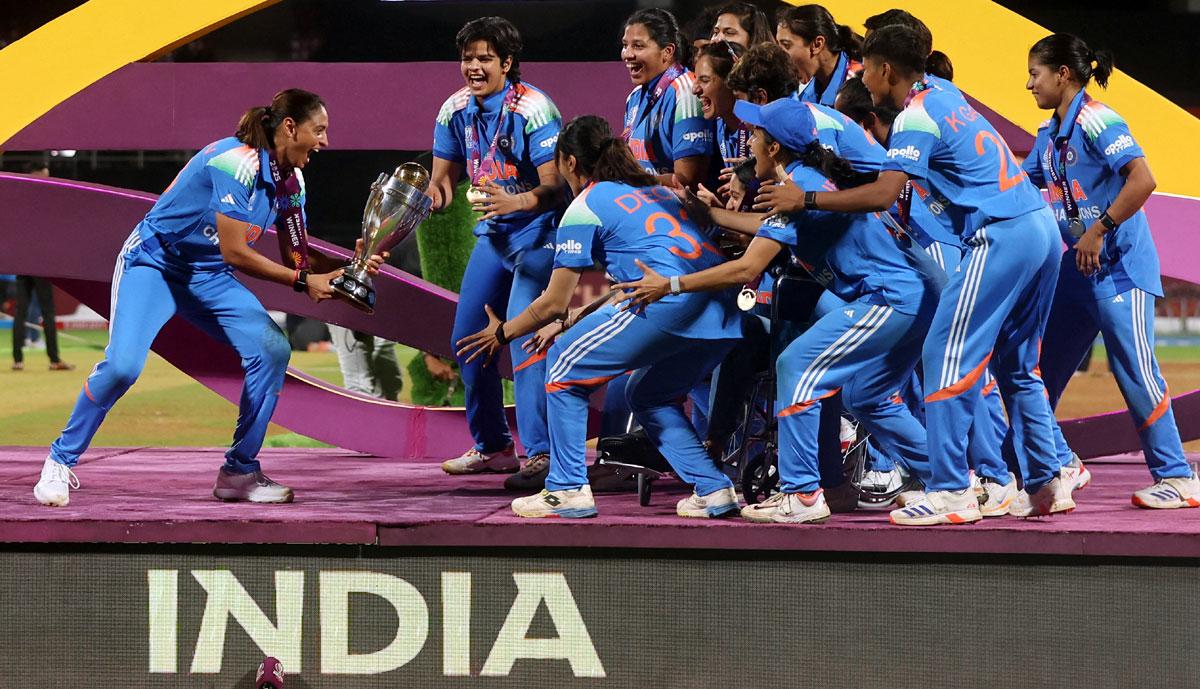
This win will spark a revolution, and it will not be in our stadiums or even on television. It will happen in the small-town maidans and schoolyards, where girls from the hinterlands will start to turn up with bats in hand and the glint of belonging in their eyes.
Victory is oxygen: Seeing someone who looks like you, sounds like you, and wins for you transforms your own notions of what is possible.
What started out as an elite hobby will become a vocation, even as what was once improbable assumes the air of the inevitable.
It will, I suspect, also lead to a cultural reset, the kind that changes how a country imagines its daughters.
India's 1983 win coincided with a new age of aspiration -- colour TVs, middle-class ambition, the first hints of a consumerist future.
This one could signal something subtler but deeper: a society learning that athletic excellence in its women is not an exception, but the new normal.
For a country still negotiating gendered boundaries, the image of a women's team lifting the biggest prize in cricket is subversive in the best possible way.
It makes women's presence in public space -- running, diving, celebrating, commanding -- utterly normal.
It tells young girls that glory can be loud, and sweaty, and unmistakably theirs for the taking.
And for their parents, the gatekeepers of what's possible, it redraws the map of respectability. Cricket no longer looks like rebellion against convention. It looks like a future.

The economic transformation will be just as profound. The Women's Premier League, which is still finding its feet, will get more backers wanting in.
Broadcasters will compete for rights and advertisers jostle for association.
Money will follow the noise, as it always does, and the BCCI and state units will find themselves compelled to build real infrastructure instead of token academies and press releases.
Equal pay, already a policy on paper, will now begin to actualise. Prize money, endorsements, and brand deals will pour in, not as gestures but as marks of respect.
These players -- Harmanpreet Kaur, Smriti Mandhana, Jemimah Rodrigues, Richa Ghosh, and their peers -- will no longer be "inspirations"; they'll be professionals whose excellence earns its market rate.
They will be stars not of women's cricket, but of Indian cricket, full stop.

Success at the top always drags the base upward. A world title will expose the fragility of the domestic structure and force reform.
The women's game needs its own Ranji Trophy, its own multi-day tournaments, its own proper calendar.
State associations will no longer be able to plead "lack of interest" when millions have just watched a final (25.3 crore [253 million] on JioHotstar halfway through the chase).
Broadcasters, too, will have to match the appetite with prime-time slots, analysis, and production that treats women's cricket as a sport in its own right and not as a filler for when the men aren't playing.
All of which is good, necessary, and overdue. But beyond the structural and financial, this would be a transformation of imagination.
A win of this magnitude would rewrite collective memory. The annals of Indian cricket -- until now dominated by 1983 and 2011 -- would find a new entry: 2025.
It will join the pantheon. For this final, many in the stadium turned up in Rohit Sharma and Virat Kohli T-shirts -- imagine a world where spectators turn up for the men's game wearing Smriti/Harman/Jemi/Shafali T-shirts.
Somewhere, far from any stadium, a ten-year-old girl will stand before a mirror, plastic bat in hand, and whisper commentary to herself.
She will not be told that cricket is a boy's game. She will not be told that ambition needs to be apologetic.
She will see, in these champions a foretaste of her own future -- confident, visible, unafraid.

That's what this World Cup could do. It could give Indian cricket -- not just women's cricket -- its next great hinge point, and Indian society its next great mirror.
If the men of 1983 gave India a reason to dream, the women of 2025 could give it something rarer -- the courage to live that dream in full daylight, under an open sky that finally belongs to them.
Feature Presentation: Aslam Hunani/Rediff











 © 2026