The Aussies vs Brian Lara
Ashwin Mahesh
It is the middle of the Australia - Windies series Down Under. Having claimed their last 12 matches in a row, the Australians are looking set to make it number 13. Despite the absence of Steve Waugh and Brett Lee, both not quite match-fit, and of Shane Warne, missing much of the season, the Aussies are expected to sweep away a West Indian side long on history and woefully short on the present.
Lacking penetration in bowling, the West Indies' lone hope lies in putting runs on the board, however, against
likes of McGrath and Gillespie. A struggling Brian Lara hasn't helped his team very much, and to make matters worse, is nursing
his own injuries. Against all sense, the West Indies play him anyway, hoping he can wave the bat to good effect, even if he cannot
run acceptably between the wickets.
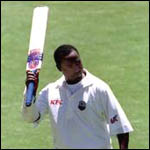 As Brian Lara posted his first Test hundred of the tour, there must have been a collective sigh from his fellow-West Indians. With their backs pressed into the wall, seemingly, every suggestion of relief must appear magnified. But for Lara himself, I would suggest, this return to form is but a modest replay from another time. The last time the superb Australian side played the fading West Indians, he turned around not merely the fortunes of a single day's play, or even the outcome of a single Test. In the knowledge of what this Australian side has accomplished since the last West Indies series, the greatness of his efforts then stand raised to the level of lore, not mere recollection.
Cricket is a team sport, and the contributions of one individual rarely transcend the whole match, let alone an entire series. But In
the early island spring of 1999, you could have been forgiven for thinking otherwise. It was Steve Waugh's first tour as Australian
captain, a position inherited without the faintest doubt, while Lara's own leadership of the West Indian side faced the axe. An
enduring Courtney Walsh climbing towards his record target offered the only meaningful support to an otherwise solo performance.
In hindsight, even that limited prop appears dwarfed by the stamp of Lara's achievements.
The first one might have passed for little more than a good innings that won the match. The West Indians had been mauled in the
first Test, limited to 218 runs in sum from two tries at the wicket, the second yielding an abysmal 51. Lara was on the mat, and on notice from his cricket board; his appointment as captain hung by the proverbial thread, with a certain severance of even this tenuous link looming. Although the bowlers were capable of holding their own, the batting, lacking both the flourish of Carl Hooper and the reliability of Shivnarine Chanderpaul, was best labeled Lara and a few others. To say that no one expected the West Indians to come back would be to overstate the obvious.
First Test Scorecard.
But therein lay the first signs of what would come. The Australians were playing with nothing to prove. They had come to the
mountain, and scaled it, in the process making it appear little more than a molehill. Whether it was lethargy born of past
successes, or even boredom with the minimal opposition they were encountering, the Aussies took to the second Test with less
than their most pressing selves. And much to their chagrin, found themselves bowled out on the first day for 256 runs. Save the
Waugh brothers and a few good heaves from Warne, they had been pushed firmly on to the backfoot.
Still, champion teams don't fade without a fight, and the Australian bowlers were equal to the task, taking out four of the West
Indians with less than 35 on the board. Brian Lara, undefeated on 7, could not have slept well, knowing that the breach in the
Australian batting wall hadn't yielded much for his team.
Perhaps that is why it happened. With nothing left to lose, Lara was playing not so much to win but for pride. Perhaps he resolved
that if he lost the captaincy, it would be in spite of his efforts, he would not remain a spectator to the passing events. Whatever it
was that fueled his fire, Lara would come back the next morning and show himself equal to the challenge at hand. Shepherding
Jimmy Adams through the game, he would put 213 runs on the board, mixing his aggression and caution well. And when all the
wickets were counted, the West Indies were ahead by many runs. Against the run, he had turned the game with his own bat.
And the Australians simply did not come back to the game. They had started out as the unquestioned champions of the game,
and despite a mediocre show with the bat the first time around, had pushed the Windies into a corner quickly. Lara's
counter-punch took the wind out of their sails too fast and too completely for them to regain the confidence they started with.
Perry, Walsh and Ambrose seized Lara's gift with both hands, and bowled out the tentative Aussies in 66 overs. Before they had
time to blink, the series had been evened.
Second Test Scorecard
A single swallow does not a summer make, they say, and the Australians took some comfort in the thought. Yes, they had
lowered their guard for the barest of moments, and Lara had played himself and his team to victory. But they were a formidable
side, were they not? And surely, it wasn't lost on anyone that without Lara's mammoth contribution to the game, they would still
have held their own fairly well against the Caribbeans. He couldn't pull that sort of innings out of his hat too many times, surely?
They would prevail, they assured themselves and all those who questioned their champion status.
And sure enough, they put 490 runs on the board when they had first crack, whaling the Windies bowling around rather at will. And
for less than a 100 runs, they had the first six opposing batsman back in the hut; Lara himself, seemingly by their prediction,
lasting a mere four overs. And even some appalling bowling later on, which let Campbell and Jacobs steady the rocking boat,
didn't take away the fact that after the first innings had been played, the Australians were 160 runs to the good. They had delivered
on their promise to wrest control.
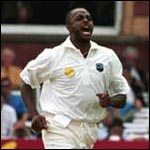 It would prove to be less than enough, however. It is a quirk of any great game that its finest moments are often crafted with a
sportsman's back to the wall, or in pursuit of a magnificent goal. And Courtney Walsh would produce such a moment now. Urged
on by the prospect of passing Kapil Dev as the game's highest wicket-taker, and already having announced his intention to
withdraw from the game soon, he sent down 17 overs of craft and pace. Together with Ricky Ponting's painfully slow scoring in the
company of tailenders, this would ensure that Australia wound up defending a total far short of what they might have hoped for.
It would prove to be less than enough, however. It is a quirk of any great game that its finest moments are often crafted with a
sportsman's back to the wall, or in pursuit of a magnificent goal. And Courtney Walsh would produce such a moment now. Urged
on by the prospect of passing Kapil Dev as the game's highest wicket-taker, and already having announced his intention to
withdraw from the game soon, he sent down 17 overs of craft and pace. Together with Ricky Ponting's painfully slow scoring in the
company of tailenders, this would ensure that Australia wound up defending a total far short of what they might have hoped for.
Still, 308 is no mean fourth-innings score to achieve, and when Carl Hooper was the fifth man gone, the score still read 105.
Australia had but one wall to climb, and they would have made good on their promise to come back on top. But Brian Lara was in
the way.
If the innings of the previous Test was an uninhibited counter-punch, this would be its ideal foil, the tenacious hold of a batsman
refusing to yield his wicket. Lara would out-Waugh his famed gritty opponent, and Adams would hang around once more to
accompany his captain. Steve Waugh would miscalculate, holding McGrath back from the attack far too long and late, and Ian
Healy would relive the memory of an earlier test in an earlier captain's first series on the job, failing to hold a crucial catch at the
death. Lara would himself score nearly half the runs needed for victory, and fittingly, walk away into the sunset with Walsh.
Third Test Scorecard
He wasn't done either; come the fourth Test and he would throw his bat at the attack in a display of such aggression that it
seemed only a few minutes after he had arrived, he was walking back to the pavilion, and yet he had a hundred runs to his name
on the board. The third hundred wasn't about his genius or his endurance, it was simply his talent; he would show himself capable
of the superlative, to be able to elevate his game so high above the opposition that it seemed natural for the opponents to give him
his hundred just so he would then go away.
But it is a team sport, and as close as Lara was to obliterating that view, all individuals - even those approaching immortality in the game - must eventually yield to the law of averages. The Australians came back in the fourth Test, and simply turned in
professional 300+ efforts at the wicket both times, while holding down their opponents to smaller totals. Walsh moved that much
closer to his cherished goal, grabbing more wickets. But it wouldn't be enough, the Aussies would prevail after all, even if not by
the margin they had imagined themselves capable of.
Fourth Test Scorecard
In the end, it was a simple enough thing. The very best team in the world, boasting an embarrassment of riches, had come
thousands of miles across the ocean to stamp their names into the annals of the game. On the verge of doing so, they had
encountered a man who had resolved that if they were to pass him, he would extract his price. True, the Australians had retained
the Frank Worrell trophy, but while Lara was out there on the field with the bat in his hand, the fans in the stands imagined that he
might yet deny the visitors. Legend, they say, is the stuff of imagination made real in front of our eyes.
Ashwin Mahesh
Mail Ashwin Mahesh


