
Ahead of the key meeting called by the steel ministry with the industry captains on Monday to discuss the impact of rising steel imports, companies have raised the issue of cheaper ‘substandard’ inflows from China, Vietnam, and South Korea, saying they are setting the benchmark for domestic prices and squeezing the profitability of Indian producers.
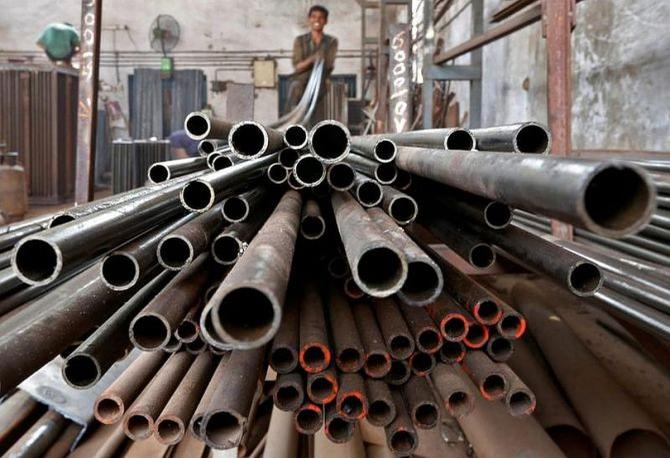
Abhyuday Jindal, managing director of Jindal Stainless, said that growing imports of ‘subsidised and substandard’ steel are creating unfair competition for Indian manufacturers.
“These imports destabilise prices and pose safety and quality risks, especially in sectors like infrastructure, automotive, food, pharma, and construction,” Jindal told Business Standard.
“India has enough capacity to meet demand, but expecting producers to match artificially low import prices is neither practical nor sustainable,” he said.
Experts say while the global oversupply accounts for most of the realisation differential, Indian producers do face structural limitations due to higher logistics costs and dependence on imported raw materials, primarily coking coal.
According to Ankit Hakhu, director, Crisil Ratings, “Declining realisations led to a dip in domestic primary steelmakers’ profitability per tonne, which fell below the decadal average in the financial year 2025.”
The average domestic flat steel prices fell by about 10 per cent year-on-year in FY25 as global oversupply and weak demand redirected surplus steel to India.
Landed import prices of Chinese hot-rolled coil (HRC) were 5-6 per cent lower than domestic prices in FY24 and FY25.
After the government imposed a 12 per cent safeguard duty in April this year, prices nearly equalised, with domestic HRC averaging Rs 52,675 per tonne in September, compared to Rs 52,207 per tonne for Chinese imports, Hakhu said.
India’s steel imports rose to a nine-year high of 4.03 million tonnes in FY25, led by South Korea (29 per cent) and China (26 per cent).
To protect primary steelmakers, a 12 per cent safeguard duty was imposed on certain flat steel from April 2025, resulting in a 40 per cent moderation in imports in YTD FY26 (till August 2025) compared to the previous year, according to Hakhu.
The Directorate General of Trade Remedies (DGTR) recommended a three-year safeguard duty with a proposed duty structure of 12 per cent, 11.5 per cent, and 11 per cent in the first, second, and third years, respectively.
The RBI’s latest bulletin released last week noted that cheaper imports are weighing on domestic production and prices despite steady demand growth in India.
Jindal said Indian producers operate under stricter labour, quality, and environmental standards, which add to production costs.
Imported material is often cheaper because of weaker standards and state support abroad.
Competing with that without diluting quality is nearly impossible, he said.
Even as large producers seek protection from low-priced imports, smaller manufacturers that depend on steel inputs are primarily focused on securing material at affordable rates.
According to Sanjay Singh, director, Jindal Steel, it is not a conflict of interest but MSMEs require input material at the best price.
“Such material is produced by large producers, who also need to remain competitive. Nevertheless, the government is facilitating the provision of input material to MSMEs at lower than market prices and has provided directions accordingly.
"Such subsidised prices are also required to be published on the steel producers’ websites,” Singh told Business Standard.
Jindal also welcomed recent government steps such as the safeguard duty and the implementation of quality control orders (QCOs) but argued that India needs to focus on long-term competitiveness.
He said the government must include chromium and molybdenum in the Critical Minerals Policy, lower logistics costs, strengthen R&D incentives, and offer compliance support to MSMEs.
He also called for a National Stainless Steel Policy to guide long-term industry growth.
He dismissed the view that restricting imports could raise costs for small manufacturers, saying that high-quality domestic material reduces lifecycle costs.
High-quality material may cost more initially, but lasts longer and reduces maintenance.
Low-grade imports often increase long-term costs and safety risks, he added.











 © 2025