

State governments have requested the Centre for export incentives, lifting of import duty in the case of cotton for the textile sector and GST exemptions.

The government of Tamil Nadu, which exported 31 per cent of its total shipments worth $52.1 billion to the US in FY25, fears massive job losses once the additional 25 per cent tariff takes effect on August 27.
The state has sought the Centre's help, as have several other states, including Andhra Pradesh.
From Uttar Pradesh to Telangana, Kerala to Rajasthan, Gujarat to Tamil Nadu, state governments are reworking their export promotion policies and exploring ways to quickly look for newer markets.
State governments have requested the Centre for export incentives, lifting of import duty in the case of cotton for the textile sector and goods and services tax (GST) exemptions.
Some have written to the Centre to look at the Brazilian model, which has announced tax deferrals and tax credits for exporters.
State governments have also consulted with exporters and other stakeholders that will suffer once the additional 25 per cent tariff --Washington's sanction on Indian goods for New Delhi's purchase of Russian oil-- comes into force.
On August 20, Andhra Pradesh Minister for Real Time Governance, Nara Lokesh, consulted with the state's marine exporters.
According to the presentation of the state's fisheries department at the meeting, shrimps from Ecuador and Thailand will be almost 40 per cent cheaper than those from India.
Shrimps from Indonesia and Vietnam will be 35.36 per cent and 9.66 per cent cheaper, respectively.
A US Food and Drug Administration team is visiting Andhra Pradesh to inspect hatcheries, processing plants, and ponds.
The government will try to explain to the team that the quality of Indian shrimp meets US quality standards, and about the need to revise tariffs.
Currently, of the 600,000 acres of total aquaculture in Andhra Pradesh, 250,000 acres are under shrimp culture.
The impact of tariffs will be on the entire seafood value chain and could lead to severe financial distress among over 450 shrimp hatcheries, 50 feed mills, 300,000 farms, over 300 processing, pre-processing, and peeling units, 260,000 fishing boats, trawlers, and other vessels, 2.78 million fishermen, and over 3 million individuals on indirect employment across the ecosystem.
When the initial 25 per cent tariff kicked in, the Andhra government set up an aquaculture advisory committee on April 9 to address sector challenges, including tariff impacts.
The steps taken included feed manufacturers announcing a Rs 4 per kg price cut from April 19 to ease farmers' input costs.
In its report, the committee has also sought removal of 5 per cent GST on packaged shrimp, soft loans to exporters for cash flow, and waiving excise duty on diesel for trawlers, among others.
The state is also looking for new markets such as South Korea, Saudi Arabia, and Russia.
It is urging farmers to diversify into important species like seabass, silver pompano, cobia, grouper, hilsa, chanos, mullet, seaweed, and crab.
It will invest in strengthening labs, better certification, and branding with antibiotic free products.
"We are supporting aqua farmers by giving them electricity at Rs 1.50 per unit. The tariff increase will burden the aqua farmers in the state," Andhra Chief Minister N Chandrababu Naidu said recently.
Based on reports, the state's textile ecosystem may also lose around Rs 15,000 crore to Rs 20,000 crore per annum.

The Tamil Nadu government, on the other hand, has pointed out that American tariffs will hit it harder than most states.
In a letter to the PM on August 16, state Chief Minister M K Stalin said 20 per cent of India's total goods exports of $433.6 billion were to the US in FY25, and 31 per cent of Tamil Nadu's $52.1 billion goods were exported to that country.
Stalin said the tariff impact on Tamil Nadu 'will be disproportionately greater than for most other Indian states', and has significant implications for the state's manufacturing sector and employment scenario, he told Modi.
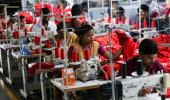
According to the Tamil Nadu government's estimate, the most affected sectors -- textiles, apparels, machinery, auto components, gems and jewellery, leather, footwear, marine products and chemicals -- are labour-intensive sectors, and any export slowdown will quickly result in mass layoffs.
Tamil Nadu accounted for 28 per cent of the country's textile exports in FY25, the largest among Indian states.
The sector employs nearly 7.5 million people, and with a 25 per cent tariff and additional 25 per cent duty on cards, an estimated 3 million jobs are at immediate risk, the state government has estimated.
Stalin, who has held consultations with the industry associations of sectors set to face losses from Trump tariffs, sought the PM's help.
'Considering the scale of the problem, a special financial relief package, including a moratorium on principal repayment, similar to the one implemented during the Covid period, is necessary to support our exporters,' he told Modi.
The US tariffs will hit Uttar Pradesh's textile, jewellery, and leather exports. In FY25, the US was UP's top export destination.
It accounted for more than Rs 35,000 crore worth of shipments. Officials said the state government was looking at newer markets and working on a new export promotion policy.
Kerala has also flagged concerns, as the US is its second-largest market for agricultural exports such as cashews, rice, vegetables, processed fruits, and cereal flours.
The state government plans to set up a body akin to the Export Promotion Council of India to help exporters diversify.
"True, the state has limitations on what it can do, but we want to work by understanding the needs and stance of the export-oriented industry sector," state Industry Minister P Rajeeve said.
Madhukar Babu, joint director (MSME), commissioner of industries, in Telangana, has said the state government will incorporate inputs of exporters in the new logistics policy that is almost ready with guidelines under development.
He urged exporters to look at markets in Africa and South America.

From Karnataka's aluminium extrusion industry to Gujarat and Rajasthan's gems & jewellery sector, there is concern of losing substantial business due to US tariffs.
They have approached the respective state governments to help facilitate exports to newer markets.
Ministers and officials in most states said they are largely helpless in the short term once the 50 per cent tariff kicks in on August 27 and Indian goods become uncompetitive in the American market.
With inputs from Shine Jacob in Chennai and Anil Sharma in Jaipur
Feature Presentation: Aslam Hunani/Rediff








 © 2026