
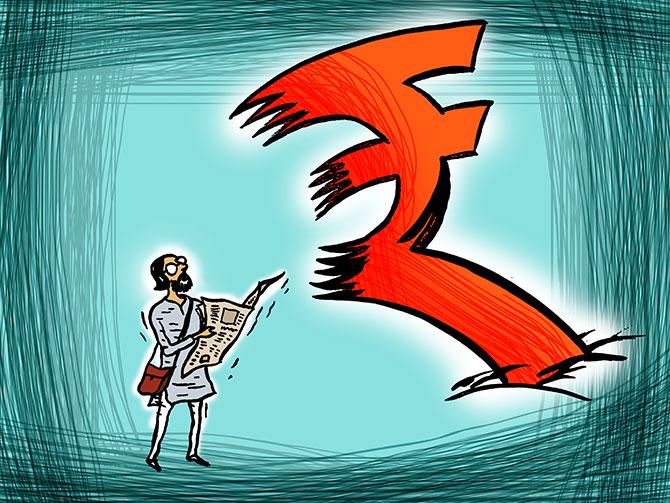
The rupee on Monday crashed to its lowest-ever level of 90.80 before settling at a new all-time low of 90.78 against the US dollar, registering a loss of 29 paise over its previous close, weighed down by uncertainty over an India-US trade deal and persistent foreign fund outflows.
Forex traders said prevailing risk-averse market sentiment, compounded by strong US dollar demand from importers, further dented investor sentiment.
At the interbank foreign exchange, the rupee opened at 90.53 against the US dollar, gained slightly to 90.51 level and then lost ground to hit a record intra-day low of 90.80, registering a 31-paise decline from its previous close.
At the end of trade on Monday, the rupee was quoted at a record low of 90.78, down 29 paise over its previous close.
On Friday, the rupee had slipped 17 paise to close at an all-time low of 90.49 against the American currency.
"The Indian rupee plunged to a record low, positioning it as the worst performer among the Asian currencies.
“Despite the better-than-expected trade balance number, the rupee was unable to find support," said Dilip Parmar, Research Analyst, HDFC Securities.
Parmar further noted, "This lack of resilience is primarily attributed to a significant demand-supply imbalance, driven by high dollar demand from importers and persistent capital outflows, which remain the biggest concerns for the currency."
"In the near term, the technical bias for the spot USD-INR pair remains bullish, with key resistance at 90.95 and support at 90.50," Parmar added.
Meanwhile, commerce secretary Rajesh Agrawal on Monday said India and the US are "very close" on the framework deal.
"We are very close on the framework deal, which we feel can be done in a short period of time.
“But I would not like to put a time period on that," he told reporters in Mumbai.
The two countries are conducting parallel negotiations -- one on a framework trade deal to address high tariffs and another on a comprehensive bilateral trade agreement (BTA).
The Indian industry and exporters are eagerly awaiting the conclusion of the negotiations and the announcement of the deal, as high import duties are hurting their shipments to America.
India and the US concluded two days of talks on Thursday, during which both sides exchanged views on trade-related issues, including the ongoing negotiations for a mutually beneficial bilateral trade agreement.
Prime Minister Narendra Modi and US President Donald Trump on Thursday discussed ways to sustain momentum in the bilateral economic partnership in a phone conversation, amid signs that the two sides are inching closer to finalising a much-awaited trade deal.
Meanwhile, the dollar index, which gauges the greenback's strength against a basket of six currencies, was trading 0.08 per cent lower at 98.32.
Brent crude, the global oil benchmark, was trading 0.21 per cent higher at $61.25 per barrel in futures trade.
On the domestic equity market front, the 30-share benchmark index, Sensex, declined 54.30 points to settle at 85,213.36, and the Nifty fell 19.65 points to 26,027.30.
Foreign Institutional Investors sold equities worth Rs 1,468.32 crore on Monday, according to exchange data.
Anuj Choudhary, research analyst, MiraeAsset ShareKhan, said the rupee the rupee is expected to trade with a negative bias amid delay in Indo-US trade deal and FII outflows.
“A weak dollar and any intervention by the RBI may also support the rupee at lower levels.
“Investors may watch of for central bank monetary policy decisions from BOE, ECB and BoJ. USD-INR spot price is expected to trade in a range of Rs 90.30 to Rs 91," Choudhary said.
According to the latest government data released on Monday, India's trade deficit narrowed to a five-month low of $24.53 billion in November, as exports rebounded by 19.37 per cent to a six-month high of $38.13 billion after contracting in October, driven by higher shipments of engineering and electronics goods.
At the same time, the country's imports dipped by 1.88 per cent to $62.66 billion due to a fall in the inbound shipments of gold, crude oil, coal, and coke.
Also, wholesale price inflation stayed in the negative for the second consecutive month in November at (-) 0.32 per cent, even though there was an uptick in prices of food articles like pulses and vegetables on a month-on-month basis, government data showed on Monday.
Wholesale Price Index (WPI)-based inflation was at (-) 1.21 per cent in October and 2.16 per cent in November last year.











 © 2025