

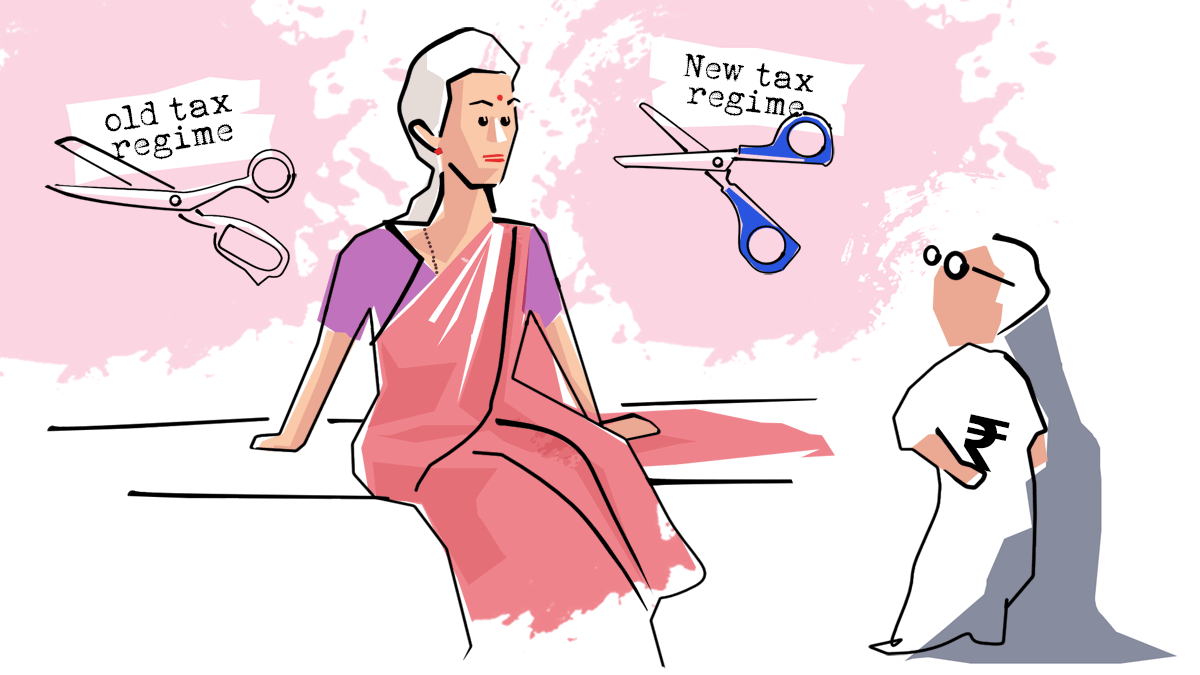
With recent enhancements to allowances and exemptions, including higher education, hostel, and HRA limits, the old tax regime is making a strong comeback, urging taxpayers to carefully re-evaluate their options against the new regime for optimal tax savings.
Key Points
- Increased limits for education, hostel, and meal allowances, alongside expanded HRA exemptions to more cities, have significantly boosted the appeal of the old tax regime.
- The new tax regime gained popularity due to its simplicity, lower tax rates for certain income brackets, and a 100% rebate for incomes up to Rs 12 lakh.
- Taxpayers should list all eligible deductions and use the e-filing portal's comparison tool to determine which regime offers lower tax liability.
- The old tax regime typically becomes more beneficial when total deductions and exemptions exceed approximately Rs 5 lakh, though the exact break-even point varies by income.
- Salaried individuals can switch between regimes annually, but those with business or professional income generally have a one-time option to choose.
As is customary at the start of a financial year, human resources (HR) teams across companies are asking employees to choose between the old and new tax regimes.
The new regime has dominated in recent years. However, recent changes to exemptions and allowances have brought the old regime back in contention.
Why the New Regime Gained Popularity
The biggest factor was the introduction of a 100 per cent rebate for incomes up to Rs 12 lakh, which took a large section of taxpayers out of the tax net.
"Due to lower tax rates, minimal documentation, and the absence of the need for last-minute tax-saving investments, it became an easy choice, especially for those without significant deductions to claim," says Vishwas Panjiar, managing partner, SVAS Business Advisors.
Exemptions Revive Old Regime's Appeal
Higher limits on allowances and exemptions have brought the old regime back into consideration.
Since allowances remain tax-exempt up to specified thresholds, any increase reduces taxable income.
The education and hostel allowances have seen a sharp jump — from Rs 100 and Rs 300 per month per child to Rs 3,000 and Rs 9,000, respectively.
"The house rent allowance (HRA) framework has been expanded, with the higher 50 per cent exemption now extended beyond metros like Delhi, Mumbai, Chennai, and Kolkata to Bengaluru, Hyderabad, Pune, and Ahmedabad.
"Meal coupon limits, too, have been raised from Rs 50 to Rs 200 per meal.
"For salaried employees with these components in their cost-to-company (CTC), the old regime deserves a closer look this year," says Panjiar.
Understanding the Break-Even Point
List all eligible deductions — Section 80C, health insurance, home loan interest and principal, HRA, life insurance premiums, National Pension System (NPS) contributions, health insurance, and allowances — and compare your tax liability under both regimes.
Go with the regime that lowers your tax liability.
"Use the e-filing portal's comparison tool to decide," says Panjiar.
The old tax regime becomes attractive only if exemptions and deductions exceed a break-even point.
"While the new regime offers nil tax up to Rs 12 lakh of taxable income, the old regime typically works better when total deductions and exemptions are around Rs 5 lakh or more," says Deepashree Shetty, partner, global mobility services, tax & regulatory services, BDO India.
The break-even point varies by income and should be evaluated each year.
Who Should Reconsider Their Tax Regime Choice?
Taxpayers whose income levels or spending patterns have changed should revisit their regime choice.
The new tax regime offers simplicity, but the old regime may deliver better outcomes if total deductions exceed around Rs 5 lakh.
Recent increases in limits for children's education and hostel allowances, meal benefits, and location-based HRA have improved its appeal for salaried individuals.
Tweaking Salary Structures and Avoiding Mistakes
Salary structures are largely standardised, but some optimisation may be possible in components such as HRA, NPS, and eligible perquisites.
"In light of recent tax and labour reforms, salaried employees should review their salary structure and align it with their expected expenses early in the year," says Shetty.
A common mistake is failing to evaluate tax liability under both regimes every year.
Taxpayers must actively opt for the old regime if it is more beneficial.
"While salaried individuals can switch every year, those with business or professional income typically get only a one-time option to choose," says Rupali Singhania, founder, Areete Consultants.
Important Considerations for the Old Regime
Taxpayers who opt for the old regime should not lose sight of their financial goals.
"Investments should be chosen based on objectives, time horizon, and risk profile," says Singhania. Such taxpayers must maintain documentation to support deductions and exemptions claimed.
Employers verify investment proofs. Benefits such as HRA require documents like rent agreements, rent receipts, and the landlord's permanent account number (PAN).
"Sometimes, employers may need to justify deductions to tax authorities, making accurate record-keeping essential," says Singhania.
Sanjeev Sinha is a New Delhi-based independent journalist











 © 2026