

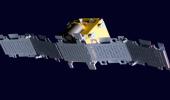
Weighing 190 kg, Mission Drishti is India's heaviest privately developed Earth observation satellite.

Mission Drishti is GalaxEye's first satellite, combining MSI and SAR sensors on a single platform to deliver reliable, all-weather Earth imagery. Launched aboard Falcon 9, it provides aligned, analysis-ready data from space. Photographs: Kind courtesy galaxeye.space
Bengaluru-based space startup GalaxEye on Sunday announced the successful launch of Mission Drishti, the world's first OptoSAR satellite, a breakthrough in Earth observation technology that further underlines India's growing capabilities in the global space sector.
Key Points
- Bengaluru-based startup GalaxEye successfully launched Mission Drishti, the world’s first satellite combining EO and SAR technologies.
- The 190 kg satellite is India’s heaviest privately built Earth observation system, capable of all-weather, day-and-night imaging.
- Mission Drishti supports defence, agriculture, disaster management, maritime monitoring, and infrastructure planning applications across sectors.
- The project reflects over five years of indigenous R&D and growing private sector momentum in India's space ecosystem.
- Strong global demand has already emerged, with satellite imagery expected to be delivered within weeks after commissioning.
Mission Drishti Launch

Weighing 190 kg, Mission Drishti is India's heaviest privately developed Earth observation satellite.
It is also the first satellite anywhere to combine electro-optical (EO) and synthetic aperture radar (SAR) sensors on a single operational platform, allowing it to capture imagery in all weather conditions, by day and by night.
OptoSAR Satellite Breakthrough
By merging the two systems, the satellite overcomes long-standing limitations in conventional imaging technology, delivering more dependable and continuous data across challenging environments.
The dual-use satellite is designed for applications spanning defence, agriculture, disaster management, maritime surveillance and infrastructure planning.
GalaxEye Space Startup
Prime Minister Narendra Modi hailed the launch on X as 'a testament to our youth's passion for innovation and nation-building'.
Suyash Singh, founder and chief executive of GalaxEye, said: 'Mission Drishti marks our first mission and the culmination of more than five years of sustained R&D to develop this breakthrough technology.
'With the satellite now successfully in orbit, our immediate focus is on completing its commissioning.
'Even at this stage, we are seeing strong global interest in the differentiated datasets enabled by our OptoSAR payload.'

EO SAR Technology Combined
Mission Drishti is the product of more than five years of indigenous research and development, reflecting a wider shift in India's space sector towards innovation-led and intellectual property-driven technological growth.
Before launch, the satellite underwent extensive environmental and performance testing to ensure operational readiness, supported in part by the facilitation and infrastructure access provided by Indian National Space Promotion and Authorisation Centre (In-Space).
Following deployment and commissioning, the first images from the satellite are expected to be delivered to customers within weeks.
According to the company, the mission has already attracted strong interest from government and commercial clients worldwide seeking high-frequency, high-resolution Earth observation data.

India Space Sector Growth
Earlier this year, GalaxEye announced a partnership with NewSpace India Limited, the commercial arm of Indian Space Research Organisation, to distribute its satellite imagery globally.
The collaboration is expected to widen access to advanced Earth observation data across a range of sectors.
Pawan Goenka, chairman of In-Space, said the mission reflected years of work to build confidence and commercial momentum in India's private space industry.
'The sustained effort over the last five to six years on confidence-building, capacity-building and the commercialisation of India's private space technology ecosystem is now showing tangible results,' he said.
'Mission Drishti by GalaxEye is a fine example of this -- the world's first OptoSAR satellite developed by an Indian private company.
'As more Indian space companies prove themselves through operational missions and engagement with global customers, confidence in India's space ecosystem will continue to deepen, driving demand both domestically and internationally.'
The satellite is expected to complement India's wider Earth observation programme, including the 29 active Earth observation satellites identified in Isro's latest annual report.
At a time of rising global demand for dependable geospatial intelligence, the mission also signals India's growing emergence as a provider of advanced intelligence, surveillance and reconnaissance capabilities for domestic and international partners alike.
GalaxEye said it plans to expand its satellite constellation over the next five years as part of an effort to build a sovereign Earth observation network for India while meeting accelerating global demand for reliable satellite data.
Feature Presentation: Ashish Narsale/Rediff










 © 2026