
Market experts say India's IPO ecosystem has matured to support both primary and secondary issuance, rendering the mix less consequential.

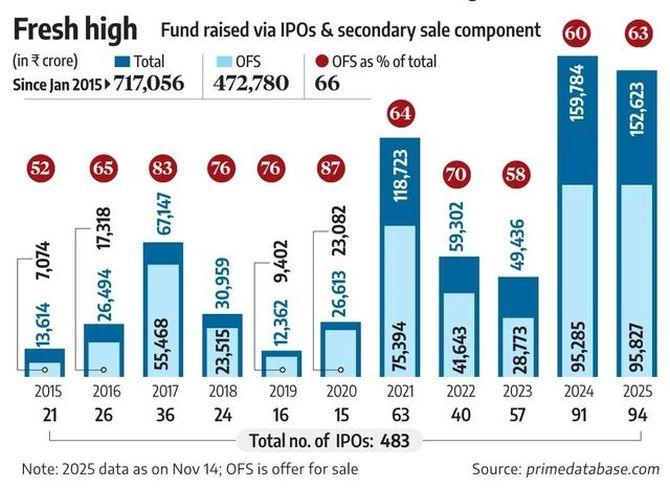
Funds raised through the offer-for-sale (OFS) component of IPOs this calendar year have already surged to a new high of nearly Rs 96,000 crore, overtaking last year's record of Rs 95,285 crore.
This comes even as total IPO proceeds, at around Rs 1.53 trillion so far in 2025, remain Rs 7,160 crore shy of the all-time peak of Rs 1.59 trillion set the previous year.
Fresh capital raised via new share issuance stands at Rs 56,796 crore this year, a figure that experts still describe as robust on a standalone basis.
With six weeks remaining in this calendar year, the overall IPO tally is on track to eclipse last year's record.
OFS collections also appear set to breach the Rs 1 trillion mark for the first time in a single year.
Since 2015, nearly three-fourths of total IPO fundraising has been in the form of OFS (Rs 4.73 trillion), while just Rs 2.44 trillion has come from primary issuance, according to PRIME Database.
Fresh capital from IPOs is typically channelled into capex and often viewed as a barometer of economic activity.
OFS, by contrast, signals a shift in ownership, usually involving private equity (PE) investors or promoters trimming stakes.
While such proceeds do not directly fund expansion, they can nevertheless serve productive ends.
PE investors may recycle capital into new ventures, and promoters may deploy funds into fresh businesses, experts said.
Most IPOs by new-age companies this year, including Lenskart, Groww and Pine Labs, have seen a greater proportion of OFS than fresh issuance.
In many cases, early investors have booked sizeable profits, sparking concerns that PE funds are cashing out at the expense of retail participants. Market participants, however, reject this narrative.
"The dominance of OFS in IPOs is a healthy sign for the market. Investors should focus on business fundamentals rather than whether their capital is being used for primary fundraising," said Bhavesh Shah, managing director & head of investment banking at Equirus Capital.
"In the past, there was a bias toward primary issuances, but that often meant funding cash-hungry businesses instead of cash-generating ones. In reality, investors create more value in mature, cash-generating companies, which typically have less need for primary capital."
Market experts say India's IPO ecosystem has matured to support both primary and secondary issuance, rendering the mix less consequential.
"The growth or risk capital companies earlier sought from the IPO market is now provided by angel, venture capital and PE funds. Firms are approaching public markets only once they achieve scale and governance maturity. This mirrors the evolution seen in Western markets," said Pranav Haldea, managing director, PRIME Database.
The debate over IPO composition resurfaced on Monday after Chief Economic Advisor V Anantha Nageswaran at an event observed that IPOs were increasingly becoming exit routes for early investors rather than vehicles for long-term capital formation, potentially undermining the core purpose of public markets.
At the same event, Securities and Exchange Board of India Chairman Tuhin Kanta Pandey downplayed such concerns.
"The mix between primary and secondary components varies from one IPO to another. Many companies have already raised primary capital earlier, which is why existing investors choose to exit during the IPO. There are also instances where companies raise fresh capital to fund greenfield projects," Pandey said.
"In my view, the capital market should accommodate all such objectives."
Feature Presentation: Aslam Hunani/Rediff










 © 2025