

Civil Aviation Minister Ram Mohan Naidu said the reduction in airport charges is aimed at containing airfare increases and supporting both airlines and passengers.

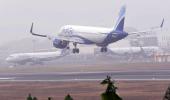
The ministry of civil aviation (MoCA) on Wednesday announced a 25 per cent cut in aircraft landing and parking charges for domestic flights for three months, a step expected to help airlines save about Rs 400 crore during this period amid rising fuel costs.
The MoCA said the reduced charges will be implemented immediately, and the Airports Economic Regulatory Authority of India (AERA) will adjust any revenue shortfall faced by airports in future tariff cycles.
Airport charges cut relief
Typically, AERA sets airport tariffs -- which include aircraft landing and parking charges -- for a five-year period, known as a control period.
Once set, airport operators can collect these fixed tariffs from all aircraft operators.
These charges are revised at the end of each control period.
Therefore, the MoCA's statement on Wednesday means that any under-recovery now will be recovered in the next control period instead of being passed on immediately.
Key Points
- Government announces 25 per cent cut in aircraft landing and parking charges for domestic flights for three months.
- Airlines expected to save around Rs 400 crore amid rising ATF prices and currency-linked cost pressures.
- AERA to compensate airports for revenue loss in future tariff cycles instead of immediate recovery.
- Relief package aims to curb airfare hikes triggered by fuel surcharges and longer routes due to conflict.
- Major carriers including IndiGo, Air India and Akasa Air have recently increased fuel surcharges.
AERA tariff cycle explained
The MoCA's decision on these charges has come as part of a broader relief package for airlines grappling with multiple cost pressures, including higher aviation turbine fuel (ATF) prices, depreciation of the rupee, which raises dollar-denominated expenses such as leasing and maintenance, and the closure of sizeable parts of Gulf airspace due to the West Asia conflict, which has led to longer routes and higher operating costs.
ATF prices and rupee pressure
Civil Aviation Minister Ram Mohan Naidu said the reduction in airport charges is aimed at containing airfare increases and supporting both airlines and passengers.
"This is a significant intervention to provide relief to airlines grappling with increasing operational costs," he said, noting that the government is in touch with airlines, airport operators and the regulator.
Government airfare containment move
The order applies to all major airports regulated by AERA and to non-major airports operated by the State-run Airports Authority of India (AAI), with both categories directed to implement a 25 per cent reduction for domestic flights for three months.
Fuel surcharge hikes timeline
The MoCA's decision on Wednesday followed a series of developments since mid-March, when airlines began introducing fuel surcharges as ATF prices surged after the start of the West Asia conflict on February 28.
IndiGo on March 14 rolled out fuel charges across domestic and international routes, followed by Air India around the same time with surcharges on both segments.
Akasa Air joined on March 15, introducing a fuel surcharge ranging from Rs 199 to Rs 1,300.
As prices continued to rise, the government stepped in around April 1, allowing only a partial increase of up to 25 per cent in domestic ATF prices to limit fare spikes, while international pricing remained market-linked.
However, airlines continued to revise -- and in most cases increase -- fuel surcharges.
IndiGo announced a fresh distance-based structure on April 1, effective April 2, while Air India revised its surcharge grid on April 7, with changes coming into effect from April 8 and some long-haul routes from April 10.
Feature Presentation: Ashish Narsale/Rediff






 © 2026