
Domestic vehicle retail sales hit record highs in October, driven by GST 2.0-induced affordability, strong festival demand, and a powerful rural recovery, with PV sales rising 11% and two-wheeler sales surging 52% year-on-year.

Buoyed up by goods and services tax (GST) reforms and festival-season demand, domestic passenger vehicle (PV) and two-wheeler sales hit record highs in October.
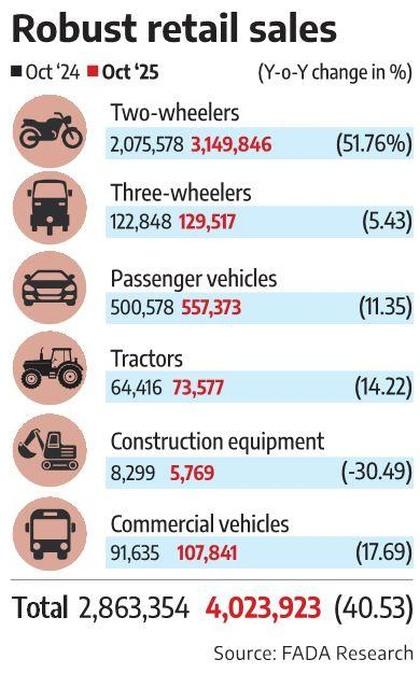
PV sales rose 11 per cent year-on-year to 557,000 units, while two-wheeler sales jumped 52 per cent to 3.15 million units, according to data released by the Federation of Automobile Dealers Associations (Fada).
Commercial vehicle sales in the month rose 18 per cent, aided by higher freight movement and infrastructure activity, while three-wheeler and tractor sales grew 5 per cent and 14 per cent, respectively.
Construction equipment was the only laggard, with sales declining 30 per cent year-on-year.
The 42-day festival season also saw the highest ever overall retail vehicles sales numbers, which were up 21 per cent over the corresponding period last year.
“The introduction of GST 2.0 proved transformational -- lower GST rates on small cars made vehicle ownership more attainable, especially for the cost-sensitive first-time buyer. This affordability boost, timed perfectly with the festival season, turned sentiment into action,” said Fada President C S Vigneshwar.
For dealers, there was some relief as inventory levels fell by 5-7 days to 53-55 days, indicating healthier supply alignment in the PV segment.
“The 2025 festival season delivered the highest ever sales and growth across categories. Overall vehicle retails surged 21 per cent Y-o-Y, affirming the success of the government’s transformative GST reforms, which truly embodies the spirit of simpler tax, stronger growth,” Vigneshwar added.
Among major players in the PV segment, Maruti Suzuki India consolidated its number-one position in October with an 18 per cent increase in sales to 239,000 units, followed by Tata Motors, whose sales rose 13 per cent to 75,352 units, and Mahindra & Mahindra, up 9 per cent to 67,918 units. Hyundai Motor India, however, saw retail sales decline 7 per cent to 65,442 units.
In the two-wheeler segment, Hero MotoCorp recorded the sharpest gain, with sales rising 72 per cent Y-o-Y to 994,787 units from 577,678 units in October 2024.
Honda Motorcycle and Scooter India’s sales grew 48 per cent to 821,976 units, while TVS Motor’s rose 58 per cent to 558,075 units.
"The standout story of the month was the rise of Bharat. Rural India became the true growth engine, as a favourable monsoon, higher farm incomes, and the government’s infrastructure push drove purchasing power.
"PV sales in rural areas grew over three times faster than in urban markets, while rural two-wheeler sales rose at nearly twice the rate seen in urban India, marking a structural shift in the demand map of the automobile sector,” Vigneshwar said.
During the festival period, two-wheeler sales rose 22 per cent over last year, PV sales 23 per cent, commercial vehicles 15 per cent, three-wheelers 9 per cent, and tractors 14 per cent.
Construction equipment, however, saw sales contracting 24 per cent amid project delays and financing constraints.
Feature Presentation: Rajesh Alva/Rediff












 © 2025