
A deep split has emerged within India's auto industry over the proposed CAFE exemption for small cars, with only Maruti Suzuki and Renault backing the move in the final SIAM vote.
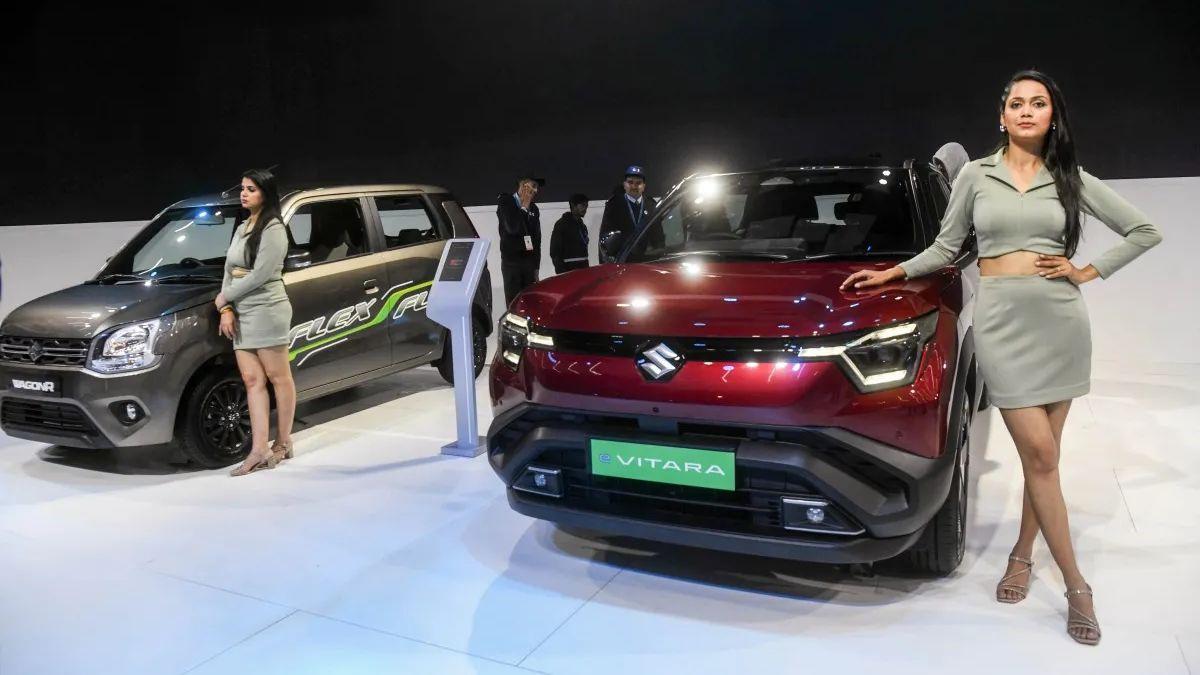
Mercedes-Benz was “neutral”, Toyota was “for consensus”, Maruti Suzuki India (MSIL) and Renault said “yes”, and the remaining 15 carmakers said “no” when asked to give their final vote on the proposal to allow a weight-based exemption for small cars under the CAFE emission norms, Business Standard has learnt.
The final vote from all 19 carmakers was taken at the CEOs Council meeting of the Society of Indian Automobile Manufacturers (Siam) held on the evening of November 7.
The next day, Siam submitted its final written comments to the Bureau of Energy Efficiency (BEE), stating that its members have “mixed views” on the issue of weight-based exemption for small cars.
The CAFE framework sets average carbon dioxide emission targets, measured in grams per kilometre (g/km), for each automaker’s overall fleet.
If a company fails to meet these targets, the BEE has the power to impose hefty penalties.
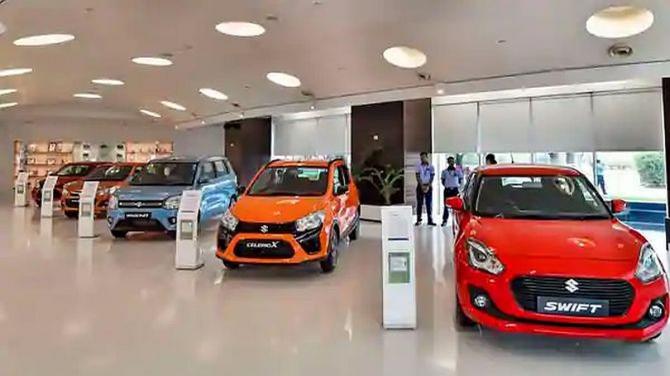
On September 25, the BEE issued a draft of the CAFE-3 and CAFE-4 norms -- set to take effect from April 2027 for a period of 10 years -- introducing a weight-based exemption for small cars for the first time.
Under this draft, petrol vehicles weighing up to 909 kg, with engine capacity below 1,200cc and length under 4,000mm, will receive an additional 3g/km deduction in their declared carbon dioxide emissions.
This proposal has sharply divided the industry, a split that was evident during the CEOs Council meeting on November 7, said people familiar with the matter.
At the meeting, the CEOs of 19 automakers were asked to give their final vote on three specific questions.
The first was whether they agreed with the BEE’s proposal to introduce a “super credit” or volume derogation factor (VDF) of 1.5 for flex-fuel vehicles and 2.5 for strong hybrid flex-fuel vehicles.
The second was whether they supported the proposal to allow pooling of up to three automobile companies to meet their carbon dioxide emission targets.
The third was whether they agreed with the proposal for an additional 3g/km carbon dioxide deduction for petrol vehicles weighing up to 909 kg.
Any fuel blend containing at least 85 per cent ethanol is considered “flex fuel”.
The VDF is a multiplier used to calculate a manufacturer’s fleet-average carbon dioxide emissions, allowing certain low-emission vehicles, such as strong hybrids, to be counted as more than one vehicle.
This effectively lowers the fleet’s average emissions on paper, making compliance easier.
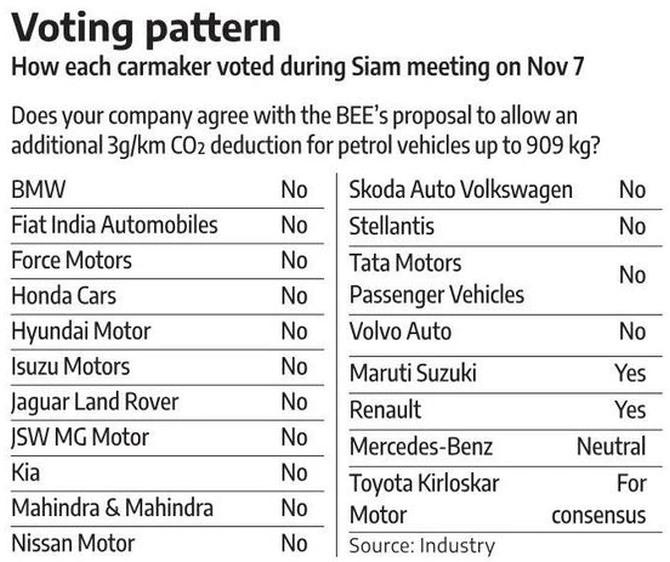
All 19 CEOs (or their representatives) unanimously voted “yes” on the first two questions. But on the third question, 15 companies -- BMW, Fiat India Automobiles, Force Motors, Honda Cars, Hyundai, Isuzu Motors, Jaguar Land Rover, JSW MG Motor, Kia, Mahindra & Mahindra, Nissan Motor, Skoda Auto Volkswagen, Stellantis, Tata Motors Passenger Vehicles and Volvo Auto -- voted “no”.
On the third question, Mercedes-Benz was “neutral”, Toyota was “for consensus”, and MSIL and Renault voted “yes”, according to those familiar with the matter.
According to these sources, Toyota did not cast a clear “yes” or “no” because it has no model under 909kg in its portfolio, but it is also part of a global alliance with Suzuki Motor Corporation, the parent company of MSIL, for joint development and production of certain cars, and therefore stated it would go with whatever consensus the other carmakers reached.
None of the carmakers responded to Business Standard’s queries on this matter, which were sent last week.
The newspaper also could not reach Fiat India Automobiles. Siam did not respond to the queries either.
The September 25 draft of the CAFE-3 and CAFE-4 norms is not the first issued by the BEE. The agency had published an earlier draft in June 2024.
Siam submitted its comments on that draft in December, seeking several changes.
A few months later, Maruti Suzuki, India’s largest carmaker and the biggest seller of small cars, independently approached the BEE requesting relief for small cars through a weight-based exemption. This marked the first signs of a divide within the industry.
In July 2025, a study by Nomura stated that all major automotive markets, including the United States, China, Japan, South Korea and Europe, incorporate protections for small cars under their Corporate Average Fuel Efficiency (CAFE) regulations because of their environmental and socio-economic value.
In contrast, India’s linear weight-based CAFE framework penalises lighter vehicles with disproportionately stringent carbon dioxide targets, the study noted.
“This creates a structural bias where heavier vehicles with higher emissions comply easily, while small cars with lower emissions fail,” Nomura said.
It warned that under such a structure, “lightweighting, a key decarbonisation strategy, is thus disincentivised”.
Feature Presentation: Rajesh Alva/Rediff








 © 2025