

'Due to tariff uncertainty, automotive customers reduced their steel uplift by almost 15 per cent.'
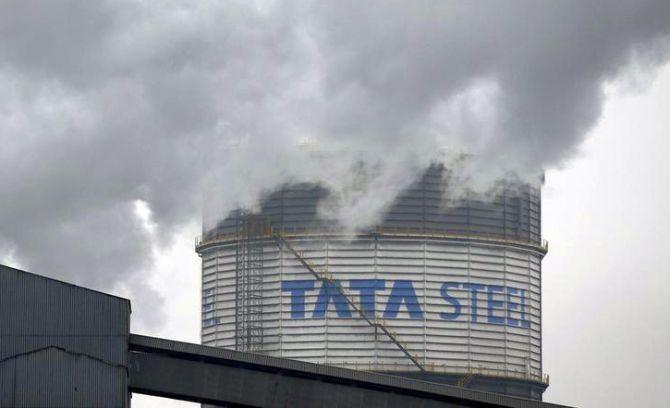
A day after Tata Steel more than doubled its consolidated net profit in the first quarter (Q1) of 2025-26 (FY26), T V Narendran, managing director and chief executive officer, and Koushik Chatterjee, executive director and chief financial officer, discuss a range of issues with Ishita Ayan Dutt/Business Standard during a video interview.
What is the impact of the US-UK and US-European Union (EU) trade deals on your European operations?
T V Narendran: For the US-UK, what has been agreed upon is a 10 per cent duty on exports from the UK to the US.
That is better than what most other countries have. But the specific issue we are dealing with is the 'Melt and Pour' condition, which says the steel should be made in the UK.
For us, until 2027, when our electric arc furnace comes up, the steel is made either in the Netherlands or India, or anywhere else that we buy from.
So that conversation is ongoing between the British government and the US government to hammer out a solution.
From the UK, we sell 70,000-80,000 tonnes of steel into the US, which is what gets impacted by this.
It's high-end steel, so we are looking at other markets to mitigate the impact. In the Netherlands, about 10 per cent of production is sold into the US.
Koushik Chatterjee: On the US-EU deal -- which is at 15 per cent -- some clarity is needed on whether Section 232 is the level of tariff or if it's Section 232-plus.
That becomes important because our contract negotiations -- in the US for packaging steel -- are typically for a year and normally done in the third quarter (Q3).
Which are the newer markets where you can divert this material?
Chatterjee: Basically, Latin America (LatAm) and West Asia are the two important areas we're looking at -- and Africa. But mostly, from a price point of view, it will be LatAm and West Asia.
In the UK, earnings before interest, tax, depreciation, and amortisation (Ebitda) losses narrowed year-on-year (Y-o-Y) and quarter-on-quarter.
When is it likely to turn Ebitda-neutral or -positive?
Chatterjee: This company is going through a major transformation with the closure of blast furnaces, and that's the Y-o-Y impact you see.
Last year, we were still operating two blast furnaces. We closed one at the end of Q1 and the second one at the end of the second quarter (Q2).
And then we had to take out all the fixed costs related to the closure. Therefore, sequentially, losses have come down.
There's also cost transformation under a very different business model where you buy the substrate and then use it.
If it were a stable market, we would have done even better than we did this quarter. But the market declined -- compared to India, where prices increased, in the UK, prices remained depressed.
And due to tariff uncertainty, automotive customers reduced their steel uplift by almost 15 per cent.
Some of these things had an impact, but because of the cost takeouts, we halved the losses from the fourth quarter to Q1. And we want to maintain that trend.
If the market supports us in terms of price stability, that will help. We expect to get to neutrality by the exit of FY26.
In the Netherlands, you are in discussion for policy and financial support, but the Dutch elections are due towards the end of October.
Is there any risk to the ongoing discussion?
Chatterjee: In the Netherlands, Parliament went through a lot of independent review before it endorsed that the government engage with Tata Steel under what they call a "tailor-made agreement".
The Parliament approved and endorsed a team under the government to lead negotiations. We are intensely engaged in progressing this.
I don't see the elections being an issue, except for the fact that there is a non-binding phase.
Then there's a binding agreement, which will be undertaken by the new government after election.
Also, there will be mutually agreed-upon condition precedents from each party. That will be done by the new government, but the process continues.
In India, are you pacing out your expansion? Is it because you don't want to load up your balance sheet?
Chatterjee: At Tata Steel, we have our cash flows. If you look at Kalinganagar, on an underlying basis, we've funded it from our cash flows.
Of course, balance sheet priority is there, but not in a manner that would infringe on growth.
Neelachal Ispat Nigam is almost like a greenfield expansion -- other than the fact that we have the land.
There's a lot of work going on in engineering, project planning, site preparation, and clearances. When we are ready, we'll go to the board.
There are concerns around the quality control order (QSO) that it goes against the interests of micro, small and medium enterprises (MSMEs).
How would you respond?
Narendran: The steel industry is conscious of the requirements of MSMEs.
When we had the safeguard duty, one thing we agreed with the government was that we would supply steel to MSMEs -- particularly for exports -- at international prices. We have already supplied some tonnage as an industry.
The QSO is something that was always there -- it's just being implemented as per the law. And all countries have these.
Sometimes, I think, we are trying to be too open, and everyone who has extra steel ends up selling it here.
That is fine as long as we don't want more investments in the steel industry.
The larger point is, India will need more steel capacity, and that means putting in a lot of money.
And if you're putting in that money, those projects have to be viable.
And they are viable only if there's some cap on the downside as far as steel prices and quality are concerned.
The surge in net profit in Q1 was largely on the back of net steel realisation and cost takeouts.
But steel prices softened in June and July. What is the outlook for Q2?
Narendran: For Q2, the guidance we have given is Rs 2,000 lower than Q1 in terms of net realisation in India.
In Europe and the UK, we expect realisations to be at the same level or maybe slightly higher.
But we expect that by Q3, things should change -- this is always a lean quarter.
But China steel prices have gone up $30-40 in the past few days because of announcements made there on July 1.
So, we are waiting to see if that sustains and international prices pick up a bit, which may push up domestic prices.
Feature Presentation: Aslam Hunani/Rediff









 © 2026