

'The next phase of India's IPO cycle will be defined by quality, pricing discipline and investor selectivity.'
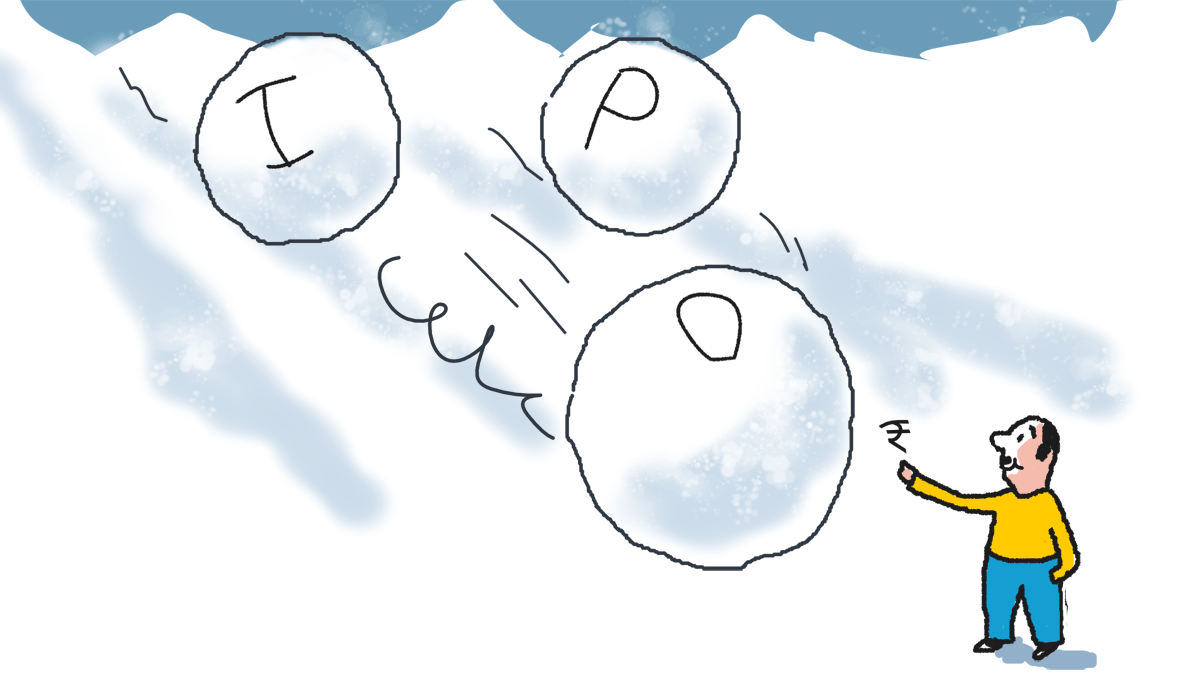
Key Points
- India's IPO market in 2026 will be more selective, favouring companies with strong earnings and good governance amidst geopolitical risks.
- Manufacturing companies with robust R&D, precision engineering, and value-added capabilities are poised to attract significant capital in the IPO market.
- Data centres and renewable energy projects with clear execution plans and stable cash flows present attractive investment opportunities in the Indian IPO landscape.
- Well-managed NBFCs are expected to revive in the IPO market as credit costs stabilise and balance sheets improve.
- Domestic institutions and high-net-worth individuals are becoming crucial for IPO success, providing stability and absorbing large issuances with the right pricing and quality.
After a record-breaking run last year, India's initial public offering (IPO) market has begun 2026 on a subdued note, with volatility and geopolitical risks tempering investor appetite.
But the slowdown does not signal a freeze, says Neha Agarwal, managing director and head of ECM at JM Financial.
Instead, the market is entering a far more selective phase.
In an interview with Samie Modak and Khushboo Tiwari/Business Standard in Mumbai, Agarwal outlines why the next cycle will reward quality over quantity and which sectors are best placed to attract capital.
After a record year, the IPO market is off to a weak start this year. What should we expect, going forward?
Even last year, the market was uneven. We saw very little activity in the first couple of months, followed by a pickup from April onwards.
Something similar could play out this year as well. However, unlike earlier cycles where weak earnings drove softness, today the markets are cautious mainly due to geopolitical risks.
Domestic macros are improving and transactions will happen -- but they will be far more selective than before.
Will the pain continue?
I wouldn't say all the pain is behind us. Valuations still need to be justified by earnings growth.
Until that happens, investors will remain cautious. What's clear is that demand will not be broad-based -- it will be highly polarised.
What do you mean by polarisation in the IPO market?
Earlier, almost any IPO could find demand. That phase is over.
Investors are now applying strong filters -- sector, business quality, margins, capital allocation and governance.
Not every IPO will attract interest, and many proposed listings will get filtered out due to pricing mismatches.
Sectors Attracting Capital in the IPO Market
Which sectors do you see attracting capital over the next 12-18 months?
Manufacturing will do well, but not commoditised manufacturing.
Companies with strong R&D, precision engineering and value-added capabilities will lead fund-raising.
This includes high-end industrials, auto components with advanced engineering, precision equipment, and pharma businesses with genuine research depth.
Indian companies that invest meaningfully in R&D are best placed to raise capital.
In pharma, for example, pure contract manufacturing will struggle.
Contract development and manufacturing organisation players with strong development and research capabilities will attract far greater investor interest, especially if global innovators recognise their value addition.

IMAGE: Neha Agarwal.
Are there any emerging themes beyond manufacturing and pharma?
Data centres are a clear theme. Asset-heavy businesses with visible and short cash-flow cycles are being well received.
We're seeing good investor response to data centre platforms, and this trend should continue as digital infrastructure scales up.
Renewable energy also remains attractive, and we expect a few large filings this year.
Execution clarity at the project level will be key. Investors want visibility on cash flows, regulatory stability, and capital structure discipline.
Financial Services and Smallcap IPOs
Financial services IPOs have been quiet. Do you see that changing?
Yes. Financial services, especially non-banking financial services (NBFCs), could see a revival.
Over the past two to three years, only a handful of listings happened, largely from strong promoter-backed groups.
As credit costs stabilise and balance sheets improve, we expect well-run NBFCs to return to the market -- though again, not across the board.
Are smallcap IPOs facing more resistance compared to mid and largecaps?
Absolutely. Mutual funds are seeing some redemptions and foreign portfolio investors (FPIs) remain cautious, which disproportionately affects smallcap IPOs.
Mid and largecap offerings with quality businesses should continue to do well, but smaller issuances will face valuation and demand challenges.
Valuation and Investment Bank Strategies
Is the issue more about lack of demand or valuation mismatches?
It's largely about valuation. In many cases, the gap between what issuers expect and what investors are willing to pay has widened. Unless promoters are realistic, deals won't go through.
How are investment banks adapting to this environment?
Banks are becoming more selective. Rather than chasing volumes, the focus is shifting to higher strike rates.
Responsible intermediaries need to decide carefully which deals to sponsor, even if that means doing fewer transactions.
With foreign investors selling in secondary markets, has marketing IPOs become harder?
Not necessarily. While FPIs have been net sellers in secondary markets, they remain active in primary issuances, especially as anchor investors.
FPIs typically help solve for size, while domestic investors help set the price. Both remain essential for large IPOs.
How important are domestic investors today?
Domestic institutions are now the backbone of the IPO market.
Mutual funds often invest from cash rather than selling existing holdings, which provides stability.
High-net-worth individuals and family offices are also becoming an important source of capital.
India now has a deep and diversified domestic capital base.
The rise of high net worth individuals and family offices shows that the market can absorb large issuances, provided pricing and quality are right.
What are the key risks investors should watch out for?
Execution risk and governance. Promoter credibility, capital allocation discipline and post-IPO fund utilisation will be under much sharper scrutiny.
Regulators are also tightening oversight, which is a healthy development for the market.
Overall, how confident are you about the IPO market over the next year?
I'm constructive. The IPO market will remain active, but it will reward quality over quantity.
Strong businesses, credible promoters and realistic valuations will find capital. Everything else will be filtered out.
Disclaimer: This article is meant for information purposes only. This article and information do not constitute a distribution, an endorsement, an investment advice, an offer to buy or sell or the solicitation of an offer to buy or sell any securities/schemes or any other financial products/investment products mentioned in this article to influence the opinion or behaviour of the investors/recipients.
Any use of the information/any investment and investment related decisions of the investors/recipients are at their sole discretion and risk. Any advice herein is made on a general basis and does not take into account the specific investment objectives of the specific person or group of persons. Opinions expressed herein are subject to change without notice.
Feature Presentation: Rajesh Alva/Rediff










 © 2026