

'Once the market decides it wants to go up, it goes up -- no amount of bad news can really hold it back.'
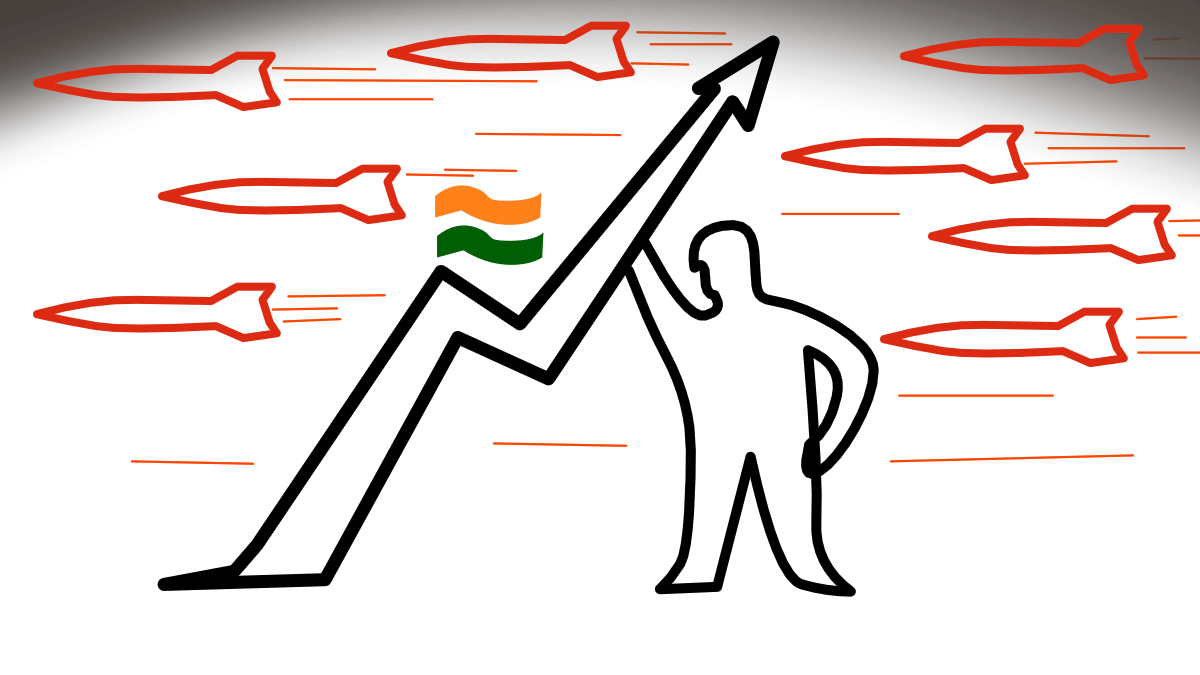
Key Points: Motivation Mantras
- 'Markets always bottom on peak pessimism. The talk of nuclear war and civilisational collapse -- that was peak pessimism. We have crossed that. Now we are in the phase of scepticism, where the market quietly climbs.'
- 'I am a great believer in what I call the Balancer Act -- the government's ability to step in and stabilise when things get extreme.'
- 'If they act on the market side, FIIs will return quickly -- because India is, right now, the only undervalued or fairly valued market in the world. Everywhere else is expensive.'
As the rupee tests record lows near 96 to the dollar and crude oil hovers above $100 a barrel, Nikhil Gangil of Intrinsic Value Equity Advisors argues the Indian stock market has already made its bottom -- and tells retail investors exactly why this is the time to act, not retreat.
The numbers are hard to ignore. The rupee has shed more than five per cent of its value since the West Asia conflict flared in early 2026, making it Asia's worst-performing major currency this year.
It struck a fresh record low above 96 per dollar last week, even as the Reserve Bank of India sold billions of dollars from its reserves -- which have slid from a peak of $728 billion in February to around $697 billion -- to slow the slide.
Brent crude has averaged close to $107 a barrel through May, and India, which imports nearly 90 per cent of its oil, is staring at an oil import bill that analysts say could rise 41 per cent year-on-year in FY2027.
The current account deficit is on course to widen to nearly three per cent of GDP, the worst since 2012-2013.
Foreign institutional investors, meanwhile, have sold over $20 billion in Indian equities since the conflict began. Against this unsettling backdrop, Nikhil Gangil, founder of Intrinsic Value Equity Advisors, tells Prasanna D Zore/Rediff in the first of a two-part must-read interview that the Indian market had, in fact, already made its bottom in March end -- and that bold, contrarian investors stand to gain the most.
'Historically, when gold becomes expensive, smart and institutional money tends to shift into equities'
How do you see the rupee-dollar parity panning out from here, given the rupee is already close to 96?
There are really two questions here -- what does this mean for the economy, and what does it mean for the stock market? On the economy, yes, if the dollar strengthens further, say to 100 or 105, inflation will go up.
India imports far more than it exports, so a weaker rupee pushes up costs across the board.
But the market story is different. Historically, moderate to high inflation has actually been quite good for markets. When goods prices rise, company revenues rise with them, and markets follow.
And there's something else working in the market's favour right now: About two months ago, the market made what I believe is a solid bottom. From everything I have seen historically, once the market decides it wants to go up, it goes up -- no amount of bad news can really hold it back.
You believe the market has already bottomed out. What if the peace negotiations collapse -- is a fresh low possible?
I had said on March 29 itself that the market had made its bottom, and I published nearly seven reasons for that view. Let me walk through the key ones.
First, after 18 months of correction, the broad market had come back to fair valuation. Historically, every time the market has reached fair value after a prolonged correction -- and we have seen this consistently over six years -- it has tended to make a bottom right there.
Second, market cycles typically correct for 18 to 20 months. That cycle was already complete by March 2026.
Third, gold was extremely overvalued. Historically, when gold becomes expensive, smart and institutional money tends to shift into equities as well.
And fourth, a headwind-tailwind indicator that we build based on the actions of promoters, FIIs, and DIIs had just flipped to tailwind territory in April -- after showing headwinds for nearly two years.
Markets always bottom on peak pessimism. The talk of nuclear war and civilisational collapse -- that was peak pessimism. We have crossed that.
Now we are in the phase of scepticism, where the market quietly climbs. Clarity will come later, but by then, the opportunity will largely be gone.
Can you explain this headwind-tailwind indicator in more detail?
It is a ratio we have built purely on the actions of promoters, FIIs, and DIIs. Every time one of these groups takes a market-supportive action -- buying, increasing stake, and so on -- we assign it a positive point. Every contrary action gets a negative point.
We then divide the positive by the negative to get a single number.
Above 1 means tailwind; below 1 means headwind.
From 2024 onwards, for almost two years, this indicator was in headwind territory.
It has now flipped back to tailwind.
That shift, combined with the valuation and cycle signals, is what gave me the conviction to say the bottom was in.
'I expect the government to take equally extreme measures to defend the rupee and restore some balance'
If the war drags on and the rupee crosses 100, with oil staying above $100 a barrel, what is the likely cascading impact on the Indian economy?
Fuel-driven inflation will rise, petrochemical and fertiliser prices will follow, and all of this feeds into a broader economic impact. The stock market responds to that in its own way, as I mentioned.
But I am a great believer in what I call the Balancer Act -- the government's ability to step in and stabilise when things get extreme. These are extreme circumstances, and I expect the government to take equally extreme measures to defend the rupee and restore some balance.
Does that rupee pressure translate into another five or ten per cent cut in broader markets?
Not necessarily, and here is why. The rupee weakness is a real pressure, but it does not automatically translate into a market correction if the policy response is swift enough.
I keep coming back to what I call the Balancer Act. I actually put out a somewhat simplified version of this as a tweet.
The government currently charges 12.5 per cent LTCG, 25 per cent STCG, and 0.5 per cent STT on market transactions. Now, what if they swapped those out for a 12.5 per cent import duty, a 25 per cent custom duty, and a 0.5 per cent tax on gold?
Think about what that does. You solve the inflow problem immediately -- remove the market taxes (12.5 per cent LTCG, 25 per cent STCG, and 0.5 per cent STT) and FIIs have every reason to come back.
And you solve the outflow problem at the same time -- import and custom duties reduce the dollar drain on the current account.
The import duty part has already been partially done. If they act on the market side as well, FIIs will return quickly -- because India is, right now, the only undervalued or fairly valued market in the world. Everywhere else is expensive.
If the government acts on the market side as well, the FII tap opens up quickly.
And here is the thing that is easy to miss right now, given all the noise: India is the only undervalued or fairly valued stock market in the world at this moment. Every other major market -- the US, Europe, most of Asia -- is expensive by historical standards.
When FIIs eventually rotate out of those overvalued markets looking for value, there is really only one destination. That is a powerful tailwind that the rupee weakness alone cannot cancel out.
So a further five or ten per cent cut? I think it is unlikely, provided the government moves with some urgency. The valuation support is too strong to ignore.
Sectors that look attractive now...
Which sectors do you see benefiting most if the rupee stays weak, and which ones are the laggards going forward?
Everything is cyclical. Take IT -- yes, it earns in dollars, and yes, it did brilliantly up to 2021-2022. But since then it has struggled, and I think that struggle continues for another two to three years.
The sectors I am more interested in are those that have not delivered much in four to seven years, because their cycle is due to turn. Three stand out.
Textiles -- India's free trade agreements, including the recently concluded ones with New Zealand, Europe, and the United States, open up a massive opportunity here. Bangladesh was the primary beneficiary of these trade flows for years. That advantage is now shifting to India.
Leather and consumer electronics -- both have underperformed for four to five years and are ripe for a turnaround.
FMCG -- the sector has been flat for six to seven years. Urban demand has been soft, and commodity prices have been a headwind. That cycle is turning. Aggregate demand -- not just rural, but overall -- should recover to double-digit growth within two to three years.
FMCG is also monsoon dependent, isn't it? Rural demand needs a good monsoon.
Monsoon matters, yes. But the bigger structural issue for FMCG was urban demand declining -- Hindustan Unilever itself acknowledged this in their annual reports.
Rising commodity prices and falling urban demand together suppressed the sector for about four years. Both are cyclical forces, and for every six to seven years of consolidation, demand tends to rebound. I expect that rebound now.
Disclaimer: This article is meant for information purposes only. This article and information do not constitute a distribution, an endorsement, an investment advice, an offer to buy or sell or the solicitation of an offer to buy or sell any securities/schemes or any other financial products/investment products mentioned in this article to influence the opinion or behaviour of the investors/recipients.
Any use of the information/any investment and investment related decisions of the investors/recipients are at their sole discretion and risk. Any advice herein is made on a general basis and does not take into account the specific investment objectives of the specific person or group of persons. Opinions expressed herein are subject to change without notice.








 © 2026